The True Cost of Downtime: A Practical Toolkit to Quantify Interruption Risk & Financial Exposure
Read more

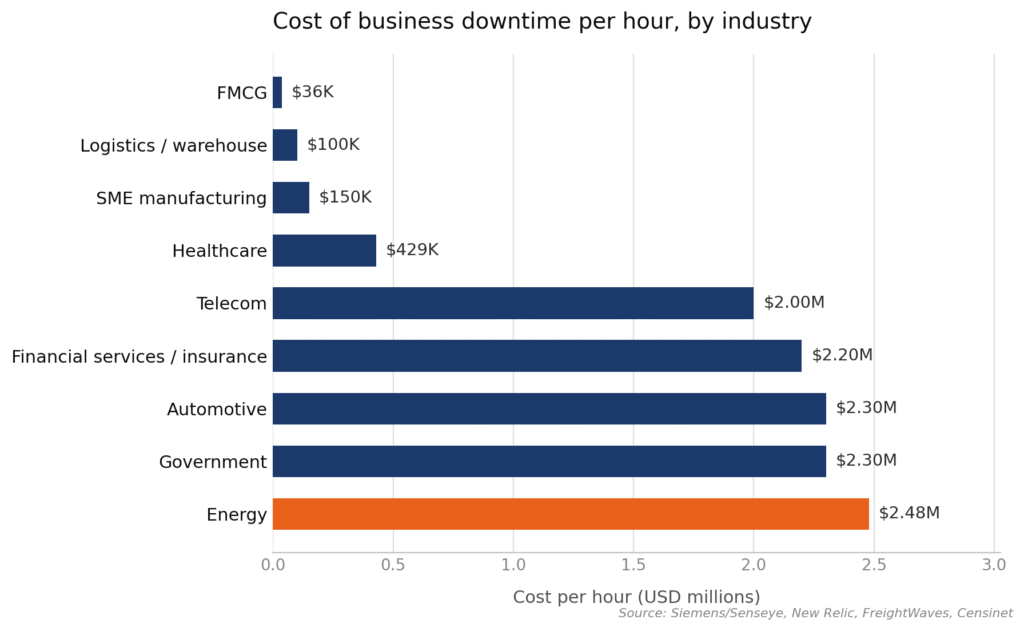
The cost of business downtime ranges from roughly $36,000 an hour in fast-moving consumer goods to more than $2 million an hour in automotive manufacturing, government, and financial services. Across the Global 2000, unplanned downtime costs an estimated $400 billion a year, equivalent to roughly 9% of profits.
Most downtime conversations default to cybersecurity; ransomware and data breaches make headlines, and the costs are well documented. But cyber incidents account for roughly a third of unplanned downtime. The rest comes from network failures, application and infrastructure breakdowns, power outages, equipment failure, and severe weather. If your business continuity plan only accounts for cyberattacks, you’re planning for one third of the problem.
Here’s what downtime actually costs, industry by industry, and why the number varies so much.
Downtime cost isn’t just about lost revenue. It reflects how tightly a business depends on continuous operation, how exposed it is to contractual penalties, and how quickly it can recover once something breaks.
An automotive assembly line loses money by the second because every idle minute represents unbuilt cars, idle labor, and missed delivery windows down a tightly coupled supply chain. A retailer’s website loses money the moment checkout stops working. A hospital’s cost isn’t just financial: delayed care and compliance exposure compound the dollar figure fast. Government agencies face longer outages on average than almost any other sector, plus the added weight of public accountability.
Automotive manufacturing downtime is among the most expensive of any sector. Large plants lose an average of $2.3 million per hour of downtime, more than $600 a second, and the cost has risen 113% over the past five years.
Per-hour costs have climbed 319% since 2019, driven largely by rising energy prices. A representative large plant loses about $59 million a year to unplanned downtime. Additionally, an industrial sector cyberbreach costs an average of $5 million.
The exception to the trend. Costs run as low as $36,000 an hour and have stayed relatively stable, though annual losses per plant have still doubled since 2019 to just over $10 million, reflecting more frequent, lower-cost incidents rather than catastrophic ones.
Downtime costs track the price of oil directly. Costs spiked to record highs in 2018 when oil neared $150 a barrel ($224 when adjusted for 2026).
Hospital downtime runs an estimated $5,300 to $9,000 per minute, or roughly $318,000 to $540,000 an hour, once delayed care, cancelled procedures, and staff redeployment are factored in. A healthcare breach costs, on average, $7.4 million, the highest of any industry for the 12th consecutive year. Beyond the dollar figure, healthcare carries compliance exposure that other industries don’t: regulatory citations and potential suspension of federal funding are real risks after extended outages.
Retail carries the highest average annual downtime cost among Global 2000 companies, at roughly $287 million a year, driven by lost sales during peak periods and the immediacy of e-commerce revenue loss. A single hour of Amazon’s site being down has been estimated to cost the company $34 million in sales.
Telecommunications downtime costs roughly $2 million an hour, reflecting both the scale of customer impact and the cascading effect on every other business and service that depends on connectivity.
Downtime for the energy industry is around $2.48 million an hour, among the highest of any sector, tied closely to the criticality of continuous power generation and distribution.
The financial services and insurance industries are among the most exposed to prolonged downtime. This sector reports the second-highest median annual downtime of any industry, at 528 hours a year (about 22 days), and hourly costs for high-impact outages run around $2.2 million. A financial services breach costs an average $5.56 million.
Government agencies report the highest hourly cost among all sectors for high-impact outages, at $2.3 million, and the longest average time to resolve an outage, at 302 hours. Public sector organizations report average annual downtime damage-control costs of $73 million, more than four times the figure for financial services. Network failure and security failure are tied as the leading causes.
Cloud and system outages can cost warehouse operators as much as $100,000 an hour, and a recent industry survey found 84% of logistics operators had experienced at least one significant disruption in the past two years. Downtime here cascades quickly: a missing part can idle an automotive assembly line at a cost of up to $22,000 a minute, and a fleet of 500 trucks running just 1% downtime a day can lose more than $2 million a year.
Even without the scale of a Fortune 500 plant, SME downtime can reach $150,000 an hour at the top end, a figure that can be unsustainable for a smaller organization’s cash flow.
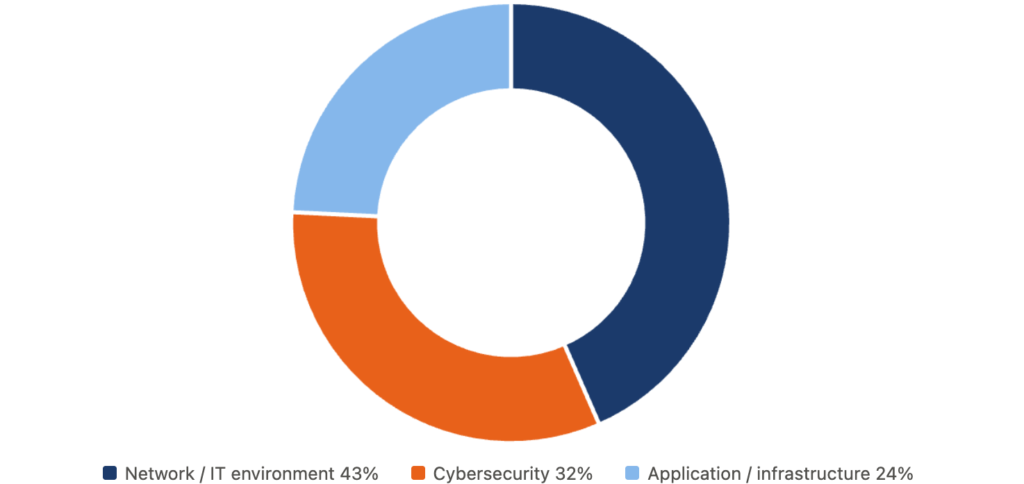
Recent research on unplanned outages found that only 32% of downtime incidents were cybersecurity driven. The rest broke down as 43% network or IT environment issues and 24% application or infrastructure failures. Power outages, severe weather, and equipment failure sit outside that breakdown entirely but remain some of the most common triggers reported across industries.
That distribution matters for how you plan. A disaster recovery and business continuity plan built solely around ransomware response leaves gaps for the outage types that are more common: a failed router, a bad software deployment, a regional power event, an aging piece of equipment nobody flagged for replacement.
The per-hour figures above capture lost revenue and idle labor, but they miss several costs that compound over time:
The wide range in these figures, from $36,000 an hour in FMCG to more than $2 million an hour in government and financial services, makes one thing clear: a generic downtime estimate won’t tell you much. What matters is calculating your own disaster recovery exposure, based on your revenue per hour, your contractual obligations, and the realistic causes of downtime in your industry, not just the ones that make headlines.
Talk to a recovery specialist to calculate your specific exposure and build a continuity plan that accounts for the full range of risks, not just cyber incidents.
The cost of downtime ranges from about $36,000 an hour in fast-moving consumer goods to more than $2 million an hour in automotive manufacturing, government, and financial services. Most mid-size manufacturers fall between $50,000 and $260,000 an hour.
Energy has the highest reported hourly downtime cost, at roughly $2.48 million. Automotive manufacturing and government follow closely, both around $2.3 million an hour, with telecommunications and financial services also exceeding $2 million.
No. Cybersecurity incidents cause roughly 32% of unplanned downtime. Network and IT environment issues (43%) and application or infrastructure failures (24%) are collectively more common causes.
Downtime cost includes direct costs like lost revenue, idle labor wages, emergency repairs, and contractual penalties, plus indirect costs like reputational damage, customer churn, and regulatory exposure. Indirect costs are harder to quantify but often exceed the direct ones.
Start with your revenue per hour, then add labor costs during idle time, contractual penalties tied to missed deadlines, and the cost of emergency response. Agility Recovery's True Cost of Downtime Toolkit walks through this calculation step by step.
The total dollar figure is smaller, but the relative impact is often greater. SME downtime can reach $150,000 an hour at the top end, which can be more damaging to a smaller organization's cash flow than a larger loss is to an enterprise.
Rising energy prices, longer recovery times from skilled labor shortages, slower parts supply chains, and growing dependence on interconnected digital systems have pushed downtime costs higher across nearly every industry over the past five years.