Business Impact Analysis (BIA) Checklist
Read more

A business continuity plan (BCP) is a documented set of procedures that keeps your organization running when something goes wrong. Whether the cause of a disruption is a natural disaster, a cyberattack, a power failure, or an unexpected building closure, a BCP defines exactly what happens next: who does what, where operations move, and how fast you can get back to full capacity.
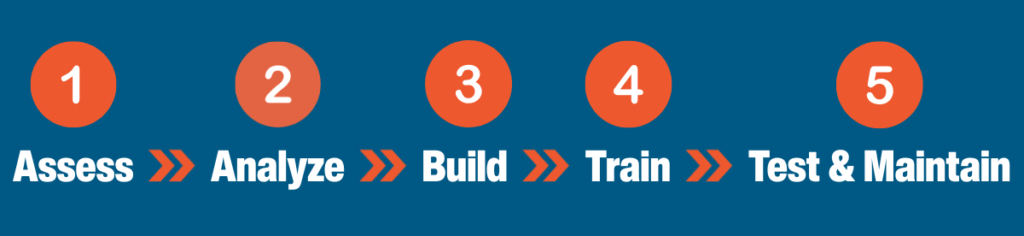
This guide walks through how to create a business continuity plan in five concrete steps. It covers the foundational definitions, the planning process itself, and what separates plans that work from plans that sit in a drawer.
Agility Recovery has been helping organizations build and test business continuity programs since 1989. The framework below reflects what we’ve seen work across industries including financial services, healthcare, manufacturing, logistics, and the public sector.
A business continuity plan is a documented, tested process for maintaining essential functions during and after a disruption. It identifies which operations are most critical to your organization, assesses what could threaten them, and prescribes specific actions to protect or restore each one.
Three related terms often get used interchangeably, but they mean different things:
| Term | What it covers |
|---|---|
| Business Continuity (BC) | The ability to maintain critical operations during any type of disruption — the broadest category. |
| Business Continuity Plan (BCP) | The documented strategy and procedures that enable continuity. Includes assigned responsibilities, communication protocols, recovery procedures, and testing schedules. |
| Disaster Recovery (DR) | A subset of BC focused specifically on restoring technology systems and data after an incident. Often included within a BCP or managed alongside it. |
| Business Continuity Management (BCM) | The ongoing program that governs all of the above: risk assessments, plan maintenance, testing, and continuous improvement. |
The financial case for business continuity planning is straightforward. According to Splunk and Oxford Economics, the average annual cost of unplanned downtime for large enterprises now exceeds $400 million. For small and mid-sized businesses, the numbers are lower, but the proportional exposure is often greater.
Beyond direct revenue loss, downtime carries costs that are harder to quantify: customer attrition, damaged supplier relationships, regulatory penalties, and reputational harm that lingers long after operations resume.
Three disruptions are affecting businesses at higher rates in 2026:
Organizations with a tested business continuity plan recover faster, incur lower costs, and retain more customer trust when disruption happens.
The risk assessment is the starting point of any business continuity plan. Its purpose is to identify what could realistically threaten your operations and what the consequences would be.
A risk assessment for business continuity typically covers:
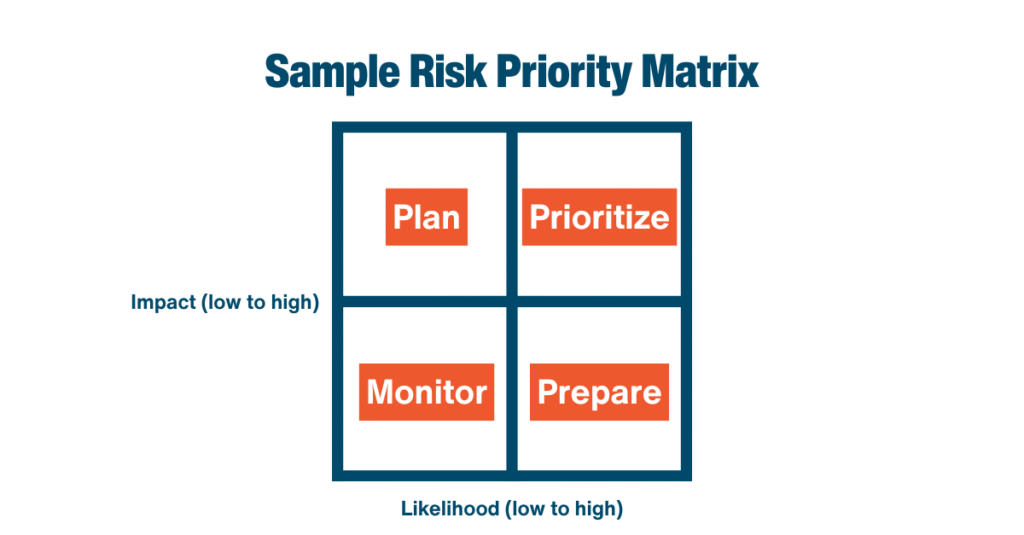
For each identified threat, you’ll want to assess two variables: likelihood (how probable is this event given your location, industry, and infrastructure?) and impact (if this event occurred, which operations would be affected and how severely?).
This produces a risk matrix you can use to prioritize your planning efforts. High-likelihood, high-impact threats get addressed first; low-likelihood, low-impact scenarios may not require dedicated procedures at all.
Where the risk assessment identifies threats, the business impact analysis (BIA) focuses on your organization’s own operations. Its goal is to determine which functions are most critical to your business and how quickly you’d need to restore them after a disruption.
The BIA answers four core questions for each business function:
The output of the BIA is a prioritized list of business functions along with recovery time objectives (RTOs) and recovery point objectives (RPOs) for each one. These targets will drive every decision in the next step.
Two metrics to define for each function:
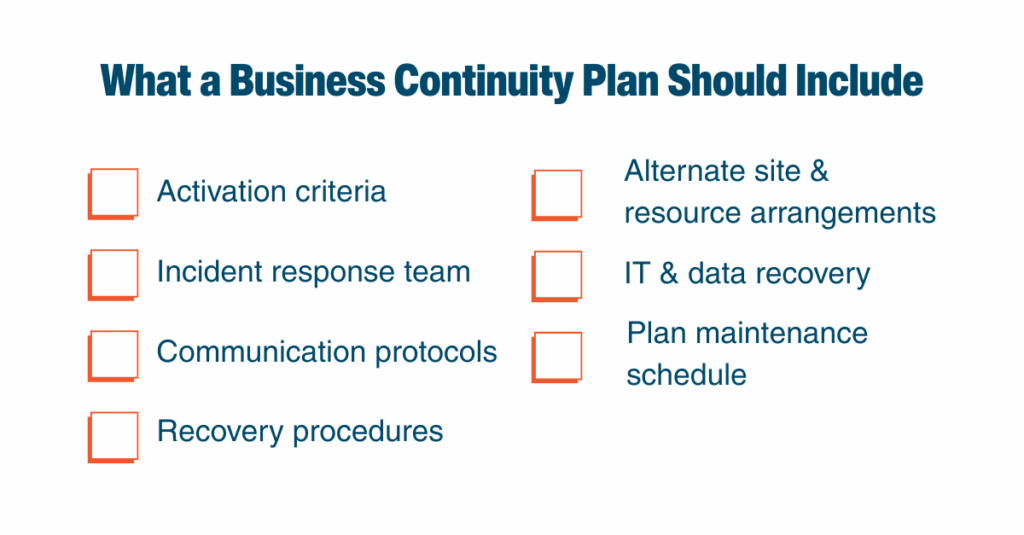
After completing your risk assessment and BIA, you have the information needed to write the actual plan. A business continuity plan document should include the following components:
The plan should be specific enough that someone unfamiliar with daily operations could follow it during a high-stress incident. Vague directives like “contact IT” are less useful than “call [Name] at [number] and follow the system restoration checklist in Appendix B.”
Most organizations assign a dedicated business continuity coordinator or BCP owner responsible for keeping the plan current and driving the testing schedule. This role doesn’t have to be full time, but someone needs to own it.
A business continuity plan that no one has read won’t work when you need it. Training ensures that key personnel understand their roles before a disruption occurs.
At minimum, training should cover:
Training doesn’t have to be a formal classroom session. A tabletop exercise where your incident response team walks through a scenario together is one of the most effective formats. It surfaces gaps, builds familiarity with the plan, and gets people comfortable with the decision-making process before they’re under pressure.
Regulators in several industries, including financial services (FFIEC/NCUA) and healthcare (HIPAA), require documented evidence of continuity training. Even where it isn’t mandated, training records demonstrate organizational maturity.
Testing is where most organizations fall short. A business continuity plan needs to be exercised regularly to remain useful, because your operations, personnel, and risk environment all change over time.
How often should you test? The general guidance from industry frameworks:
Testing serves two purposes. First, it validates that the plan works as written. Second, it identifies gaps before they become failures. A test that surfaces a problem isn’t a failure. Finding that your backup generator doesn’t cover your entire data center during a drill is far better than finding it during an actual outage.
After each exercise, document what was tested, what gaps were identified, and what changes were made to the plan. This documentation is also typically required for regulatory compliance reviews.


A few patterns appear consistently in plans that don’t hold up when tested:
Creating a business continuity plan is one of the more concrete things an organization can do to reduce risk and operating exposure. The steps above give you a framework to start. The harder part is keeping the plan current and tested over time.
Agility Recovery provides membership-based business continuity programs that combine physical recovery resources (workspace, generators, equipment), planning tools, and testing services. Our members can activate a fully operational recovery site within hours of a disruption, without the overhead of building and maintaining that capacity themselves.
A complete business continuity plan should include activation criteria and decision authority, an incident response team with contact information, internal and external communication protocols, recovery procedures for each critical business function, alternate site and resource arrangements, IT and data recovery procedures, and a testing and maintenance schedule. The BIA and risk assessment results should underpin each section.
Timeline varies significantly by organization size and complexity. A small business with straightforward operations might complete a working BCP in four to six weeks. A mid-sized organization conducting a thorough BIA and risk assessment across multiple departments typically needs three to six months. Larger enterprises with complex dependencies and regulatory requirements often work in phases over a longer period. Using a template and working with an experienced partner can compress these timelines.
Disaster recovery (DR) is a subset of business continuity. A disaster recovery plan focuses specifically on restoring IT systems and data after an incident. A business continuity plan is broader, covering all critical operations including physical workspace, workforce, supply chain, and communications, in addition to technology. Most organizations need both, and they work best when built together.
Industry frameworks and most regulatory bodies recommend testing your business continuity plan at least once per year, with many organizations running tabletop exercises twice annually. IT failover tests and communication drills should also occur at minimum annually. The plan itself should be formally reviewed and updated after any significant organizational change and at least once per year regardless.
A business impact analysis (BIA) identifies which of your organization's functions are most critical, quantifies the cost of disruption for each one, and establishes recovery time objectives (RTOs) and recovery point objectives (RPOs). It's the analytical foundation that tells you what to prioritize in your plan. A BIA is typically conducted before the plan is written and should be updated whenever your operations change significantly.
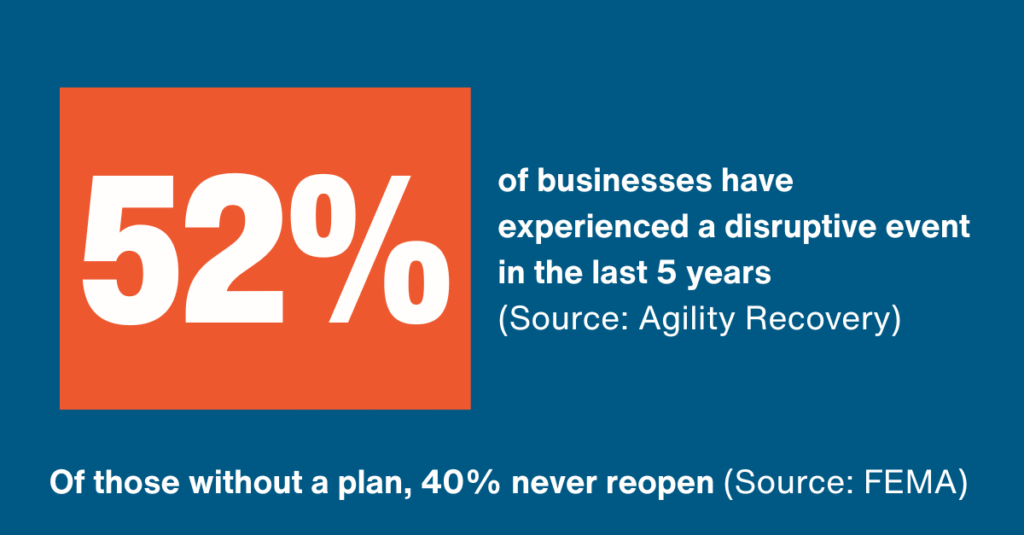
Yes. Small and mid-sized businesses are often more vulnerable to disruption than larger enterprises because they have fewer redundancies and less cash reserve to absorb the cost of downtime. A 2023 FEMA study found that 40% of small businesses that experience a disaster never reopen. A BCP doesn't need to be a lengthy document to be effective. A focused plan that covers your most critical functions, key contacts, and alternate arrangements can meaningfully reduce your exposure.