
When an office floods, most businesses lose more than furniture and flooring. They lose access to their workspace, their systems, and their ability to serve customers — sometimes for days, sometimes for weeks. How quickly you recover depends less on the severity of the flood and more on how prepared you were before it happened.
This post covers what to do in the immediate aftermath of an office flood, how to protect your people and critical assets, and how to keep your business running while your facility is out of commission.
The First 24 Hours Matter Most
The actions taken in the first hours after a flood significantly affect how long recovery takes and how much the total damage costs. The priority order is consistent regardless of the cause, whether a burst pipe, storm surge, sprinkler failure, or sewage backup.
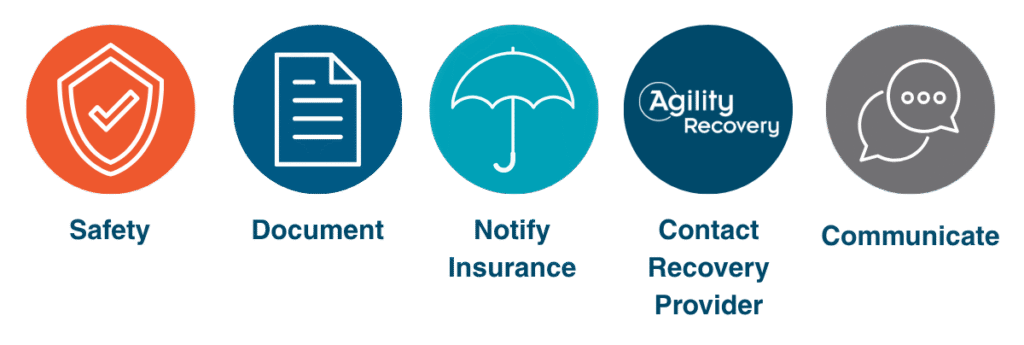
1. Ensure safety before anything else.
Water and electricity are the immediate life-safety concern. Do not re-enter the building until the power has been shut off and the space has been assessed. If there is any uncertainty about structural integrity or contamination, particularly with sewage or floodwater from outside, keep people out until a professional has cleared the space.
2. Document everything before cleanup begins.
Before removing a single item or calling a restoration crew, photograph and video the entire affected area. Capture water levels, damaged equipment, furniture, and building materials. This documentation is essential for insurance claims and, in regulated industries, for compliance records.
3. Notify your insurance carrier.
Most commercial property policies have reporting windows. Call as soon as possible after ensuring safety. Ask specifically about coverage for business interruption, temporary relocation costs, and equipment replacement, not just physical property damage.
4. Contact your business continuity provider.
If you have a pre-contracted recovery plan, this is when it activates. Your provider can begin coordinating temporary workspace, equipment, and logistics while you’re still managing the immediate situation on-site. The earlier you make this call, the faster alternative operations can begin.
5. Communicate with employees, customers, and vendors.
People need to know what happened, what it means for them, and what the plan is, even if the plan is still being formed. A brief, factual update is better than silence. Designate one person to manage communications so the message stays consistent.
Protect What You Can
Once safety is confirmed and documentation is done, the focus shifts to limiting further damage.
Equipment and electronics
Do not power on water-damaged electronics. Move undamaged equipment to a dry area or off-site storage as quickly as possible. Servers, workstations, and networking gear are priorities, but only move them if you can do so safely.
Physical records and documents
Paper records exposed to water deteriorate fast, particularly in warm or humid conditions. Prioritize anything irreplaceable: signed contracts, financial records, compliance documents. Wet paper can sometimes be salvaged if frozen quickly; a document recovery specialist can advise.
Inventory and assets
Depending on your industry, damaged inventory may need to be documented and disposed of under specific protocols. Healthcare facilities, food service operations, and financial institutions often have regulatory requirements around what can and cannot be salvaged.
Keep the Business Running
The biggest operational question after a flood is where your people work and how they access the systems they need. The answer depends on what you had in place before the flood happened.
Temporary workspace
For businesses that cannot shift fully to remote work, or where in-person operations are essential, a temporary workspace solution gets employees back to functioning workstations quickly, often at or near the affected location. Mobile office units, trailer-based workspace, and pre-configured office setups can be deployed within hours for businesses with pre-contracted recovery services.
Remote work as a bridge
For roles that can operate remotely, activating a remote work protocol immediately limits how much revenue and productivity is lost during the transition. The key is having remote access to critical systems established in advance — VPN access, cloud-based files, communication tools — so the switch requires no setup under pressure.
Customer and vendor continuity
Identify which customer commitments are most time sensitive and prioritize those first. Communicate proactively rather than waiting for customers to follow up. For vendor relationships, notify key suppliers of the situation early, particularly if it affects order fulfillment, service delivery, or payment timing.
What a Flood Exposes About Your Business Continuity Plan
A flood is one of the most common and disruptive events a business can face, and it is also one of the most revealing. Organizations that recover quickly almost always had a few things in place before the event:
A documented response plan
Knowing in advance who is responsible for what — safety, communications, insurance, facilities, IT, operations — removes the confusion and delay that compounds damage in the early hours.
Pre-contracted recovery services
Businesses that have established relationships with a recovery provider don’t have to start from scratch in the middle of a crisis. Equipment, workspace, and logistics are already arranged. The call activates the plan rather than starting a search.
Tested systems
Backup systems — data backups, remote access, communication protocols — that have never been tested often fail when they’re needed. Regular testing is the only reliable way to know your plan works.
A business impact analysis
Understanding which functions are most critical to revenue and operations, and what the cost of downtime is for each, shapes how recovery resources get prioritized. Without it, decisions get made on gut feel under pressure.
If a flood has revealed gaps in your plan, the time to address them is during recovery — not after the next event.
If a flood shut down your office today, how quickly could you get back to work?
Find out what a temporary workspace solution looks like for your business.
When the power goes out, your network drops, or your facility becomes inaccessible, most businesses stop. Agility Recovery exists for exactly that moment.
Our College Station, Texas, facility is a fully equipped, off-site business recovery location ready for your team whether you’re facing an active disaster, planning an off-site test, or need space for 78 or more people to get work done outside your primary office.
What’s Inside
Workstations 78 seats configured and ready to go. Show up and get to work.
Connectivity Lightning-fast 1 gig fiber to keep your operations running at full speed.
Power & Climate Redundant power and redundant AC mean this facility stays up even when yours doesn’t.
Security 24/7 monitoring, alarm system, keypad access, and badge access — safe, secure, and compliant.
Server & Colo Space Need to bring servers? Our colocation center supports redundant failovers and backups.
Everything Else Printers, shredders, scanners, breakroom, coffee, bathrooms. Everything your team needs to get through a test or a recovery.
Built for Testing. Built for Recovery.
Whether you’re running a full technical failover, relocating back-office staff during a disruption, or satisfying an audit requirement with documented off-site testing, College Station is ready for it. Financial institutions, healthcare organizations, and businesses of all types use this facility to prove their continuity plans actually work — not just on paper, but in practice.
See how Agility’s College Station facility can support your business continuity plan.
Banks and credit unions face unique challenges and requirements for their physical, customer- and member-facing locations. In many cases, the livelihood of an entire community may rely on a branch being open for business despite any disaster, construction, or interruption. Just one hour of downtime can have far-reaching ripple effects.
That’s why banks and credit unions must have a backup for brick-and-mortar locations, particularly those with no other area branches. Mobile recovery solutions can be exactly what’s needed to stay in business and serve your community.
Full Capacity and Convenience of a Brick-and-Mortar Branch
If a storm makes a branch unreachable or your institution is planning a long-term renovation, that doesn’t mean there has to be a pause in operations. Instead, by employing an Agility mobile recovery solution, your institution can stay in business without major interruption to your work. You can even remain at the same location your customers and members know and love by setting up the unit right in your parking lot.
The biggest benefit is to remain at the location the institution determined was right to open a branch. This is convenient for both their employees as well as their customers and why nearly all of our branch recoveries take place within the parking lot of the branch impacted by a disaster.
Mark Norton, CBCP, Sales Enablement Manager, Agility Recovery
Agility’s mobile recovery solutions have all the capabilities needed so you can get back to serving your community quickly.
Productivity

Your employees must be able to serve your clients or members, no matter the circumstance. Our mobile branch is a great solution to a business interruption at your traditional brick and mortar location and can include:
- Break/conference area for employees to meet
- Private office space for confidential conversations
- Employee workstations
- Restrooms
- Satellite and LTE communications
- Power
- Teller stations (2-3)
Customer and Member Comfort

Especially in times of disaster, ensure your customers/members and employees alike feel comfortable when visiting your mobile branch with:
- Drive-up window for quick and convenient transactions
- Lobby/waiting area
- Teller stations (2-3)
- Check-writing stand
One client shared that he was extremely pleased with the unit. The unit was more spacious than the institution had expected, and Agility was able to customize the unit to their liking. This particular member had multiple branches but they were geographically inconvenient to their customer base, so the Agility mobile unit provided a quick and effective solution. Agility had their mobile unit up and running just one day after they declared.
Safety and Accessibility

Even in a mobile unit, everyone should feel safe when accessing their work or money. Agility’s mobile units are customizable and can be outfitted with safety equipment provided by either Agility Recovery or the financial institution. Many clients opt to put their own door alarms and security cameras up; some choose to have Agility set them up. Safes are kept in areas with reinforced flooring. Units may include:
- ADA accessibility
- Alarm system
- Compliant Diebold safes
- Safe room
- Night drop box
- Cash drawers
All this and more ensures your customers, members, and employees see the value of your branch and all it can provide.
Customizable Layouts

What works for one financial institution may not work for another, which is why Agility’s mobile recovery units include customizable layouts, providing the flexibility you need to support your customers or members when they need it most. The unit arrives empty, but upon arrival, Agility will build partitions, run network cabling, and place furniture according to your institution’s needs. Recoveries are stressful enough; let Agility configure and install equipment in a way best suited to your institution. We can adjust these layouts based on the size of your workforce or expected customer/member volume.
No Requirements for Special Permits
The last thing financial institutions need to worry about during a disaster is permitting for a mobile unit. If an institution plans to put down a building that will be block and leveled, they will need to go to the county for a permit; however, with Agility’s mobile units, there is no additional hurdle of gaining county permission when setting up unit in your parking lot or an alternative site. We encourage advance site visits so our team can spring into action when you need us.
A client of ours in Texas had to wait over two months and submit numerous drawings before the county gave them the green light to move forward. In a time of recovery, the extra variable of going to the county for permission and waiting weeks to months is incredibly difficult given all the other tasks needed to get back to business as usual.
Damian Hunter, Solutions Consultant, Agility Recovery
Remain Compliant
Agility can provide fully compliant safes, night drop boxes, and more. We will make any changes necessary to our units and positioning and provide any documentation needed to ensure your full compliance.
Efficiency
Agility’s recovery solutions are efficient. We don’t require a bank or credit union to take ownership of assets you may never use, nor do we require a bank or credit union to pay vendors and service providers to be on retainer for a bad day. Agility Recovery is the best solution to save your institution money now and save the business later.
Expertise and Proven Success
Agility is the expert at performing branch recoveries within 48-72 hours. By partnering with Agility, your institution can take advantage of our expertise while your employees can focus on theirs: serving the community. Agility has been in the recovery business for 35 years. Most of our recoveries with banks and credit unions take place during the first disaster they’ve experienced; by recovering with Agility, institutions don’t have to try to save their business with little experience at high-stakes moments. Ready to get started? Learn more about our mobile recovery solutions and our full ReadyFinancial+ program and reach out to us for a free quote.