
Our recent Q1-Q2 2021 Business Resilience & Insights Report delves into some of the top trends in the business continuity landscape. The World Economic Forum reported that the most likely risks of the next decade are extreme weather, climate action failure, and human-led environmental damage. Additionally, the biggest impact risks are infectious diseases, climate action failure, and other environmental threats. In 2020, natural disasters caused global losses of $210 billion . Organizations are increasingly prioritizing long-term climate-related risks by evaluating the exposure and impact a potential event could have on the business and mitigating those effects. Factoring climate change risk resiliency into facility design and operations is critical for ensuring business continuity.
60% of all major business risks are either directly caused or negatively affected by climate change.
BCI 2020 Risk Report
Climate Risks to Business Continuity
Loss of or damage to physical property and disruption of systems
Whether a flood, fire, tornado, hurricane, earthquake, or another weather-related event, your physical offices, warehouses, and more can be severely damaged and even destroyed in a matter of hours. These disasters can affect your workforce's ability to work, your inventory, and your overall ability to maintain operations – or even stay in business.
Disruption to supply chains
Your business may be in a low-risk area, but what about your vendors? If your business relies on third-party suppliers who face significant climate-related risks, your operations are at risk, too.
New climate-related regulations
Businesses face new regulations with potentially expensive fines for noncompliance as the world transitions towards a lower-carbon economy.
Higher costs
As shortages of raw materials and resources like water increase, so do prices. Another cost to look out for is insurance. Climate change risk will likely have a substantial impact on insurance rates as insurers adjust risk models.
Steps to Increase Climate Risk Resilience
1. Incorporate climate change risk into your planning strategy
Organizations must begin preparing for imminent climate change risks, whether floods, fires , hurricanes , or other myriad disruptions. Incorporate these risks into your planning strategy and governance framework to avoid being caught unawares or running afoul of regulatory requirements. The BCI states that "climate change might be the biggest threat to business continuity this century." Make sure to incorporate these risks into your risk assessments and business continuity plans.
2. Identify climate risk and weather-related exposures and their potential impacts
Even if your company doesn't expect to be directly impacted by physical events like wildfires or tornadoes, there are far-reaching impacts of climate and weather events. These events may disrupt critical systems , or you may lose connections with suppliers or data centers.
3. Plan how to mitigate effects in the short term
What will you do to maintain business as usual if a disruption occurs? Determine the most likely risks to your company using resources like weather forecasts and historical analysis.
4. Predict and plan for long-term effects
Long-term effects may include increasing temperatures year over year or impending regulations and legislation around carbon emissions. According to the BCI , "the number of organizations performing longer-term trend analysis has risen to an all-time high of 81.3%."
5. Assess your third parties’ risk awareness and vulnerabilities
Your risk assessment may cover nearly every possible scenario, but increasing dependence on third-party suppliers and vendors increases the chances of disruption. If your supplier is in a different climate, they likely face other risks. Ensure that they, too, have plans in place in case of disruption and maintain continuity.
Plan for Your Organization’s Future
With a robust business continuity plan in place, your company will be better prepared to respond to any disaster. Through tabletop exercises and other testing procedures, your workforce will know exactly what to prioritize and how to work with vendors to maintain operations. When climate change risk affects your operations, be ready to respond and spring into action.
Why Organizations Should Plan for Potential Impacts of Power Outages
With hot summer days approaching the U.S. this season, businesses are faced yet again with a recurring threat—blackout and power outages that can last hours if not days, leading to significant financial losses in any industry. According to the Department of Energy, yearly power outages cost the U.S. economy $150 billion annually.
The Growing Risk of Power Outages
Power outages have been on the rise in the past couple of years. Particularly, the region that got affected the most was the state of California, with hundreds of thousands of customers being affected in April alone. A single power outage event can devastate an organization’s revenue, productivity, capacity, and labor. Increasingly, utilities are practicing planned de-energization events, or Public Safety Power Shutoffs (PSPSs). As a last resort to prevent power lines from starting wildfires and putting human lives in danger, planned power outages are scheduled to take place during hot, dry days.
The Facts
- 70% of Agility Recovery customers’ business interruptions involve a power outage
- Power outages from storm-related events cost the U.S. economy between $20 billion and $55 billion annually
- Weather-related outages have doubled since 2003
- Approximately 44% of power outages are caused by storm-related events
- Power outages are happening more often and lasting longer
2020 Challenges and Considerations
It is important for organizations to understand how power outages in 2020 will have a different impact on their people and operations amid COVID-19. Here are some questions to start the conversation and get prepared in the event of a blackout:
- If most of your workforce is working from home, how will they be able to continue work?
- How will you communicate with employees, customers, suppliers and more?
- Who is responsible for communicating information during a power outage?
- How will a blackout impact your equipment?
- Do you have a backup generator or a partner to help you acquire one when demand increases?
How Businesses Should Prepare and Respond
Power outages, or blackouts, can strike unexpectedly. One way to mitigate the risks and reduce these types of disruptions is to use “undergrounding”—placing electricity distribution lines underground. This technique is believed to make the service more reliable in those areas more susceptible to the damage. Alternatively, a business can conduct smart grid improvements. The U.S. power grid, for the most part, needs significant modernization . So, it can be helpful to your business to update their facilities for better performance. Some blackouts—called rolling blackouts—are necessary for the longevity of the power system and are typical during the summer months. Furthermore, to mitigate future risk, utility companies are using rolling blackouts to protect dry landscapes from power lines that could overheat and spark deadly fires. It is important to remind employees about your blackout response plans, especially if rolling blackouts are common, and to back up all critical files. To help organizations educate their workforce on how to respond to blackouts, we have developed a quick checklist that covers steps to take before and after a blackout.
Rolling Blackouts
Some blackouts—called rolling blackouts—are necessary for the longevity of the power system and are typical during the summer months. Furthermore, to mitigate future risk, utility companies are using rolling blackouts to protect dry landscapes from power lines that could overheat and spark deadly fires. Utility companies and their equipment have been blamed repeatedly for some of California's most destructive wildfires. Most notably, California’s Pacific Gas & Electric, recently agreed to plead guilty to unlawfully starting the 2018 Camp Fire that burned more than 153,000 acres , resulting in 85 deaths and over $16B in losses. Despite PG&E’s wildfire mitigation work and efforts to reduce rolling power outages for 2020, California could experience more planned blackouts heading into a fire season that’s likely to be more severe and starting earlier. PG&E may need to rely more heavily power outages during this year’s upcoming wildfire season due to a variety of reasons:
- – The coronavirus pandemic has caused difficulties in fire-prevention progress and utility work. According to PG&E, COVID-19 restrictions and economic disruptions “will continue to result in workforce disruptions, both in personnel availability (including a reduction in contract labor resources) and deployment.”
- – PG&E’s 2020 wildfire mitigation plan is reportedly on track, but according to their first-quarter earnings report, there is still has a lot of work to be done in grid hardening, vegetation clearing, physical inspections, and installation of specialized gear.
- – PG&E stated that their efforts should reduce the number of customers affected by blackouts by one-third, noting that the reduction would only come “if the exact same weather patterns are seen in 2020 as experienced during the largest [public-safety power shutoff] events in 2019.” Keeping that in mind, California experienced a fairly light fire season in 2019 along with a mild winter and lower amounts of rain and snowfall than usual that has since increased the 2020 wildfire risk outlook. This could make it difficult for PG&E to reduce the amount of blackouts this year in an effort to prevent fires.
How to Prepare Your Business for a Planned Power Outage:
If you are anticipating a planned electric outage, here are some steps you can take to reduce the impact:
- – Establish an emergency response team responsible for planning and communication regarding power outages and rolling blackouts
- – Make sure your utility company has your organization’s updated contact information so they can inform you of planned power shutoffs and updates
- – Have team members enable local power outage alerts or apps
- – Know your options for relocating personnel, forwarding telephones and obtaining replacement equipment
- – Set up a Crisis Communications and Emergency Notification System to communicate your policies, plans, decisions, and news updates to your employees, stakeholders, clients and vendors
- – Establish protocol for saving work in progress
- – Keep important phone numbers in case emergency assistance is needed
- – Turn off major appliances and electronics in the office
- – Make sure laptops and mobile devices are fully charged or have backup power supply
- – Keep supplies on hand including petty cash, flashlights, extra batteries and battery powered radio
- – Ensure backup systems are ready to go and review plans to restore affected systems
For more detailed steps, see the full Responding to Blackouts Checklist. Additional Considerations:
- – How your remote employees will continue business if working from home amid a blackout or wildfire
- – How travel restrictions may impact your people and operations
- – Consider partnering with business continuity services that can provide fast backup office space in a different location or quick access to power generators to keep operations running
As part of our Power Workspace Recovery Solution , Agility helps customers source, reserve, and maintain power generators even with increased demand and price hikes due to simultaneous disruptions like wildfires, blackouts, and pandemics.
Wildfire Season Risk, Outlook and Facts
A Wildfire season typically aligns with times when there’s an excess of dry fuels, winds and temperatures are above average, and humidity is low, which creates hot, dry conditions. Wildfire season also varies from one region to another. While there are wildfire hot zones, every region in the country faces at least some degree of wildfire impact risk. The National Significant Wildland Fire Potential Outlook by the National Interagency Fire Center for June through September of 2020 indicates that many areas in the western United States will have above normal potential for wildfires whereas the wildfire potential in the southern states is predicted to be normal to below normal. The aftermath of such a disaster can permeate many aspects of city life. A wildfire can cause flooding or obstruct transportation, cause problems related to gas, power, and communication, not to mention extensive damage that can be done to a property. Several factors contribute to the magnitude of wildfires and the speed at which they spread. Winds, high temperatures, and drought can convert trees, shrubs and fallen leaves into the perfect tinder for a wildfire to rage.
- – According to Verisk’s 2019 Wildfire Risk Analysis 4.5 million U.S. properties were identified at high or extreme risk of wildfire, with more than 2 million in California alone.
- – As many as 90% of wildfires in the U.S. are caused by people.
- – From January 1 to June 2, 2020 there were 19,762 wildfires compared with 14,968 wildfires in the same period in 2019, according to the National Interagency Fire Center. About 439,422 acres were burned in the 2020 period, compared with 277,745 million acres in 2019.
- – About 4.7 million acres were burned in 2019.
How to Stay Safe and Prepare Your Employees and Business
Before the wildfire:
- – Train your employees and their backups on how to use fire extinguishers and in general fire safety
- – Establish an evacuation plan and keep it up-to-date
- – Know your community’s evacuation plans and find several ways to leave the area
- – Create an emergency supply stock
- – Use fire-resistant materials when building, renovating or making repairs
- – Consider using emergency notification software to communicate alerts, updates and instructions to employees
During the wildfire:
- – Evacuate to a pre-designed shelter area
- – Listen to EAS, NOAA Radio, or local alerting systems for updates. Use a battery-operated radio, if other means of communication are unavailable.
- – Call 911 if trapped
- – Use a facemask for safe breathing
After the wildfire:
- – Listen to authorities to know if it’s safe to return
- – Document the damage
- – Contact your insurance or disaster recovery provider for assistance
Plan and Prepare for Wildfires and Covid-19 Impacts
It is important for businesses to actively consider how wildfires will have a different impact on their workforce and operations, as many companies are still actively working through continuity of operations from the pandemic. Considerations for Businesses:
- – What to do if your employees are working from home?
- – Will your employees be able to continue work?
- – How will you know if your employees are safe? How will you communicate with them and receive check-ins from them, on any device?
- – What to do if there is an evacuation?
- – What if there is a blackout power/internet outage?
- – Do you have a backup plan for office space?
Make sure you have updated your business continuity process and solutions to compensate for these recent market conditions. Download the full preparedness checklist below.
A single power outage event, or so-called blackouts, can devastate an organization’s revenue, productivity, capacity, and labor. To safeguard uninterrupted operations, many large businesses implement levels of redundancy, resiliency protections, and manage energy solutions such as backup power. But learning about the details of how businesses respond to blackouts may help other organizations in similar circumstances. Among a growing number of business threats are also those that don’t necessarily involve physical damage but may still result in financial losses. If the power goes out, a company is unable to serve its clients, sustaining staggering damages to its revenue. Businesses annually lose more than $27 billion due to power outages.
Summer 2019 Heat Update
With a dangerous heat wave expanding across the majority of the U.S., temperatures are climbing up to the century mark. And the National Weather Service is getting ready to release a heat advisory blanket for some regions. Hot summer days are one of the leading causes of power outages , taking down different appliances and triggering a domino effect that occurs on the heat-sensitive power grid. Many predict that the state of California is going to go dark this summer to deal with the wildfire season. Yet, its residents may not be well prepared for such planned outage. To stay cool, we keep our office and home air-conditioners turned up to the max, contributing greatly to the cause, overloading transmission lines which have limited capacity. However, their ability to transport power decreases even more during the summer season. The problem escalates because the lines naturally heat up when carrying a lot of power. When one line shuts down, others have to pick up the slack, leading them to go through the same cycle. As the lines struggle to carry additional power, they can no longer keep voltages at their intended level. These declining voltage levels can subsequently cause lights to dim and equipment to operate at speeds that cause excessive wear and tear on components.
Power Outage Numbers
On average, 70% of Agility Recovery customers’ business interruptions involve a power outage. According to the U.S. Energy Information Administration, in 2016, customers (municipal, investor-owned, and co-op utility types) experienced an average of 1.3 interruptions, being left without power for four hours throughout the year.
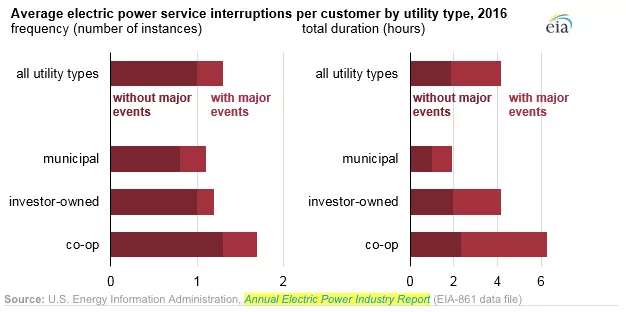
Even though some distribution customers have access to backup generators, most customers are in the dark when outages occur. Research proves that extreme weather is a developing threat to the United States’ power grid. From hurricanes to wildfires and drought, the power distribution system is progressively exposed to extreme weather, which by some estimations causes 80% of all outages. A few years back, Climate Central reported that weather-related power outages were increasing. Looking at 28 years of power loss data in the U.S., Climate Central demonstrated a tenfold escalation in major power outages from the mid-1980s and 2013.
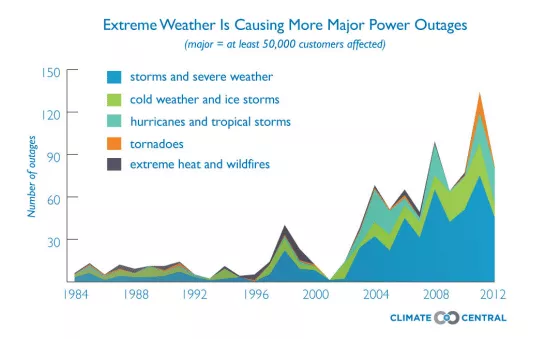
The graph above shows a distinct increase in power outages after 2003. As for a mode in-depth breakdown, weather-related outages caused by storms and severe weather—59%. Cold weather and ice storms only caused 19% of all power outages, followed by hurricanes and tropical storms—18%.
How Businesses Should Respond to Blackouts
Power outages, or blackouts, can strike unexpectedly. One way to mitigate the risks and reduce these types of disruptions is to use “undergrounding”—placing electricity distribution lines underground. This technique is believed to make the service more reliable in those areas more susceptible to the damage. Alternatively, a business can conduct smart grid improvements. The U.S. power grid, for the most part, needs significant modernization. So, it can be helpful to your business to update their facilities for better performance. Some blackouts—called rolling blackouts—are necessary for the longevity of the power system and are typical during the summer months. It is important to remind employees about your blackout response plans, especially if rolling blackouts are common, and to back up all critical files. To help organizations educate their workforce on how to respond to blackouts, we have developed a quick checklist that covers steps to take before and after a blackout.
In his recent annual letter to investors, business magnate Warren Buffett believes that a catastrophe in the form of either a human-made disaster, a cyber-attack, or a major hurricane is looming over humanity. Even though the timeline of this dreadful event is unknown, Buffett assures: “ When such a megacatastrophe strikes, we will get our share of the losses and they will be big — very big. ” In this blog post, we are taking a deep dive into the empirical evidence of disaster recovery statistics to help your organization take the necessary steps to get prepared.
Numbers Don’t Lie
Experts have been actively discussing the imminent nature of a global catastrophe. In the past couple of years, concerns about such an event have grown, along with our ability to predict the risk of approaching natural disasters and preparing for the ‘unexpected.’ According to NOAA National Centers for Environmental Information (NCEI), there have been twenty-six-billion-dollar weather events in the United States since 2017. The severity and frequency of weather-related disasters have increased in recent years.
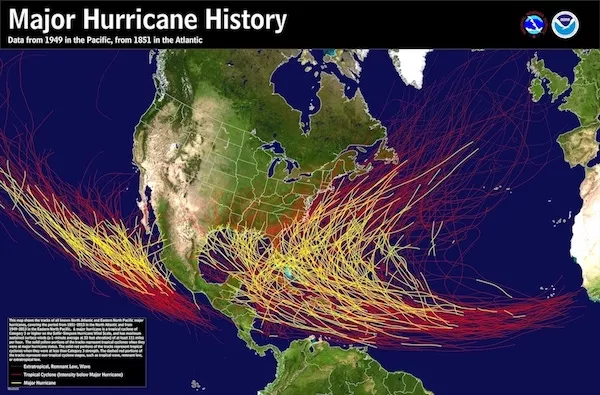
National Weather Service developed a shocking map , demonstrating the tracks of all known North Atlantic and Eastern North Pacific Hurricanes. In addition to that, Agility Recovery has anticipated that 70% of businesses or organizations will face a power outage within the next 12 months, with a 10x increase in recoveries in the past ten years, leading to more than 350 business recoveries in 2018.
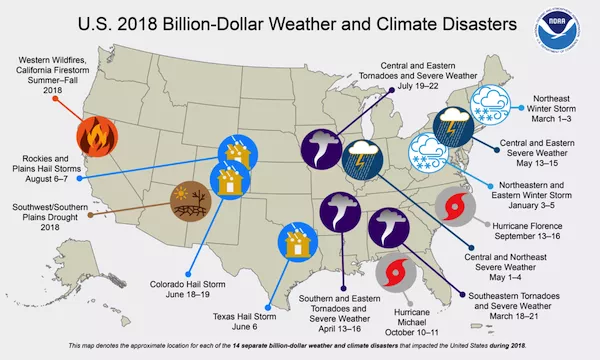
Specifically, in 2018 14 different weather-related events wreaked havoc nationally, with losses exceeding $1 billion each .
Business Interruption Meets Business Recovery
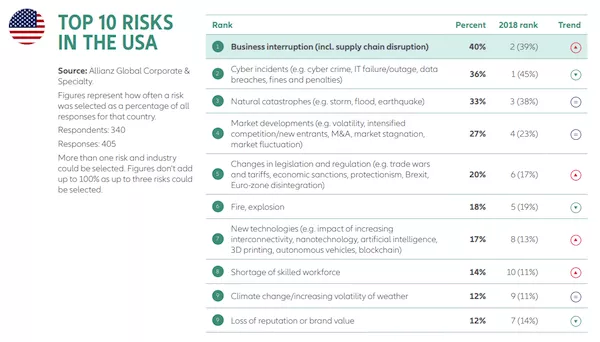
Although the world’s population isn’t the major cause of natural disasters, they are intensified by isolated events like a burst pipe, vehicle crash, or theft, which have a lot more chances to affect businesses anywhere, putting companies’ operations on hold and dwindling their revenues. With an evolving nature of the risk in the modern networked society, more and more businesses are faced with a continuously increasing number of business interruption scenarios. Some of those scenarios may not result in the actual physical damage, but rather lead to significant financial losses. The new year promises to be as perilous as the previous ones. The findings in the risk ranking report by Allianz shows that the leading dangers for companies in the U.S. are business interruption (40%), cyber incidents (36%), and natural catastrophes (33%).
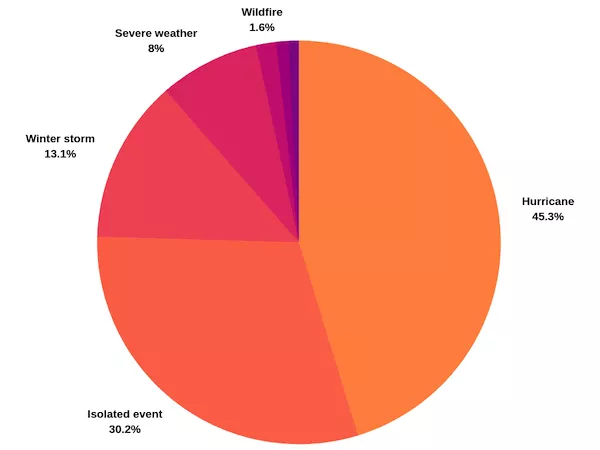
According to RIMS Business Interruption Survey , 40% of companies have experienced a business interruption in the past five years. Based on Agility’s own recovery statistics, the three top events that affected businesses’ continuity in 2018 were hurricanes (45.3%), isolated events (30.2%), which include everything from a planned construction to a rodent infestation, and winter storms (13.1%).
Next Steps: Get Your Business Ready
With all the numbers being thrown around on the internet in great quantities, let’s not forget about the fact that behind those numbers are real businesses, real companies, and real people. The question, however, remains: is your business prepared?
JULY OPERATIONS REPORT ON BUSINESS INTERRUPTIONS
This year isolated incidents and planned events are some of the most common causes of business interruptions for our customers. More and more, our customers are turning to us to assist during situations that, although planned, can still cause major disruptions to critical functions. In July recoveries, we deployed physical resources to six of our customers experiencing business interruptions. Nine additional customers placed us on standby for recovery. We also supported 12 ongoing customer recoveries and facilitated 30 test exercises throughout the month.
Six Physical Recoveries
-
Shopping in the Dark?
This national retailer experienced a sudden power failure due to arcing in a faulty electrical panel where city power tied into the building. In order to conduct repairs, the local utility was forced to completely disconnect power to the facility while a new panel was installed. The commercial electrician onsite estimated a timeframe of between 8 and 24 hours for the repair to be completed. They called us and requested a 300kW generator to power the store during the repair. Our team vetted the suggested solution and discovered that an additional 250 feet of cabling would be required in order to facilitate connecting to their building. We had delivered the cables and generator by the time the store opened in the morning. -
Business Interruption Mystery #72: The Case of the Cut Power
When their power was suddenly cut, this customer called us and requested immediate deployment of a 500kW generator and 100 feet of cabling to their National City sorting facility, located just south of downtown San Diego. The local utility never explained why there was a power outage, but they later issued a notice that it would last at least until the next day. Within 45 minutes, our mobile team had sourced the equipment and began mobilizing it to the sorting facility. -
Legal Trouble
This legal staffing and contract management firm based in New York City operates one of its 4 locations in Charlotte, North Carolina, with approximately 100 employees. To accommodate an upcoming renovation of their facility, they required temporary space for employees to operate for two months. They sought our help with securing office space, furnishings, and IT hardware. We developed a creative solution, phasing their recovery in 2 locations for different departments, which helped provide flexibility during the interruption. Our logistics and networking teams coordinated the multi-phase recovery in both a nearby ReadyOffice location and subsequently in a nearby in-line retail office space. They plan to remain in recovery for approximately 75 days. -
Hot Bankers Need AC
This independent bank customer operates 134 branch locations throughout Texas. This July, as Texans suffered through intense triple-digit temperatures, utility companies struggled to keep up, causing intermittent brownouts in areas throughout Dallas, Fort Worth, and Houston. Our customer couldn’t keep their employees in facilities that continually lost power, so they called us to request a generator to provide consistent power, particularly to ensure their air conditioning unit would remain operational. The customer continued to use the generator periodically as the hot temperatures remained for 17 days. -
Weekend Power Problems
PECO, the largest utility provider in Pennsylvania, provides power to a retail store location for one of our customers in Philadelphia. One Saturday evening, the store manager noticed issues with their power supply, which was subsequently discovered to be “phase loss.” Phase loss can be caused by thermal overload, damaged transmission wires, or mechanical failure. A phase loss that goes undetected can rapidly result in unsafe conditions, equipment failures, and costly downtime. HVAC, elevators, generators, and pumps are highly sensitive to phase loss and can be damaged beyond repair. As a retailer, the weekends are their highest traffic periods, and therefore it was critical their power was restored by 6am the following morning. Our operations team sprang into action that night, sourcing the appropriate equipment for delivery and connection the next day. -
Construction Blocks Employee Bathrooms
This customer routinely conducts facility renovations and construction projects to accommodate their rapidly growing company. During one particular project at a fulfillment center in New Jersey, just across the Delaware River from Philadelphia, PA, they discovered that the project would prevent access to restroom facilities for their staff. They contacted us to request temporary restroom facilities on-site throughout the construction project. We obtained the specifications, sourced equipment, and had the facilities delivered the following morning as employees arrived for their shift.
Other Unexpected Events
- Long Term Care Facility – Greensboro, NC – Alert for a power outage and failed backup generator
- Inpatient Rehabilitation Hospital – Round Rock, TX – Alert for 750kW generator due to scheduled power outage
- Regional Bank – Crescent City, CA – Alert for a mobile retail bank branch, due to possible sick building condition making employees ill
- Regional Bank – Aspen, CO – Alert for mobile retail bank branch due to nearby wildfires
- National CPA Firm – Sudbury, Ontario, Canada – Alert for phone and internet connectivity due to severe microburst storm activity that interrupted service
- Global Online Retailer – Campbellsville, KY – Alert due to nearby thunderstorm activity
- Federal Public Services & Procurement Offices – Multiple provinces in Canada – Five locations on Alert due to severe storms
- Local Municipality – Versailles, KY – Alert for power outage due to severe weather
- Global Food & Beverage Wholesaler – Redding, CA – Alert due to power outages caused by nearby wildfire activity
Ongoing Customer Recoveries
We also supported 12 other ongoing recoveries in July including the following:
- Regional Bank – Billings, MT – Mobile branch recovery due to building fire
- Regional Credit Union – Dudley, MA – Planned mobile branch recovery due to branch renovation
- Regional Bank – Elberton, GA – Planned mobile branch recovery due to branch renovation
- Small Municipality – Cavendish, VT – Space recovery due to building fire at a garage facility
- Medical Equipment Supplier – Jacksonville, FL – Site-to-site VPN Cradlepoint device due to ISP outage
- Private Country Club – Clifton, NJ – Planned recovery due to facility renovation
- Regional Credit Union – St. Petersburg, FL – Planned mobile branch recovery due to branch construction
- Local Credit Union – Gadsden, AL – Planned recovery due to new employee training
- Regional Bank – Fort Worth, TX – Planned generator recovery because of a prolonged power outage
- Regional Bank – Houston, TX – Planned long-term relocation due to closure of an existing location
- Small Municipality – Lafayette, OR – Mobile space recovery due to a building fire at one of their utility plant locations
Overview
Hurricane Ida hit the Louisiana coast in late August as a category 4 Atlantic hurricane. After Hurricane Katrina in 2005, Ida was the most damaging and intense hurricane to make landfall in Louisiana. Thirty-three people lost their lives in the state of Louisiana alone, most oil production along the Gulf Coast was shut down, and power outages resulting from the storm lasted for weeks.
Hurricane Ida is the sixth most expensive hurricane on record and the fourth most expensive in the U.S. It caused at least $65.2 billion in damages, with $18 billion as insured losses in Louisiana. Many Agility customers were impacted, and the Agility Recovery Services team helped more than 60 organizations and their communities as they activated their coverage due to Hurricane Ida and the earlier Tropical Storm Henri.
Hurricanes have impacts far beyond simple physical damage; a power outage can mean loss of connectivity. Without connectivity and active networks, people can’t use credit cards or use ATMs to buy food, water, tarps, and other essential supplies. If banks are down, the rest of the community can crumble.
Problem: Loss of Physical Space and Network
This bank outside of New Orleans had three branches located in an impacted area, one of which had its bulletproof glass blown out. At the same time as company leaders were trying to salvage their location and maintain continuity, they were also balancing a focus on their families’ safety and security. Many didn’t have the option to evacuate, and people were in panic mode.
Along with resuming operations, the bank prioritized getting cash in hand to distribute cash advances to their community to start rebuilding roofs before the next rainfall.
Solution: Agility Recovery Services
After the bank activated their coverage, the Agility team set out from Georgia to Louisiana, encountering downed power lines, flat tires, and other road hazards along the way.
When the Agility team reached the bank, they asked one simple question before beginning: What can we do to make this easier for you?
We’re there for the customer, no matter what. We do this with pride.
Network Architect, Agility Recovery
During the site survey, Agility team members spent time not only assessing but also cleaning the site’s parking lot so that it would be safe to bring in a mobile banking center to resume operations.
Results
With Agility’s help, the bank was able to fulfill its mission of securing cash advances for its community as well as get back up and running. Along with cleaning the parking lots and bringing in mobile units, the bank and Agility provided ice, food, and water to help support the community.
Overview
Hurricane Ida hit the Louisiana coast in late August as a category 4 Atlantic hurricane. After Hurricane Katrina in 2005, Ida was the most damaging and intense hurricane to make landfall in Louisiana. Thirty-three people lost their lives in the state of Louisiana alone, most oil production along the Gulf Coast was shut down, and power outages resulting from the storm lasted for weeks.
Hurricane Ida is the sixth most expensive hurricane on record and the fourth most expensive in the U.S. It caused at least $65.2 billion in damages, with $18 billion as insured losses in Louisiana. Many Agility customers were impacted, and the Agility Recovery Services team helped more than 60 organizations and their communities as they activated their coverage due to Hurricane Ida and the earlier Tropical Storm Henri.
Hurricanes have impacts far beyond simple physical damage; they can knock essential services like oil refineries offline, causing a wave of problems that trickle down to every part of society. Oil and gas companies not only need backup power; they need backup power for their backup power.
Problem
After rarely having to use emergency backup generators, this oil and gas company – one of the largest in the U.S. – saw the largest disaster hit their refineries in decades. Hurricane Ida severely impacted two refineries on the Louisiana coast, knocking out power and limiting network communications. The refineries were directly supplying fuel and providing transportation efforts throughout the region including to local law enforcement, fire, and EMS. It was vital they remained online and operational.
Solution
Agility rapidly and simultaneously deployed eight generators ranging from 100kw to 2000kw, 1,950 feet of cabling, two fuel tanks, two satellite communications systems, multiple 4G LTE Cradlepoint devices, and computer equipment to ensure the refineries remained operational while the utility infrastructure was repaired and restored.
Results
The company was able to continue with operations, providing fuel and other goods to the region. Additionally, they arranged for RVs, cots, food, and restroom facilities at the refineries for employees and their families to use in the event their homes were damaged or destroyed. Agility’s efforts contributed to powering those provisions.
Impressed with the Agility team. Very receptive to any questions and team worked hard to get us all started.
-I/S Sourcing Manager
Thanks to the Agility team’s performance, the company is confident in us as their long-term recovery provider. Agility stepped up to the plate and delivered when it mattered most.
Oftentimes, having just one backup power option isn’t enough.
After all, what happens if the backup goes down or needs unexpected maintenance? One Agility Recovery member didn’t want to risk that happening.
The Challenge
A pharmacy benefit management company planned to make repairs on and upgrades to its onsite generator but did not want to risk not having an operating backup generator in case of a power outage.
The Solution
Agility delivered a backup generator for the customer to keep onsite within less than three hours of calling.
Results
The company was grateful for the rapid delivery of a new generator. Agility’s operations team coordinated the delivery quickly during a time of crisis to provide necessary redundancy as the company performed essential repairs to their own generator.
This customer’s experience shows the criticality of having a backup for your backup – and Agility Recovery can help.