
COVID-19 revealed many foundational cracks across all industries, especially when it comes to business continuity planning and enterprise risk management. In March 2020, 12 percent of 1,500 businesses surveyed believed that they were prepared for how the pandemic would affect their businesses. Even more surprising, over a quarter of them thought that the virus would have minimal impact on their businesses. Fast forward six months, and it’s plain to see that the pandemic left no sector unspared. We saw real estate, hospitality, logistics, and consumer durables as just a few of the sectors with so much disruption that companies that had been a part of the landscape for decades folded. Having a business continuity plan means maintaining some function during major disruptive disasters, including a pandemic. It goes beyond just getting your data back because this is a comprehensive plan that is not limited to disaster recovery.
The First Two Steps of Your Business Continuity Plan
There are at least two fundamental steps to take when creating a resilience plan for your business. The first is to establish your emergency response team. These are people who will initiate specific mission-critical tasks in the event of an emergency. This committee can include specific supervisors, managers, and even employees if your business is small. Secondly, you need to do a business impact analysis, BIA. It will help you identify and quantify the impact of all interruptions and disruptions. Here, you will discuss how this negative situation will impact your business if it continues for three, six, or nine months. And when we say your business, we don’t just mean your employees. We’re also talking about your clients and suppliers. Creating a BIA is extensive, and once you see the risks written down, it informs your planning strategies along with goals and objectives, communication, and risk mitigation.
4 Common Objections
Businesses with objections about creating a comprehensive continuity plan speak to a few inaccurate perceptions about what it involves and why it’s needed. Some of the most common objections are:
- “We don’t have to worry about that.”
- “My Disaster Recovery Plan is good enough!”
- “Downtime isn’t that expensive…we can handle it.”
- “Oh, our insurance deals with all of that!”
Here’s how we break these down.
1. Objection: “We don’t have to worry about that.”
What they probably mean: “We’re unsure about the full spectrum of risks to our business and how to address them.”
The argument: One of the most dangerous assumptions is that your business already backs up your data as a part of its business continuity plan. In 2019, ransomware, a cyberattack type in which hackers take your data hostage for a fee in untraceable cryptocurrency, hit 15.4 percent of government institutions. In 2020, their attention turned to small and medium businesses. Over 85 percent of managed service providers reported increased ransomware attacks against SMEs, predicting it will worsen. For those who choose to pay, the likelihood of being hit again increases, because they see you as a ripe target. Even if you have your data backed up, how will you handle the infrastructure recovery process? This forensic investigation can go on for weeks and your company will have to pay for that. Along with that, there are hardware and software costs, in addition to employee training. In many cases, the downtime caused by a ransomware attack costs a company far more than the ransom itself. This is one of the reasons why a comprehensive business continuity plan with detailed mitigation and recovery steps in place involves more than having regular back-ups.
2. Objection: “My Disaster Recovery Plan is good enough!”
What they probably mean: “We put a lot of time and money into developing this plan and don’t see how another plan would work better.”
The argument: Disaster recovery is all about getting your computer systems up and running, while business continuity involves keeping your business going as smoothly as possible so hardly anyone suspects how hard you’ve been impacted. It’s also about minimizing the tangible and intangible losses that come with the disaster and recovery. Let’s take a common natural disaster scenario, such as a hurricane. Damaging rains and winds can completely devastate small businesses. Rising waters introduce infrastructure and health risks that go beyond damage to computers and servers. The hazards of mold and potential building collapse are also part of the equation for which all business owners need a plan. In the case of a hurricane, identifying and implementing emergency contact procedures, renting temporary office space, or even executing a remote worker strategy until your business and local employees figure things out is key to your recovery strategy. For example, if half of your local employees don’t have the means to communicate much less travel to work, can the other half pick up the slack, or will you need to employ temporary remote staff to help you keep it together? Can you and your staff even get back into your original location? Is it salvageable and safe? These are the types of questions disaster recovery plans can’t fully answer without integrating continuity. If you’re doing regular data back-ups that will mitigate that data loss, that’s great. But when was the last time you tested this to make sure that your back-ups work or were complete? Testing the redundancy measures and upgrading procedures in your recovery plan ensures that employees know what to expect, and your customers never know your business had a problem.
3. Objection: “Our downtime isn’t that expensive…we can handle it.”
What they probably mean: “We haven’t taken into account the full value of our business.”
The argument: One of the starkest reminders of how much downtime costs a business, look at the airline industry. For any of the top carriers, those planes cost hundreds of millions every day they are grounded. That cost doesn’t just include fuel but also customer refunds, worker salaries, and leases, if applicable. Any business that wants to understand whether they can handle the downtime, needs to do the math. One of the simplest ways to quantify how much your downtime costs is with this formula: Cost of Downtime = (Number of Impacted Employees) * (Productivity Factor %) * (Average hourly salary)
Say you’re running a small business with just five employees, you included, and you were completely down. If your average hourly salary is a modest $25, that means downtime costs you: 5 (employees) x 1(100 percent for complete downtime) x $25(per hour) = $125 per hour
This means your business is losing $3,000 per day. Can you afford to lose $3,000 per day? There aren’t many small businesses that can afford to hemorrhage that much for a prolonged period. That number makes a case for allotting between 5 and 10 percent of your business’ annual budget towards continuity planning.
4. Objection: “Oh, our insurance deals with all of that!”
What they probably mean: “We’ve paid a lot of money for this policy, but we’re not sure what it covers or how much we’ll get. We know we’ll get something.”
The argument: Business continuity insurance, also called interruption insurance, is an integral part of your continuity plan. Its goal is to make the business whole, so to speak. It can restore finances to the point they were before the loss and can include repair or replacement. It can facilitate some continuity while you try to get things going, but it has its limitations. It covers a good amount of monetary lifelines, depending on the coverage you get, but it doesn’t usually cover asset sales profits or investment payments. If you have a disaster, you are obligated to cover all of that. Another complication arises for businesses with inventory. While you may have some coverage, how you fill the gaps and minimize turnover for material that isn’t covered requires extra planning. Additionally, if multiple locations containing inventory are damaged at the same time, adjusting those claims can be complex and time-consuming, resulting in delayed payments. Business insurance supports your business continuity plan; it doesn’t replace it. As a business, you’ll still have to deal with the ripple effect of the disaster your business is facing, including unfulfilled client expectations, potential missed market opportunities, and stalled objectives. Business continuity planning is a strategy that makes the risks feel less harrowing and affords businesses peace of mind. It can also instill confidence in your brand and mitigate damage to your reputation among clients, suppliers, and creditors.
While over half of small and midsize business owners say it would take at least three months to recover from downtime, 60% don’t have an emergency response plan. However, according to Gartner, the average cost of downtime can climb up to $5,600 per minute.
When it comes to business continuity planning, there are several critical issues leaders should be addressing. You must lay out the steps you will take to react to business shocks now, but also entirely reshape your business continuity plan.
Now is the time to create an active recovery plan if your organization doesn’t have one. It takes effort, but you will give your business the best chance at survival after (and during) an unexpected event.
Keep reading to learn the steps to effective business continuity planning.
What Is Business Continuity Planning?
Business Continuity Planning focuses on maintaining business functions or efficiently resuming them in the event of a major disaster. A major disaster can be anything from a flood, fire, malicious cybercriminal to a pandemic.
A business continuity plan (BCP) outlines the procedures your organization will follow in the face of such disasters. It covers crisis communication strategy, assets, business partners, human resources, and more.
You’ve likely heard of a disaster recovery plan that focuses on restoring IT infrastructure and operations after a disaster. However, disaster recovery is one small part of a complete BCP, as it seeks to ensure the continuity of the entire organization.
As time passes and the COVID-19 pandemic is controlled, organizations must review and renew business continuity plans. You will need to assess how your current BCPs are working—if you have any.
The best way to locate any gaps is through business continuity testing. If you spot deficiencies, you must highlight them and identify the root causes, whether it’s external environmental issues, lack of infrastructure, or timeliness of action.
Then, outline new procedures based on lessons learned, and contingency plans to build resilience and adequately respond to future disasters.
COVID-19 is unlike anything our economy has ever experienced, so it was impossible to prepare for with traditional wisdom and forecasting tools. However, you should view this disaster as something to learn from and carry the lessons learned forward once the pandemic has passed, and you’ve had time to analyze your response.
Top Threats to Your Organization’s Continuity
Depending on your industry and level of risk, every organization will have different primary threats to daily business. Risk assessments before creating a BCP is helpful for this reason. You don’t need to have a plan for every possible scenario, but you should watch out for the following common disruptors.
Global Pandemics
You’ve likely experienced how a global pandemic can throw a wrench in the best of business plans, from all angles.
Many employees must work from home, demand for specific items grows, and supplies decrease due to disturbances across the supply chain.
When considering how your organization will respond to a global pandemic, put in place a solid disaster communication plan. You’ll need to envision how your employees will work together and conduct necessary business offsite.
It’s also necessary to consider alternate suppliers and products to avoid a single point of failure.
Use what’s happening now to determine what is and isn’t working for your business, then plan for how you will handle similar scenarios in the future.
Power Outages
Imagine the disruption to your “business as usual” that would be caused by a loss of communication lines, power generation, or water shutoffs.
Unexpected utility outages can also potentially damage physical assets, causing a loss of productivity and downtime.
Power outages have been on the rise in the past couple of years. Particularly, the region that got affected the most was the state of California, with hundreds of thousands of customers being affected in April alone. A single power outage event can devastate an organization’s revenue, productivity, capacity, and labor. Increasingly, utilities are practicing planned de-energization events, or Public Safety Power Shutoffs (PSPSs). As a last resort to prevent power lines from starting wildfires and putting human lives in danger, planned power outages are scheduled to take place during hot, dry days.
Natural Disasters
A natural disaster describes any weather-related disaster, such as hurricanes, tornadoes, ad tsunamis. It also refers to natural phenomena such as earthquakes, volcanic eruptions, and wildfires.
The worst disasters happen in an instant and are impossible to predict. Any business could experience grave damage to its physical structures and assets.
Natural disasters also disrupt supply chains in affected areas, causing a lack of supply for in-demand items.
Cybersecurity
A cyberattack is a malicious computer-based attack on a technical asset.
Cyberattacks include data theft, ransomware attacks, SQL injections, and distributed denial of services (DDoS) attacks.
If you have the right security measures in place, you may only experience limited IT functionality until the issue is resolved. If you don’t have data backup or recovery, you could potentially lose access to valuable business data. We have developed a brief and actionable cybersecurity checklist to help your organization take the first steps to check for any signs that may lead to a data breach or a cyberattack at your organization and develop preventative measures to safeguard your operations.
Steps to Creating a Business Continuity Plan
While creating an effective BCP is a lot of work, it’s a critical piece of operating a resilient business.
You, your appointed business continuity team, and your staff must take continuity planning seriously. Here are five steps to help you get started.
Step 1: Assemble a Business Continuity Management Team
The makeup of your team depends on your continuity objectives and the size of your company.
A good BCP should detail what your staff needs to do in the event of a disaster, what communication methods are required, and the timeframe in which critical IT services need to be available.
- Create a contact list of key people involved in your company’s BCP, including names, titles, and communication info (both work and personal) such as phone numbers, email addresses.
- Provide a detailed overview of their roles and responsibilities so that everyone knows what is expected of them in an outage event.
- Have a process in place for how your BCP will be updated and how these updates will be communicated to the team.
This team will prepare standards for the project and train additional team members. They will also identify clear processes to improve project flow.
Step 2: Ensure the Safety and Wellbeing of Your Employees
- When planning, you must prepare to prioritize the safety of your employees amid a crisis. They will look to you, their community, and the government for guidance. Be proactive and transparently address their concerns. Right now, many companies have to decide to initiate or expand remote work arrangements and other policies that allow employees to work flexibly.
- Depending on your industry, you’ll want to reallocate resources and reorganize teams, as well as establish employee wellbeing programs and procedures that support a safe working environment.
- Make sure you have proper communication channels in place to get in touch with all of your employees at the same time. Sending an email may not be sufficient if the wifi is down. Consider implementing a BC Planning software with an integrated emergency messaging tool to ensure all business processes are continuous, and everyone is safe. Communicate with your teams early and regularly. You want to engage your employees as you navigate through the current crisis.
Reimagining your usual business environment while minimizing disruptions requires a delicate balance. In some situations, telecommuting and flexible work arrangements aren’t possible. In scenarios during which you’ll have workers in direct contact with customers, you must prepare to provide personal protective equipment.
Step 3: Understand the Risks to Your Company
Once your business continuity management team is assembled, you must conduct a business impact analysis (BIA).
This type of analysis will help you identify specific threats to financial performance, operations, supply chains, reputation, employees. It can serve as a starting point when identifying risks.
You and your team should brainstorm a list of threats and potential risks to your business. Then discuss how the risks mentioned above could affect business operations.
Don’t undermine the importance of this step—or how long it could take. A proper BIA will typically involve a comprehensive questionnaire to gather the breadth of information you will need. BCP production tools such as Agility Planner help get started with creating a BCP or a BIA and provide access to historical data and ready-to-use templates.
Step 4: Implement Recovery Strategies
Once a disaster occurs, and financial losses begin to grow, it can be challenging to get back on track without a BCP in place. Consider the following questions as you discuss options with your team:
- Do you have a way to get sales, HR, manufacturing, and support personnel back to work after a disaster to continue operating your business?
- How will you continue to meet the demand for products or services if your equipment or facility is damaged?
- If your facilities are impacted, will your employees work remotely at home or from an alternate location?
You’ll address concerns like these and more in your business continuity plan.
Address Every Business Function
It’s essential not to leave any business function out of your plan. Be sure to address the following:
- Level of risk
- Impact on customers and employees
- How you will communicate with stakeholders
- Financial resources available in the event of a disaster
- Emergency policy creation
- External partners who can work together with you in a mutually-beneficial way.
Set realistic timelines and intentions across your company’s resilience journey to ensure you reach your goals and exceed expectations.
As you work through your plan, develop relevant reports to share with all stakeholders. Use highly visual reports to highlight areas that need attention and show progress.
Step 5: Test, Test Again and Make Improvements
No matter how long you spend perfecting it, a business continuity plan is never truly finished—just as the risks and requirements of your industry are never set in stone.
Testing your business continuity plan allows you to validate it as you manage risks. While 88% of companies test their strategies to identify gaps, 63% of them do so to validate their plans.
The result of this testing is not “pass or fail,” yet continuous improvement by identifying findings through a live exercise. Prepare your organization for success by using this checklist for business continuity testing.
Many people want to protect their data, but often don’t know where to start. There are two key concepts on the topic of data restoration that you first need to understand. It begins with examining recovery time objectives (RTOs) and recovery point objectives (RPOs) and the difference between them.
-
Recovery Time Objective (RTO)
How quickly you want access to your restored data.
-
Recovery Point Objective (RPO)
How far back in time you want to restore your data from before the event.
These two concepts are best shown with the following graphic:
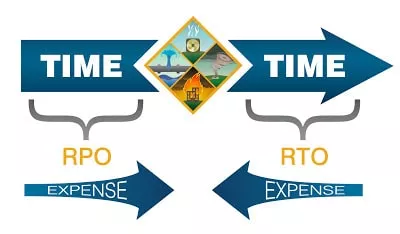
As you can see, with RPOs, the more recent you want your restored data to be after a disaster occurs, the more you can expect to pay. Costs increase due to the frequency with which you back up your data.
With RTOs, costs increase the faster you want to recover your business after a disaster. For instance, recovering your business in 72 hours will be exponentially less expensive than recovering your business within 24 hours.
Defining RPO and RTO beforehand can help your management team and IT staff understand how their expectations for recovery can affect the price of their data recovery options.
Creating a business continuity plan has never been more important. Whether it’s a tornado in Oklahoma, a hurricane in Florida, or an earthquake in California , all natural disasters share similar characteristics. First off, they are usually difficult to predict. Secondly, they can severely impact an organization’s operations. Yet despite an increase in natural disasters over the past few years, many companies, including those who are already leveraging the benefits of cloud infrastructure, are reticent to invest the time, resources, and budget into a business continuity plan (BCP) to protect their most valuable asset—people. If you’re still on the fence about investing in the development of a business continuity plan, consider the following facts:
- 52% of businesses experienced a business interruption in the past 5 years (Agility Recovery research, 2020).
- An average cost of a data breach is $3.86 million* (Cost of a Data Breach Report, IBM & Ponemon Institute, 2018).
- 40% of small businesses never reopen their doors following a disaster (FEMA).
Sure, you can view business continuity services as an “insurance policy” that your company may never use. Or, you can put a business continuity plan in place to ensure your organization will be up and running with minimal disruption to your customers, staff, and partners.
Put Your Plan to the Test
Creating a Business Continuity Plan
Keep in mind that a business continuity plan doesn’t need to be complicated or dozens of pages long. A BCP is simply a documented set of processes that helps a company minimize disruption to business operations in the event of an outage.
What are the key steps to creating a business continuity plan?
1. Outline roles and responsibilities
A good business continuity plan should detail what your staff needs to do in the event of a disaster, what communication methods are required, and the timeframe in which critical IT services need to be available.
- Create a contact list of key people involved in your company’s BCP, including names, titles, and communication info (both work and personal) such as phone numbers, email addresses and social media handles, if applicable.
- Provide a detailed overview of their roles and responsibilities so that everyone knows what is expected of them in the event of an outage.
- Have a written process in place for how your BCP will be updated and how these updates will be communicated to the team.
2. Analyze potential threats and outcomes
Take the time to determine “worst-case scenarios” for your particular business, industry, and geographic location. For example, a company located in Florida will be more concerned about hurricanes than earthquakes. An e-commerce company could analyze the risks and business impact of a data breach, while a manufacturing firm could map out scenarios based on production downtime. Next, rank each possible disaster and its potential long-term consequences. Map out how your team would respond to each one. This will provide a framework of issues that need to be covered in your BCP.
3. Factor in data loss
A key component of your business continuity plan should address data loss and recovery. Create a list of scenarios that could impact your data assets, including deleted or corrupt files, server hardware failure, viruses or data breaches caused by an employee’s personal laptop, and so forth. By classifying your business operations according to these two metrics, you can select the appropriate protection and recovery requirements. Consider cloud-based solutions for recovery of your critical data as these solutions allow for quicker connection and recovery of data or applications and provide access from anywhere. Lastly, it’s important to remember the only way to ensure that the plan is effective is to exercise the program. This can be done via a tabletop exercise or a full test of the recovery process. The key is exercising the program to ensure you will be able to recover your business in the event of a disaster as smoothly as possible, and staff understand their roles.
A business continuity plan is vital to help safeguard your business and minimize disruptions. However, setting up a business continuity program isn’t always that easy. It comes with its own challenges and obstacles. Overcoming these business obstacles can be tough, but it is possible with the right support. With education and the recent experience of a disruption being the most effective triggers for businesses to adopt a BCP*, the challenges are plentiful. We gathered some of the most common obstacles to business continuity programs, along with the ways to overcome them.
1. Lack of Resources
When you’re running a business, you aim to make money. Diverting resources to business continuity programs may slow down the growth of your business. What’s more, there is no apparent benefit from a business continuity program when everything is going well. You’ll only truly reap the benefits in case of business interruption. Trying to run a robust business continuity program can be a challenge when you’re not given the budget, manpower, or resources to do things properly. One of the best ways to ensure that you are getting everything you need is to make a clear budget of the exact costs of the program. Then estimate the costs to the business if something went wrong without the plan in place.

There should be a significant difference between the two. You can show senior management that business continuity is an investment. If all else fails, show them exactly how much your competitors are spending on disaster recovery; this should appeal to their competitive nature if nothing else.
2. Lack of Executive Support
Even with a clear cost-benefit analysis, you may still be lacking enthusiastic support from the top. There is a lot of risk-taking in business, and you may find that management is more inclined to take the risk that nothing major will go wrong, rather than spend money to prepare for business disruption. Changing that mindset and getting management’s buy-in can be a real challenge. One way that may you be able to overcome this issue is to provide them with some real-world case studies that show the dangers to businesses just like yours. You can then explain how your business continuity program can keep your business running even through the very worst scenarios. You should also show them how your program will benefit the business before, during, and after a crisis. Your business continuity plan should be not only able to cope when the worst happens, but also to reduce the risk of things going wrong in the first place.
3. Lack of Organizational Engagement
An effective business continuity program requires every member of staff to know what needs to be done and to be on board with the program. According to 2019 BC Benchmark Study, 61% of companies named lack of organizational engagement as one of the greatest BC challenges. Even in small organizations, that can be difficult, and if you have a large workforce, it becomes a serious hurdle. A chain is only as strong as its weakest link, so if you’re not all fully committed to the plan, it can compromise the quality of your program. One way that you can try to get people on board is to involve them in the planning and exercising process. Rather than just forcing responsibilities onto your workforce without them understanding why, involve them in the strategic planning or a tabletop exercise to give them a sense of ownership and inclusion. While it’s not realistic for every member of staff to be included, you can still seek input and ideas from your entire workforce. Adequate training allows explaining everyone’s roles and responsibilities in a critical situation. Getting everyone on board with the plan during a test ensures a streamlined and smooth business recovery process.
4. Insufficient Tools and Technology
A large part of your business continuity program will relate to technical problems such as data loss, technology failure, and a loss of communications systems. Your plan to overcome these issues may call for the use of specific tools or technology, such as incident management software and satellite systems or 4G LTE connectivity. Once again, a large part of this comes down to being given an appropriate budget. One method of addressing this is to try to find ways of utilizing that tech for other purposes. An incident management software can be useful in staying compliant with business continuity rules and regulations, or help document the timeline of all in-flight BC projects. Doing some more research on how your organization can benefit from such technology will aid you in making the case.
5. Lack of Routine Testing
Setting up and implementing a business continuity program is challenging. Even if you bring in outside help to assist with the planning, it’s still only the start of the process. You can never be sure of how well your program will work unless you test it. By running different scenarios , you can find out exactly how well the processes you have put in place perform. You are then able to identify weaknesses either in your plan or in the enactment of it. Once you have this information, you can modify and improve your business continuity program. Another benefit of testing is that you may be able to show management that any weaknesses in your program were due to a lack of funding, equipment, or staff engagement. This will give you more fuel to help address some of the issues raised above.
6. Inability to Monitor the Program
There are several reasons why monitoring the ongoing running of a business continuity program can be challenging. First of all, there is the sheer scale of the problem. Monitoring the readiness of all the systems as well as the key personnel can be a complex task. Secondly, there’s no clarity of what metrics to use to determine the success of a plan. Besides that, if managing business continuity isn’t your primary occupation, time can be very limited. When you first set up the program, you need to be clear with your managers that you will need to time to monitor, test, and update the program, and that this needs to be built into your position. You will also need to train up new members of staff when they join the company. It’s not something you should be doing as and when you can fit it in.
7. High Complexity
New threats are continuously emerging, and keeping track of all of them is an arduous task. As well as the more obvious risks such as severe weather or other natural disasters, there are more complex risks such as cyberattacks. With other work to attend to, you don’t have the time to learn about the latest technological threats. One of the most effective ways to overcome this challenge is to seek outside help. Companies that offer integrated business continuity solutions can take much of the complexity out of your hands. You will also be able to present your management with examples of how they have helped businesses like yours, as well as freeing yourself up to be far more productive in your other roles at the company. In addition, they will be able to help with every step of the process, from planning to testing.
8. Constant Training
All of your staff need to be fully trained to know what their roles and responsibilities are. The trouble is, your business continuity plan is not likely to remain the same. As new threats are identified, or improvements in the plan are made, your workforce will need to be retrained to include these changes. When workers leave and are replaced, their knowledge also goes with them, and new hires will have to be trained up from scratch. * 2018 Agility Stax Report
As of November 2025, the average cost for a data breach for a U.S. company is $10.22 million per incident – about 130% higher than the global average. That figure doesn’t even begin to cover the cost of lost business you will have in the future because of the data breach.
You may be thinking something like that could never happen to you because you’re too small of a company, or too careful with your data. You can never be too small of a company or have enough protection against computer hackers. Hackers can get behind any firewall you have if they target you.
The answer to data breaches and a host of other crisis business interruption events is business continuity management. Customers want it, and many company leaders need to know more about it. In its simplest terms, business continuity management (BCM) is an insurance policy against a high-impact crisis’ that can do immense damage to a company’s operations. It’s true, events like data breaches have a considerable impact but may not happen tomorrow. A huge impact event may not happen to your company in the next decade. But if it does happen, are you ready for it?
Business Continuity vs. Business Continuity Management

Before going through business continuity planning steps, it’s essential to understand the difference between business continuity and business continuity management. Business continuity is your process or procedure that lays out and identifies any potential risks and threats to your organization. The process uses a formula to estimate the impact of these risks to your organization or business. Then you provide a framework to handle the risk incident. This framework is what gives your company strength through preparedness and resilience.
Business continuity management (BCM) takes your business continuity framework and consolidates it through a holistic process. The holistic process identifies potential threats to the business and provides an effective and efficient response. It is the comprehensive process that safeguards the businesses’ key stakeholders, reputation, brand, and value-creating activities.
Business Continuity Return on Investment (ROI)
Sometimes businesses don’t incorporate business continuity steps to any robust business continuity program. That’s because the company’s return on investment (ROI) isn’t instantaneous. Not seeing a BCM’s ROI return on investment is a flawed way to think about BCM’s value. BCM should never be put into an expense column of a business spreadsheet. Instead, it should be valued as a business asset. What’s more is there is an ROI that can be calculated using the cost of the business continuity program, a probability model of an impactful event, and the revenue that’s at risk when the event happens. It’s that number the business stakeholders and executives need to be looking at because its an investment that does pay off. Business stakeholders and executives will give you a hundred different reasons why they don’t have the ROI number. But there are actionable items they can do to get ready and plan for what steps are needed for business continuity.
Business Continuity is About Addressing the Risk

Risk is the beginning, middle, and end of business continuity steps. That’s because BCM is all about calculating risks, what the event will cost you in real-time and dollars, and what you can do to prevent a massive disruption to your company when risk becomes a real-life event. Business stakeholders and executives gave the reasons for not having a BCM run from one extreme to the other, but the three most common reasons are:
- Companies will state they already know what to do in an emergency.
- Companies may also relay their insurance covers any of their losses.
- Many companies will tell you they don’t have time to develop a business continuity plan.
But companies with BCM have a plan and procedure for any emergencies. Companies with BCM also know insurance can begin to address all the financial losses you will be hit with during a high-impact risk event. Most of all, a company telling you they don’t have time to put together a business continuity plan is like a firefighter telling you they don’t have time to put on their protective clothing and equipment before running into a fire.
Business Continuity Plan Template
Every business continuity plan has steps and a rough template it can use to walk you through what your BCM should have and be ready to use if and when the time comes. The template begins with its first step— business impact analysis . It will determine everything in your company that has critical business functions or processes. You want to know what in your company is time-sensitive and can’t have any delays. What resources will those business functions need to be supported in a crisis event?
Your second step in the template is your business recovery. What gap analysis has been done to identify and address the gaps your company will incur? What recovery requirements and strategies have you put together to address any gaps or concerns after a significant impact crisis?
Your third step on the template is plan development. Your plan development will be able to document manual workarounds and organize recovery teams for relocation plans. Your fourth and final step is one of testing and exercises. This is when you do mock high-impact crisis events and test your manual walkarounds, your relocation plans, and more. Once you’re able to evaluate the recovery strategies, you can fix any holes you still see or finalize your plans to be implemented when needed.
Business Continuity Management
Business continuity management is more than a framework that enables your company to keep operating during a high-impact crisis event like a data breach. BCM allows you to operate your business without your customers feeling they’ve been forgotten or ignored. Your company can seamlessly keep functioning if they invest in a BCM plan that keeps them operational, functional, and providing what their customers or clients need. Your company’s ROI of business continuity can’t always be analyzed and given back to you in a number. But your ROI of business continuity can protect your company’s integrity, competence, and seamless day-to-day operations while everyone around you is trying to scramble and get their company functional again. When you want decades of experience that’s gone through a multitude of recoveries with top-tiered services, Agility Recovery can help.
There’s no doubt that data is king. If you don’t have business continuity and disaster recovery metrics to measure the processes, you can’t manage those processes. Reporting on metrics allows you to estimate the efficacy of your strategy and efforts, but there are certain challenges involved. First off, what are those metrics? It’s critical to understand which metrics present the most value in business continuity and disaster recovery, which is what this article will focus on.
The Importance of Business Continuity Metrics
Business continuity metrics perform vital functions:
Metrics serve as a monitor and control tool.
What’s the best way to know your business functions are in order? Metrics present an objective insight into your organization’s processes.
Metrics allow for an accurate evaluation.
To substantiate the fact that your efforts are either fruitful or futile, metrics will help you quantify your observations with solid evidence.
Metrics are the basis for improvement.
Metrics will help you outline the path of your progress and set forth the improvement tactics.
What Are The Most Important BCDR Metrics?
Each BCDR metric corresponds to a specific business continuity practice area. Operational metrics help understand risk assessment and conduct business impact analysis . Such metrics focus on the threats to the organization, their probability, and how these threats can affect the business. Operational metrics assist in estimating and determining:
- – Operational vulnerabilities during the steps of the process.
- – Downtime impact measured by RTO and BIA.
- – Critical business processes and their value to the business.
- – Critical auxiliary resources, including the type of data and specific roles within a company.
- – Critical vendors.
Business Continuity program metrics help track the overall progress of a task or an entire project. Such metrics also provide insights into the efficiency of completing tasks, along with compliance with regulations and conformance to standards. Resilience metrics let us evaluate how effective are our hazard mitigation measures and how quickly an organization can respond to a disruption. In this case, testing exercises help get a broad estimation.
Business Continuity Metrics Tool
When it comes to finding a particular tool for collecting, analyzing, and presenting your data, there may not be a singular solution. For example, don’t neglect using a good old Excel spreadsheet, backed by a tool containing built-in templates. When reporting and presenting your findings, start with the most important metrics and high-impact findings from your research. Visuals tend to make your data analysis more comprehensible, for instance, data visualization charts. However, don’t overload your presentation with imagery. The following type of information can assist you in completing your analysis:
- – Company mission and objectives.
- – Main organizational processes.
- – Data from a business interruption analysis that can help with prioritizing your metrics.
As a good practice, keep your data clean. To achieve that, analyze your data for potential duplication and standardize the data input with drop-down menus, pick lists, text formatting, and data validation. Additionally, integrate your BCDR software with other platforms or tools for a more streamlined process. A metrics-driven approach to Business Continuity can either make or break your entire Business Continuity Management initiative. Some businesses may not have the processes or keep documentation necessary to develop and report in detail for the metrics mentioned above. However, once established, such metrics will produce an ongoing method for communicating performance, progress, and escalating issues that answer executive questions about business continuity program performance and the livelihood of a business.
Business continuity and disaster recovery (BCDR) is one of a few industries where you can’t afford to make a mistake. If insufficient planning or lack of testing hinders your business continuity planning, there’s no easy way to fixing it. At the very least, experienced downtime will affect revenue and productivity. There are, however, more substantial damages, such as permanent data loss, undermined reputation, and lawsuits. While you shouldn’t be expecting something bad to happen any minute, Murphy’s Law says anything that can go wrong will go wrong. So how can a business continuity and disaster recovery plan go off course?
BCDR Failure Scenario Example
A software company “XYZ” in Southern Georgia was proud to have its BCDR plan developed, detailing how the organization would recover lost data and resume its operations. During a hurricane season, a storm hits the area where the XYZ’s office is located. It turns out, their BCDR plan didn’t cover most of the aspects of their operations. Their office building lost power. As a backup plan, the strategy relied on a generator. However, a first miss was that the building management didn’t service the generator properly and forgot to provide fuel for the generator. The decision has been made to reach out to the nearest gas company in the area. However, the gas company ran out of the kind of fuel needed for the company’s generator. Every business in the area was affected by the storm and desperately needed the same type of fuel. With no power, XYZ couldn’t access their cloud-based infrastructure, delaying their planned new product launch.
How a Business Continuity & Disaster Recovery Plan Can Fail
Your business may have or have not experienced a similar business interruption scenario. Yet, there’s a chance your business recovery plan will go awry due to the following reasons:
1. Insufficient planning
The limits of a business continuity plan and its processes often come to management’s attention only after a business interruption. Planning and training help address the missing parts of the strategy. To get management’s buy-in , it’s critical to provide the leadership with a detailed analysis covering the impact of various business interruptions. Industry reports, such as Business Interruption Report , make a compelling case that will convince and encourage company leaders to implement a BCP.
2. Lack of testing
Whether through a tabletop exercise or a simulation walk-through, testing business continuity allows your business to practice how to approach a crisis. It also locates gaps in the plan to address where it needs improvement. It’s very typical for businesses to have a plan but not make it a priority to test regularly . Such oversight leaves your BCDR plan to get buried under more gratifying things such as profits.
3. No review or analysis of results
A plan review is much like an audit of the BCP. Your business is ever-evolving, so should your BC plan. Among other aspects of a good review are updating contact information, approving the validity of recovery contracts, and verifying coverage of applicable business continuity and disaster recovery scenarios. A plan review may also include training new managers on plan details so they can pass that knowledge down to their teams. Looking back at how you did during a test or an actual recovery will help your workforce to learn what can and should be improved, and to visualize how much progress has been made.
How to Improve a Business Continuity Strategy
Continually updating and testing your incident management plan will allow your organization to adapt to new and rising threats. Having certain forms of communication set up to alert everyone during an emergency is also critical in responding quickly and efficiently. It’s hard to predict the occurrence of specific threats. However, if your incident management plan includes all of the above elements, you will be ready to maneuver through any unanticipated business disruption. Following up on these items and consolidating recommendations from tests is the most crucial process in the BCP testing lifecycle. Testing, registering the results of your testing, and executing methods to improve your BCP is the most reliable way to strengthen your organization’s response processes.
Business interruptions happen without warning, so the worst-case scenario is to be completely unprepared. A well-defined business continuity plan can provide a lifeline and allow your organization to face the unexpected. When news about hurricanes, wildfires, and earthquakes makes headlines, we tend to think of people and communities affected by these natural disasters. But how often does one think about the impact on businesses? September is National Preparedness Month. So we’d like to highlight the importance of proper disaster preparedness and business continuity (BCDR) for businesses.
Definition of Business Continuity
Business continuity is a process, plan, and procedures that identify potential risks and threats to an organization, estimate the impact of those risks to business operations, and provide the framework for establishing organizational resilience and preparedness.
Business continuity management consolidates such critical disciplines as incident management, emergency notification, disaster recovery, and business continuity. The goal of a robust business continuity plan is to keep the fundamental processes of a company operational during a disaster and to reduce downtime. A business continuity plan may consider various scenarios, such as natural disasters, wildfires, cyberattacks, or any isolated incident. However, it’s important to have a general outline of an action plan. It should include everyone involved in the crisis communication process and their responsibilities during a crisis.
Business continuity is critical for companies of any size. The cost of downtime for a small business can result in permanent business closure. A larger business will not only be faced with hefty bills, but will also need to deal with reputational damage.
Business Continuity vs. Disaster Recovery: Understanding the Difference
Disaster recovery is a subdivision of business continuity. If the latter focuses more on preparedness and building resilience, while the purpose of disaster recovery planning is to mitigate the post-failure processes and restore operations as quickly as possible following a disruption. Disaster recovery can involve managing various elements, such as data and physical recovery.
Plan with an Expert
Create or audit your business continuity plan with a resilience expert.
4 Steps to Business Continuity Planning
Business Continuity Planning is an ongoing process that may involve separate departments in designing a plan to address any potential crisis. Several steps can help in creating a solid business continuity plan.
1. Assessing and Prioritizing Potential Threats for a Business
As the initial stage of forming a disaster preparedness plan for your business, you need to identify which situations or events pose the most risk to it. Different scenarios may pose different threats to your business continuity, but they all can paralyze your processes. Do you have secure protection against cyberattacks? Do you and your employees know what to do if there’s an active shooter situation in your office? Who is responsible for communication during an emergency? Following the steps of a simple risk assessment plan can help you identify the probability of a certain threat and its impact on your business.
2. Creating a Disaster Preparedness Plan
The best way to create a dependable and organized plan is to have a designated person for this task. This person will be responsible for designing such a plan, but you, as a business owner, should specify what to include in it. Consider asking the following questions when you assign an important task.
- Does your business continuity specialist need a supporting team? When it comes to large businesses with different departments, it’s helpful to have a team working on securing business continuity. Each department has its unique processes and regulations; that’s why it’s crucial to eliminate the guesswork and have someone from each team to represent their interest. Additionally, if you’re dealing with any vendors or suppliers daily and consider them crucial to your operations, they should also be represented on your disaster preparedness team.
- What’s the scope of your plan? The goal of a good disaster preparedness plan is to ensure your employees’ safety, the stability of your work location, and continuity of your work processes. Defining the scope of your plan will help everyone involved to stay focused. The basic elements of a plan include:
- An evacuation plan.
- Crisis comms plan, detailing emergency contact information.
- Who’s responsible for shutting all equipment down or performing other essential final functions
- Any other special instructions
3. Implementing a Business Continuity Plan and Training Workforce
Once drafted, your business continuity/disaster recovery coordinator, the team, and you need to approve the plan. However, your involvement doesn’t end here. Contrary to common belief of what a disaster recovery plan is, it’s not meant to gather dust on a shelve. As soon as the plan is complete, you have many action items. The goal is to identify what can be done now before a crisis strikes. Among the examples, are some of the following materials:
- Emergency communication plan
- Emergency kit
- Training and testing exercises, such as tabletop exercises
All of your employees must be trained on how to evacuate the building, where to get information in case of emergency or business interruption, and know how to access general safety information. Your business continuity team needs to be trained on their roles and responsibilities described in a plan. The same goes for your crisis comms team, which needs to be fully trained on developing specific messaging for different situations.
4. Refinement and Testing a Business Continuity Plan
No plan, regardless of how thorough it is, is no good unless it’s regularly reviewed and updated. Your business is a continually evolving entity. That’s why, at every step of the way, your disaster preparedness plan needs to adapt to your company’s needs. It’s important to remember that the question is not if, it is when the unexpected is going to come your way. For the sake of business’s longevity, invest in devising your own disaster preparedness plan.
Your business is a continuously evolving entity. Different moving parts influence change, create an opportunity for progress, and support growth. When it comes to developing an enterprise business continuity plan (BCP), these moving parts need to mirror the changes. Whether change follows from workforce restructuring, acquisitions, or employee turnover, a BCP must be reviewed annually. However, regardless of plan reviews, some companies still overlook the most common glaring gaps in their BCPs that can lead to extensive losses. Having worked with hundreds of organizations and orchestrated a myriad of recoveries, our experts highlight the most common gaps in enterprise business continuity plans.
Unclear definition of disaster recovery success and planning by management
A cost-benefit analysis of business continuity can present its challenges.

The management may disregard a “what-if” scenario unless there are certain rules and regulations to be followed. What drives the decision-making of company leaders is based on solid financials that profit departments, stakeholders, and the bottom line. There’s always some uncertainty associated with executing an enterprise business continuity plan. However, benefits that result from BC planning efforts are everchanging and affect numerous departments and operations. That’s why it’s essential to provide managers with detailed analyses covering the impact of various business interruptions. Industry reports, such as Business Interruption Report, make a compelling case that will convince and encourage company leaders to implement a BCP.
Lack of enterprise business continuity testing and training
The limits of a business continuity plan and its processes often come to management’s attention only after a business interruption. Planning and training helps address the missing parts of the strategy. Whether it is a tabletop exercise or a simulation walk-through, testing business continuity allows you and your workforce to exercise how to approach an emergency situation. It also helps in finding gaps in the plan to address where it needs improvement. A common issue that we’ve seen over the years is businesses that have a plan, but don’t make it a priority to test regularly . Such neglect leaves your BCDR plan to get buried under more gratifying things such as profits. We recommend taking the time to thoroughly test your BCDR plan at least once a year to help you mitigate any risks before a disaster actually strikes.