This checklist outlines specific steps to take to reduce the chance of potential injuries, property damage, and down time.
Overview
Unlike other natural disasters, earthquakes can’t be predicted and occur without warning. Besides that, they aren’t limited to the West Coast of the U.S. and can happen anywhere, anytime. There are specific steps one can take to reduce the chance of potential injuries, property damage, or any other business disruption. To be effective, these steps must be reviewed before an earthquake occurs. Earthquakes rarely present any warning, which makes them hard to prepare for. But there are specific steps any organization can take for earthquake preparedness to safeguard its workforce, assets, and business continuity.
Current Landscape
Thanks to the work of the National Oceanic and Atmospheric Administration (NOAA), The United States Geological Survey and the National Earthquake Information Center, we now have a visualized map of all of the earthquakes that took place for the past decade. The video demonstrating the timeline of the earthquakes starting from 1901 shows circles of different sizes, proportional to their magnitude, and the colors represent the depth beneath the surface of the quake. Planning, testing, and preparing are critical in keeping your workforce safe and remaining your business lights on. Maintaining or quickly restoring business operations and other processes depend on how developed a company’s culture of preparedness is. Also, whether its management plans in advance and how it communicates with external partners. Everyone has a role in preparing for a disaster. All employers and organizations are fundamental elements of the community and can others to be more prepared.
Download our checklist for a complete list of preparedness steps.
Download our Earthquake Tabletop Exercise to plan, prepare, and test your emergency preparedness plan.
Overview
Planning, testing, and preparing are critical in keeping your workforce safe and remaining your business lights on. Maintaining or quickly restoring business operations and other processes after an earthquake depend on how developed a company’s culture of preparedness is. Also, whether its management plans in advance and how it communicates with external partners. Everyone has a role in preparing for a disaster. All employers and organizations are fundamental elements of the community and can others to be more prepared. Here's a piece of brief advice on how to successfully run a tabletop exercise, no matter the threat.
Before a tabletop exercise
A successful tabletop exercise should resemble the real world as closely as possible. This means choosing threats that are viable to the organization, as well as designing a scenario that includes realistic attacker behavior.
During a tabletop exercise
Make copies of your emergency response and business continuity plans and a whiteboard to track the progress. Before you begin, the moderator needs to review the objectives and scope of the exercise. Note that the crisis leader has the final say if there are conflicting opinions. It’s also important to keep track of time; the moderator needs to set time limits for each action item.
After a tabletop exercise
After each exercise, it’s essential for the team to debrief and discuss any shortcomings in the response. They should also document what worked as well as what didn’t so the organization can identify vulnerabilities and missing links and work to patch and fill them. Download our Earthquake Tabletop Exercise to test your emergency preparedness plan.
Unlike hurricanes or tornadoes, earthquakes don’t occur at predictable times or in predictable patterns. Earthquakes rarely give any warning, which is why they present such a challenge to preparedness. One earthquake doesn’t cause much damage, but large earthquakes can cause widespread destruction and loss of life.
Any organization’s emergency plan should consider how to protect employees, assets, and business continuity. In this article, you’ll learn the best ways to prepare for the unexpected and keep your business intact.
Preparing Your Company for an Earthquake
Earthquakes are one of the most significant threats to business continuity, with devastating effects on companies, employees, and customers. Earthquakes occur in remote, high-risk areas with few or no warning systems, making them nearly impossible to predict. In the aftermath of an earthquake, employees are often left without access to their offices, computers, or other critical infrastructure they need for their jobs. Moreover, disasters often disrupt transportation networks, telecommunications lines, electricity grids, and water and sewer systems, making it difficult for employees to get to work.
You can reduce the potential impact of an earthquake on your business by ensuring that you have an emergency plan and conducting regular earthquake preparedness drills. This enables you to assess your workplace’s vulnerabilities and plan for potential disruptions, which can reduce the chances of injury and damage.
Establish an Emergency Plan
You should establish your company’s emergency plan ahead of time. In addition to routinely training employees on what to do during an emergency, you should encourage all the key stakeholders in your company to participate in an emergency training exercise. You and the key stakeholders should also establish an alternate worksite if possible. In a natural disaster, your employees will appreciate the level of preparation you put into a disaster plan.
Design Your Company’s Emergency Plan With the Following
- In the event of an earthquake, it is essential to establish a designated emergency area outside of the workplace. Ideally, the location should be open-air and free of other buildings or power lines. Make sure that your employees are aware of the site of the designated emergency area.
- After evacuation, designate one or more individuals to conduct a roll call of employees, depending on the size of your company.
- Having teams handle basic first aid, search and rescue, fire and evacuation, damage assessment, and security is an excellent way to involve your employees in the process.
Prepare Disaster Supply Kits
You can also mitigate your employees’ injury rate if you have a disaster supply kit on hand after an earthquake. During a time of any disaster, you may lack access to food, water, and information, for some time. A disaster supply kit at your workplace needs to contain, at the very least, the following:
- Bottled water
- Hand-crank or battery-powered radio
- Additional batteries
- Emergency first aid kit
- Emergency whistle
- Local maps with information about the nearest hospital and police station
- Chargers and backup batteries (or power banks) for cell phones
- Pain relievers and other non-prescription medications
Develop a Business Continuity Plan (BCP) and an Emergency Action Plan (EAP)
Business continuity plans and emergency action plans are essential components of every business. BCPs ensure that a company’s ability to respond to and recover from the unexpected is protected and minimizes downtime for the organization. Your employees need an EAP in case of an emergency to know what to do. Getting expert assistance can be an excellent way to build a fully actionable EAP and BCP for business owners without the time or expertise to do so themselves.
The best way to determine whether your plan will effectively protect your organization is to partner with Agility’s expert business continuity testing team to develop a testing protocol tailored to your unique needs. Both weather and technology failures can account for power outages. Business owners should prepare businesses to support their productivity even when faced with a power outage and consider a backup plan that includes additional computer equipment, an emergency power supply like a generator, or a portable power and connection pack like ReadyTechGo.
Store Information Remotely
Businesses should have all critical company information, including client data, work orders, contracts, intellectual property, marketing information, and other sensitive materials, safely stored in the cloud if an unexpected disaster hits. Businesses should also have critical business data, like employee training records, sales records, and financial statements, on a remote server. Having the valuable materials mentioned above will enable your company to do business still while handling the aftermath.
Prepare Your Employees to Deal with Emergencies with Training and an Emergency Messaging System
As a result of a natural disaster, time is essential, and you must take action immediately. A person may become overwhelmed in a moment of crisis and freeze up when they should be acting quickly. Organizations that are likely to be affected by natural disasters should prioritize preparing their employees to respond to natural disasters such as hurricanes or power outages.
Importance of Earthquake Awareness
Earthquakes can cause significant disruption for businesses and their employees. Employees who are knowledgeable and prepared for earthquakes are safer and less likely to become seriously injured. Companies that establish an emergency preparedness plan are more likely to recover from the aftermath of an earthquake. Contact Agility today to strengthen your resilience against earthquakes and other disasters.
Our recent Q1-Q2 2021 Business Resilience & Insights Report delves into some of the top trends in the business continuity landscape. The World Economic Forum reported that the most likely risks of the next decade are extreme weather, climate action failure, and human-led environmental damage. Additionally, the biggest impact risks are infectious diseases, climate action failure, and other environmental threats. In 2020, natural disasters caused global losses of $210 billion. Organizations are increasingly prioritizing long-term climate-related risks by evaluating the exposure and impact a potential event could have on the business and mitigating those effects. Factoring climate change risk resiliency into facility design and operations is critical for ensuring business continuity.
60% of all major business risks are either directly caused or negatively affected by climate change.
BCI 2020 Risk Report
Climate Risks to Business Continuity
Loss of or damage to physical property and disruption of systems
Whether a flood, fire, tornado, hurricane, earthquake, or another weather-related event, your physical offices, warehouses, and more can be severely damaged and even destroyed in a matter of hours. These disasters can affect your workforce’s ability to work, your inventory, and your overall ability to maintain operations – or even stay in business.
Disruption to supply chains
Your business may be in a low-risk area, but what about your vendors? If your business relies on third-party suppliers who face significant climate-related risks, your operations are at risk, too.
New climate-related regulations
Businesses face new regulations with potentially expensive fines for noncompliance as the world transitions towards a lower-carbon economy.
Higher costs
As shortages of raw materials and resources like water increase, so do prices. Another cost to look out for is insurance. Climate change risk will likely have a substantial impact on insurance rates as insurers adjust risk models.
Steps to Increase Climate Risk Resilience
1. Incorporate climate change risk into your planning strategy
Organizations must begin preparing for imminent climate change risks, whether floods, fires, hurricanes, or other myriad disruptions. Incorporate these risks into your planning strategy and governance framework to avoid being caught unawares or running afoul of regulatory requirements. The BCI states that “climate change might be the biggest threat to business continuity this century.” Make sure to incorporate these risks into your risk assessments and business continuity plans.
2. Identify climate risk and weather-related exposures and their potential impacts
Even if your company doesn’t expect to be directly impacted by physical events like wildfires or tornadoes, there are far-reaching impacts of climate and weather events. These events may disrupt critical systems, or you may lose connections with suppliers or data centers.
3. Plan how to mitigate effects in the short term
What will you do to maintain business as usual if a disruption occurs? Determine the most likely risks to your company using resources like weather forecasts and historical analysis.
4. Predict and plan for long-term effects
Long-term effects may include increasing temperatures year over year or impending regulations and legislation around carbon emissions. According to the BCI, “the number of organizations performing longer-term trend analysis has risen to an all-time high of 81.3%.”
5. Assess your third parties’ risk awareness and vulnerabilities
Your risk assessment may cover nearly every possible scenario, but increasing dependence on third-party suppliers and vendors increases the chances of disruption. If your supplier is in a different climate, they likely face other risks. Ensure that they, too, have plans in place in case of disruption and maintain continuity.
Plan for Your Organization’s Future
With a robust business continuity plan in place, your company will be better prepared to respond to any disaster. Through tabletop exercises and other testing procedures, your workforce will know exactly what to prioritize and how to work with vendors to maintain operations. When climate change risk affects your operations, be ready to respond and spring into action.
According to the National Oceanic and Atmospheric Administration (NOAA), the 2021 Atlantic hurricane season will likely be above average. Specifically, there is a 60% chance of an above-normal season this year – and therefore a high chance that your business continuity will be interrupted. But, because of the pandemic , it may be even more disastrous than experts initially thought. This means that organizations like the Federal Emergency Management Agency (FEMA) are working to create a revised set of rules for crisis management . Pandemic operational guidance must factor in for extreme weather. We’ve organized these regulations so that your business can prepare similarly. Ahead of this year’s hurricane season, you should be sure that you know what to do in the case of a natural disaster.
Applying FEMA’s Coordination Plans to the Workplace
If you live in an area prone to natural disasters, you should know that FEMA has a plan to assist. And, from their plan, your workplace can make its own. You can still work and expand your company’s needs during this time. Neither the pandemic nor the hurricane season should slow you down. If a natural disaster like a hurricane strikes, FEMA will deploy a Federal Coordinating Officer (FCO). These are the captains of coordination between regional administrators who ensure that each area is getting the help it needs based on the level of incident management required. Your business can employ a similar technique. If you find a problem area with your business, you need an appointed leader who will show up if there’s a problem and determine how to continue business operations.
Workforce Protections in Crisis Management
In the COVID-19 work environment , FEMA is careful about its deployments. While the organization needs most of its staff to deploy to the area of incidence in person, they have been allowing consultants to assist virtually. Your business should also adopt a virtual policy. Perhaps positive rates in your area are high, so you’d feel more comfortable with employees working from home. Then, you could conduct meetings over video chat and keep everyone safe until the CDC deems that it’s safe to return to the workplace without regulations. Since FEMA worked on incident management for COVID-19 , its workforce has become better equipped to handle these kinds of situations, and they plan on evolving their practices even more. Here are some of the workforce protections and other changes that FEMA has put in place:
- – On-site testing and screenings at FEMA facilities
- – Overall health and wellness screenings
- – Virtual registration
You can adapt these changes to your workforce. For example, you may want to consider offering health and wellness screenings for all your employees if there are some coming into the office to reduce the spread of infection and keep everyone safe.
Protecting Employees During Emergency Planning
FEMA is continuing to protect its employees, even as vaccines become available across the country. However, it’s important to think about those individuals who have not gotten their vaccine yet. Here are some of the things that FEMA is doing to protect its employees:
- – Making vaccines available to FEMA employees
- – Encouraging employees to get vaccinated
- – Offering on-site testing for employees
- – Conducting contact tracing
- – Providing masks and other personal protective equipment
- – Enforcing protective guidance for staff and visitors
- – Encouraging physical distancing through facility modifications, better ventilation, and thorough cleaning
- – Encouraging employees to remove themselves from unsafe situations
You may want to follow a similar mindset with your business organization and offer information about the vaccine, encourage employees to consider it, and even offer paid time off to receive and recover from the vaccine. When it comes to the facilities that your employees are working in, you may want to consider these changes:
- – Engineering improvements for better ventilation and air quality
- – Reasonable accommodations for employees with disabilities, especially immunocompromised individuals
- – Not allowing employees who have recently tested positive to come into your facility
These strategies can protect you, your employees, and your employees’ families.
Remote Pandemic Operational Guidance
As FEMA has been moving some of its employees to work virtually, it’s also been working with the public on crisis management concerning the pandemic. This means that they’ve been working on educating the public about COVID-19 and what steps they need to take to protect themselves. Here are some of the initiatives that FEMA has been conducting virtually for citizens and employees:
- – Increasing communication efforts with the public
- – Engaging with citizens via social media
- – Hosting virtual townhalls
- – Coordinating messages with FEMA employees
- – Increasing the availability of FEMA personnel
- – Allowing FEMA personnel to have more control over the kind of deployment they have
- – Using virtual centers to support areas impacted by natural disasters
As an authority in your industry, your business could do something similar and take to social media to teach your target audience about the pandemic and how to keep themselves safe. As a part of this, you could explain how you’re keeping your own employees safe during this time.
Emergency Planning
Usually, FEMA provides mass shelter assistance in case of an emergency. But, with the pandemic, these plans have had to change. With these new changes, FEMA is focused on keeping citizens safe. FEMA can continue with mass shelters on a smaller scale by keeping families together and creating distance between different family units. Although they may not house as many citizens, they’re still crucial to emergency planning and disaster assistance. As they’re implementing these rules and regulations, FEMA is also sure to promote consistency across the bases. Virtual check-ins with intelligence officials keep every base accountable for ensuring the safety of citizens and employees alike. Here are some more considerations that FEMA is making:
- – Planning for protective measures for all care personnel
- – Health screening
- – Mask use
- – Social distancing requirements
- – Consistent cleaning and disinfectant use
- – Creating quarantine/isolation areas
- – Planning for additional supplies that areas may need
- – Developing strategies for protecting individuals from COVID-19
- – Addressing health screening assumptions for individuals with COVID-19 symptoms without a positive test
- – Tracking individuals entering and exiting the facility
- – Continuing health monitoring as individuals leave and return to the facility
- – Planning for feeding strategies
Accounting for all these changes is essential as the pandemic has changed the face of natural disaster crisis management. Whether it be a hurricane or something else, FEMA cannot back down on virus regulations. Otherwise, the crises would be made worse by the spread of COVID-19. Therefore, you need to be serious about COVID-19 regulations in the workplace, especially ahead of hurricane season . Having ill employees isn’t going to make emergency situations any better. And, if your shelter is a small area, this could exacerbate the problem.
Preliminary Damage Assessments
Another advantage to virtual staff implementation is preliminary assessments. While FEMA is sending staff to an area, they can virtually conduct a preliminary damage assessment. This means that they’ll have an idea of what their team needs before they even get there. This can help reduce the number of times that FEMA staff may run out of supplies. Your workplace can follow this example as well. By keeping an eye on the weather ahead of each week and day, you can assess whether your employees are at-risk during that time. With the pandemic still raging, you should also check the positive testing rates in your area at that time. It may help to have a specific percentage as a benchmark. This number can be the determining factor as to whether employees come in that week or not. This is a refined preliminary damage assessment for your workplace. And, by taking five minutes to check the weather and COVID-19 rates for that week, you’re going to protect a lot of people. As you’re guiding your workplace through these strange times, you should be sure to make these plans transparent with your staff. Tell them that you’re looking for specific markers to make decisions and let them know that you’re doing all of this for their safety. These times are tough, but enacting crisis management is a must.
Acting on Pandemic Operational Guidance
All in all, FEMA (and the rest of us) have learned a lot from the past year. This period proved that we weren’t prepared for a pandemic, but we learned and adapted quickly. FEMA has shown growth in its pandemic operational guidance just as we’re sure you’ve shown growth in other areas. FEMA has implemented more and more virtual solutions that will drive success in disaster-related situations. And, with their guidance, your business can follow similar guidelines. If you’re worried about protecting your business during this time of COVID-19, hurricanes, and more, you need business continuity experts. Agility can help in a variety of ways, including with our emergency notification system.
The magnitude 7.1 earthquake ripped through California and its neighboring areas the first week of July, leaving dozens of homes and businesses impacted, even though it hit a scarcely populated area. Unlike other natural disasters, earthquakes don’t have a season. Earthquakes rarely present any warning, which makes them hard to prepare for. But there are specific steps any organization can take for earthquake preparedness to safeguard its workforce, assets, and business continuity.
Current Landscape
Thanks to the work of the National Oceanic and Atmospheric Administration (NOAA), The United States Geological Survey and the National Earthquake Information Center, we now have a visualized map of all of the earthquakes that took place for the past decade. The video demonstrating the timeline of the earthquakes starting from 1901 shows circles of different sizes, proportional to their magnitude, and the colors represent the depth beneath the surface of the quake.
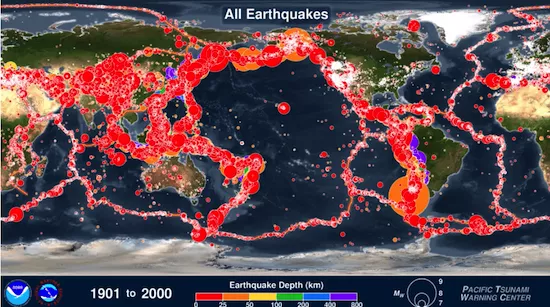
The data shows that the number of recorded earthquakes drastically increased since the 1970s. However, the rising number of earthquakes doesn’t necessarily mean that the planet is becoming more seismically active; it’s the technology that has become much more advanced, allowing to detect earthquakes with greater precision.
Understanding the Earthquake Phenomenon
Earthquakes are caused by the shifting and breaking of rock beneath the planet’s surface. Ground movement from earthquakes can damage buildings and bridges, disrupt communications and, sometimes, trigger landslides, avalanches, flash floods, fires, and cause tsunamis. The most common injuries that result from earthquakes are due to collapsing walls, shattered glass, and falling objects. While California has recently experienced frequent damaging earthquakes, Alaska is the top state shook up by this natural disaster, with more than a thousand earthquakes happening each year. However, earthquakes can occur in all states and U.S. territories. Based on estimations, a major earthquake in a densely populated area in the U.S. could result in as much as $200 billion in damages and losses.
Earthquake Preparation
While hard to predict, there are various ways to make sure your organization is prepared for an earthquake.
1. Have an Earthquake Survival Kit
Due to the destructive nature of earthquakes, the extent of damage could affect access to water, gas, electricity, internet, phone, or sewage services for days. If severe enough, an earthquake can trap everyone in the building. To ensure the safety of everyone involved, we suggest that you include the following items in a disaster survival kit:
- One gallon of water per person, per day (3 day suggested supply for businesses)
- Non-perishable food items (3 day suggested supply for businesses)
- Battery-powered radio and extra batteries
- Flashlight and extra batteries
- Personal hygiene items
- First aid kit
- Copies of important documents
- Emergency contact information
- Extra cash
- Emergency blanket
- Fully charged cell phone and extra chargers
2. Create an Emergency Action Plan (EAP) and a Business Continuity Plan (BCP)
EAPs and BCPs are essential for every business. An EAP is created to ensure that your employees know how to act in an emergency. A BCP focuses on safeguarding your business’s ability to respond to and recover from the unexpected as quickly as possible to mitigate downtime for an organization. For business owners who need to have a fully actionable EAP and BCP, but have no time to build one on their own, opting for assistance can be a solution. Companies such as Agility offer assistance in helping you develop an EAP and BCP that not only keep you compliant, but also establish safety measures, and safeguard your employees and your business.
3. Train Your Employees & Implement an Emergency Messaging System
In the heat of the moment, people may become overwhelmed and “freeze” when they should be acting quickly. In the event of an earthquake, time is of the essence, and you must act quickly. Training employees on how to respond to natural disasters, such as hurricanes or power outages, should be a top priority for organizations located in areas prone to be affected by natural disasters. Besides, with the chaos that follows an emergency, any company needs to have an emergency messaging system in place for immediate communication.
In Conclusion
Planning, testing, and preparing are critical in keeping your workforce safe and remaining your business lights on. Maintaining or quickly restoring business operations and other processes depend on how developed a company’s culture of preparedness is. Also, whether its management plans in advance and how it communicates with external partners. Everyone has a role in preparing for a disaster. All employers and organizations are fundamental elements of the community and can others to be more prepared.
Disaster Recovery to Protect Sonic Automotive Operations
Sonic Automotive is one of the largest car retailers in the United States. They operate over 100 dealerships across the country, and they regularly surpass over 100,000 auto sales a year. They work in two different segments, one part consists of franchised dealerships representing over 20 different new vehicle brands, and the other offers cars in the pre-owned market. Each dealership has its own unique threats to continuity, and Sonic needs to be ready for everything from earthquakes to fires.
Challenge: Fire, Structural Damage, Power Loss
On two separate occasions in 2014, Sonic Automotive reached out to Agility with severe continuity problems. The roof at a dealership in Orlando, Florida, collapsed, and the building was condemned. In the early hours on Thanksgiving morning, a small fire damaged a Texas dealership and crippled the building’s power. Any pause in sales for a dealership is a major loss in revenue, but Black Friday is one of the year’s largest vehicle sales weekends.
Solution: Mobile Recovery Unit, Backup Power, Connection
In each recovery situation, Agility deployed a mobile unit to serve as a temporary office. After employees showed customers their inventory, they could bring them back to the recovery unit to speak. Each employee had access to work stations and meeting areas, as well as computers and phones. Agility’s generators powered the units, and our 4G LTE router provided the Internet connection.
Results: Operations Restored
The dealership in Orlando resumed normal operations within days of making the call, and agents worked out of the temporary office until a permanent replacement could be built. Within 48 hours of the Texas location reaching out to Agility and implementing their recovery plan, the mobile office was operational. Their ability to recover before the Black Friday sales event prevented Sonic’s devastating loss, the dealership, and the individual employees.
To call on Thanksgiving and to have Agility respond and be up and running within 48 hours was amazing.
Tim Hallice, Director of Risk Management