
Join us for this educational webinar on business continuity testing do’s and don’ts.
We’ll cover essential areas of testing and the key reasons to test your plans, including:
-
– Test to know exactly what your company needs to recover – and to leverage the resources available to you
-
– Test to know what to expect during a recovery
-
– Test to learn what permits your organization needs
Formulating a business continuity plan (BCP) is only half the battle. A solid BC strategy needs more than just a well-laid out theory, and business continuity plan testing can help you achieve optimal results. Can your backup systems withstand a cyberattack? How efficient is your recovery time objective (RTO) for restoring data? Are your employees familiar with emergency procedures? Do you have an emergency communication strategy to let everyone know about an incident immediately? Business continuity plan testing is the most reliable way to find out, and it is a critical component of continuity planning. By skipping regular testing, you won’t know if your organization is prepared for a disaster—until it’s too late. In this article, we’ll look at six BCP testing scenarios that will prepare your teams and technologies for the unexpected.
Test with Agility
Agility Recovery offers several testing options to fit your organization's needs.
Why Test?
Strategic tests and these business continuity plan scenarios will help you to:
- Identify gaps or weaknesses in your BC plan
- Confirm that your continuity objectives are met
- Evaluate the company’s response to various kinds of disruptive events
- Improve systems and processes based on test findings
- Update your BCP accordingly
Without testing your plan, you’re putting both the business and its people at risk. In fact, over the past few years, 35% of small businesses have lost as much as $500K due to downtime . Having an inadequate plan is just as risky as having no plan at all.
Testing Your BCP: How Often is Enough?
So, what do you need to test, and how often? If you already have a BCP, then it must be filled with myriad procedures for various events . But do you need to test everything? And how often do you need to do that? The answer to that depends on your organization’s unique risks, which should be previously identified in a business impact analysis. For instance: A company that has more at stake when it comes to disruption, such as revenue loss, operational downtime, or damaged reputation, will typically require more BCP scenarios, as well as running those tests more often. Every organization is a unique entity, and its BCP will differ in scope and priority. Below, you’ll find business continuity tests that our experts recommend for most organizations that are concerned about their both basic and advanced BC needs. Tailor their suggestions to fit your business needs.
Business Continuity Plan Testing Scenarios
As your team is prepping for those tests, you need to agree on how realistic and detailed you want a test to be. Testing can present challenges for companies: it requires investing time and resources. With that in mind, it may make more sense to conduct a tabletop test at a conference room, rather than involving the entire organization in a full-blown drill. There are several types of tests, such as a plan review, a tabletop test, or a simulation test, which we explained in detail in our previous post.
1. Data Loss/Breach
One of the most prevalent workplace disasters today. The cause of data loss or breach could vary:
- Ransomware and cyberattacks
- Unintentionally erased files or folders
- Server/drive crash
- Datacenter outage
Data is mission critical for any company, and losing it can have many serious consequences, such as significantly impacting sales and logistics applications. The goal is to regain access to that data as soon as possible. Restoring a backup is the solution. However, who’s responsible for that? What’s the communication plan in this case? What are the priorities? Who needs to be contacted right away? Are there any vendors involved? These and many other questions will be answered during a test.
2. Data Recovery
In this scenario, you need to make sure your BC disaster recovery systems work like clockwork. To do that, run a test that involves losing a bulk of data, and then try to recover it. Some of the elements you’ll need to evaluate will include your RTO, and whether your team met its objectives. Besides, was there any damage to the files during recovery? If your backup was stored in the cloud, did you come across any issues? Include all critical activities to be performed in a BCP scenario.
3. Power Outage
Let’s imagine there was a power outage due to a recent storm. The utility company reported that the power wouldn’t be back up for a few days. What do you do? First off, your incident response team needs to coordinate among themselves and communicate with the rest of the company.
- How will you notify your workforce about the incident? Who’s expected to come in the office, and who’s able to work remotely?
- Which departments get affected the most and thus need immediate relief (e.g., accounting, logistics)?
- Do you have a backup power generator? Do you or anyone on the team know how to use it?
- Do you have an arranged office or mobile recovery location?
Answers to these questions must be covered in your BCP. And running a test will confirm that everyone’s on the same page.
Put Your Continuity Plan to the Test
4. Network Outage
Power outage inevitably leads to a network outage . However, network outages can happen with electricity still being on, and they could last indefinitely. In such scenarios, many businesses rely on a work-from-home strategy that isn’t reliable for an extended period. When working from home, many employees have various distractions that affect their productivity. So, during your test, verify the following points:
- Does everyone have access to their work systems?
- Is everyone aware of the security measures to take while working remotely (VPN, safe network connection, etc.)?
- What is the plan for network restoration?
Answers to these questions also need to be specified in your business continuity plan.
5. Physical Disruption
Fire drills are one of the most critical company-wide drills that must be completed annually. There may already be local fire code compliance in your area, but if not, it’s vital to conduct a fire drill regardless. Similar to a fire drill, you can test disaster recovery response to other situations, like natural disasters (e.g., earthquake, tornadoes, storms) or other critical situations (active shooter, bomb threat, etc.). These exercises will help familiarize everyone with emergency procedures and safety steps to take.
6. Emergency Communication
Being able to communicate during a disaster or an emergency can provide a lifeline. Yet, the most disruptive events—hurricanes, floods, tornadoes—are very likely to leave you with no traditional means of staying in contact. For these scenarios, your plan needs to outline the actions to be taken. An emergency notification system is the most efficient means of immediate communication for a company of any size. Regularly update the contact information of everyone in your contacts database, so that all of the employees receive timely notification. Additionally, create templates for every disaster scenario to streamline to process.
Healthcare facilities face constant pressure to safeguard sensitive patient data and protect critical systems from cyber threats. With an increasing reliance on technology, hospitals, clinics, and healthcare providers must prioritize cybersecurity to ensure patient safety, maintain trust, and comply with strict regulations like HIPAA.
When it comes to identifying vulnerabilities, both automated and manual penetration testing play important roles. But which is better suited for healthcare environments, where both speed and thoroughness are paramount? Let’s explore the differences and how to strike the right balance.
Continuous Penetration Testing: Automated & Fast
Continuous or automated penetration testing leverages advanced tools to simulate cyberattacks and identify vulnerabilities quickly. It’s particularly effective for environments that require:
- Speed: Automated tools can scan an entire network within minutes, detecting common vulnerabilities like misconfigurations or outdated software.
- Continuous Monitoring: Healthcare systems require constant vigilance. Automated testing can run regularly to provide real-time insights into new vulnerabilities as they emerge.
- Scalability: For large healthcare facilities with expansive IT infrastructures, automated testing efficiently assesses a wide range of systems and devices.
However, automated tools can sometimes miss nuanced or context-specific vulnerabilities. While they provide a strong baseline for ongoing monitoring, they may lack the human insight needed to identify sophisticated or emerging threats.
Guided Penetration Testing: Detailed & Strategic
Guided simulation penetration testing (also referred to as manual PTaaS) is conducted by cybersecurity experts who simulate real-world attack scenarios to uncover vulnerabilities that automated tools might miss. This approach excels in areas where:
- Human Expertise is Critical: Guided testing identifies complex vulnerabilities, such as logic flaws in custom applications or specific risks in medical devices.
- Targeted Analysis is Needed: For high-priority systems, such as electronic health records (EHRs) or connected medical devices, manual testing provides in-depth scrutiny.
- Compliance is Complex: Many healthcare facilities require detailed reporting to meet standards like HITRUST or HIPAA. Manual testers can tailor their evaluations to align with these frameworks.
The downside? Guided simulation penetration PTaaS is time-intensive and often more expensive. It’s not practical to use exclusively, especially in fast-paced environments like healthcare.
Striking the Right Balance: A Hybrid Approach
For healthcare facilities, a combination of continuous and guided simulation penetration testing is often the best solution. Continuous testing ensures automated, “always-on” coverage, quickly identifying common vulnerabilities across large networks. Guided simulation testing complements this by providing a deeper, manual, and more nuanced evaluation of high-risk areas. Here’s how healthcare facilities can integrate both approaches:
- Use automated testing to conduct regular scans of your entire IT environment.
- Deploy manual testing periodically for critical systems, such as EHR platforms or medical devices, where the stakes are highest.
- Leverage automated reporting to prioritize vulnerabilities and direct manual testers to areas of greatest concern.
This hybrid approach ensures that healthcare facilities stay ahead of evolving threats while maintaining compliance and protecting patient data.
Take Action Today
Cybersecurity in healthcare is non-negotiable. With the right balance of continuous and guided simulation penetration testing, you can protect your systems, secure patient data, and reduce the risk of cyberattacks. Contact Agility Recovery to learn how our Cyber Resilience and Threat Detection solutions can help safeguard your healthcare facility.
Testing your business continuity plan allows you and your workforce to exercise how to approach an incident and find gaps in the plan to address where it needs improvement. Even though a developed business continuity plan provides your organization with the tools to predict, drafting a plan is only half the battle. Businesses face myriad threats, from a rodent infestation to a planned renovation. A developed business continuity plan provides your organization with the tools to predict, prevent, and respond to risk efficiently. The strategy ensures that the organization and its clients will remain operational with minimal to no downtime or threat to operations.
However, drafting a plan is half the battle. What’s most important is ensuring your business continuity strategy is sound, useful, and practical. This is where testing your plan comes into play. Testing business continuity allows you and your workforce to exercise how to approach an emergency and find gaps in the plan to address where it needs improvement.
Types of Business Continuity Tests
Plan Review
A plan review is much like an audit of the BCP. The BCP team and the C-level management or department heads get together to review the plan and decide if any components are missing or need revision. This type of test is beneficial for training new members of the BCP team or in regular onboarding. Among other aspects reviewed during a meeting are contact information, the validity of recovery contracts, and coverage of applicable business continuity and disaster recovery scenarios. A plan review may also include training new managers on plan details so they can pass that knowledge down to their teams.
Tabletop Test
This is a more involved way of reviewing and testing a BCP. Employees participate in an actual exercise during a tabletop—a scenario-based, role-playing exercise. Everyone involved practices their roles and responsibilities during an emergency, such as an earthquake, hurricane, or active shooter.
Walk-Though/Simulation Test
A BCP simulation test is a more hands-on type of tabletop exercise. While a tabletop test, as the name suggests, typically consists of discussing plan details around a table, a simulation test combines real recovery actions. It can be data loss and restoring backups, live testing of redundant systems, network outage, physical recovery, emergency notification, and other relevant processes. In addition to critical personnel, all employees would be involved in this BCP event testing process.
Frequency of Business Continuity Plan Testing
The frequency of testing your BCP depends on your company. We recommend evaluating each of your emergency preparedness plans, such as business continuity, disaster recovery, incident response, and other plans, during a year. Testing would typically include an annual tabletop exercise or a walk-through test of all individual EPP plans, including testing various scenarios for threats that are a high risk to your organization. Make sure to continually test those scenarios of higher priority to your organization. Many factors can help you determine how often your organization needs to test its EPP plans.
- Employee count changes
- Changes in clients/vendors or their contact information
- Department changes
- Employee job function updates
- Structural changes to the building
The size, location, and how often your company goes through changes are typically the most significant factors in determining how often you should test your BCP. Enterprise companies and employees who experience regular turnover should be updating and testing their BCPs twice a year. For small to mid-sized organizations, it is recommended to do a run-through test once a year to make sure that the plan is still effective and all staff is refreshed on what to do in the event of an emergency.
Involving Vendors in Your BC Testing
In the course of your testing process, whether you’re doing a plan review, tabletop test, or simulation test, you need to make sure your critical vendor partners are included in your testing. Verifying that your vendors are prepared for the unexpected and have a contingency plan is essential, as it allows for greater accuracy and usability of your strategy. It also allows your vendors to provide feedback that may be valuable to your plans or testing process.
Document the Testing Process
Finally, it’s necessary to document the results of any testing conducted, along with any actionable findings from those tests. Doing so will help your workforce learn what can and should be improved and visualize progress that’s been made. Following up on these items and consolidating recommendations from tests is the most crucial process in the BCP testing lifecycle. Testing, registering your testing results, and executing methods to improve your BCP is the most reliable way to strengthen your organization’s response processes.
When it comes to business continuity and disaster recovery planning, resilience professionals know that no plan is ready for the real world before it is tested.
There are different test types to choose from, including:
- Tabletop tests: Employees participate in an actual exercise during a scenario-based, role-playing exercise. Everyone involved practices their roles and responsibilities during an emergency, such as an earthquake, hurricane, or active shooter.
- Plan reviews: Similar to a business continuity plan audit. The BCP team and the C-level management or department heads get together to review the plan and decide if any components are missing or need revision.
- Walk-through/simulation tests: A simulation test combines real recovery actions, like data loss, restoring backups, live testing of redundant systems, network outage, physical recovery, emergency notification, and other relevant processes.
In this blog, we’ll focus on tabletop testing. With guidance from Agility recovery manager Alysha Hester, we will explore what a tabletop test is, what scenarios it’s best suited to address, and how you can use tabletop testing to enhance your organization’s resilience.
What Is a Tabletop Test?
A tabletop test is a walkthrough of an actual disaster scenario – like a hurricane, active shooter, or power outage – in real time. This walkthrough allows businesses to talk through reactions and strategies to ensure that department strategies are aligned with all areas of the organization. The walkthrough also allows organizations to gauge individual teams’ readiness levels if a disaster were to occur at that moment.
Think of this as a business continuity plan brainstorming session in real time, but in the safety of your office, outside of the actual disaster.
Alysha Hester, Agility Recovery Test & Declare Manager
What Are Tabletop Tests Used For?
Organizations use tabletop tests to test for gaps in written continuity plans. They allow businesses to explore the scenario and identify any dark corners in those plans, providing the opportunity to answer any questions before experiencing an actual event.
Why Do Businesses Use Tabletop Tests?
Tabletop tests are useful for several reasons, including:
- Identifying recovery gaps in plans, resources, and communication strategies
- Implementing new training protocols for safety that are identified post exercise
- Meeting compliance requirements
According to expert Alysha Hester, “I would say the main reason businesses use tabletops is to deep dive into a specific potential disaster to determine findings that could be further explored after the exercise. Once a post-event investigation has been completed, plans would be updated accordingly (and then the cycle of testing starts over so you can explore if these new adjustments provided greater resilience during a disaster.”
Pros and Cons of Tabletop Testing vs. Other Types of Tests
Why implement tabletop exercises instead of other types of tests and exercises? Ultimately, we advise utilizing all types of exercises, but tabletop tests are a great place to start.
Pros:
- Test the specific people and processes documented in your organization’s BCP
- Can be done virtually to conveniently include all staff (including hybrid employees or third-party vendors/MSPs)
- Low- to no-cost option
Cons:
- Creating exercises internally can be extremely time consuming and take some creative thought.
For additional value, consider involving a 3rd party perspective in facilitation if you feel your tabletop exercises have become more of a check-the-box type of event or a BCP/incident response read-through.
Alysha Hester, Agility Recovery Test & Declare Manager
- Tabletop tests can’t test the physical components of the recovery, so it still may be unknown if some IT and manual processes will function as expected at the time of the disaster as discussed in an exercise.
After the Tabletop Exercise
So you’ve completed your tabletop exercise – now what? One of the most critical outputs of any test or exercise is identifying gaps and areas for improvement. These could include realizing there is no personnel redundancy, not knowing how to get in touch with remote employees, or not having enough people who know how to access important information. Document this information and use it to update your organization’s business continuity plan. Then, be sure to update your organization on any new plans and procedures. In doing so, you’ll be more prepared for any interruption that may affect the business. Ready to get started? Agility provides free tabletop exercise templates; we can also create a custom tabletop exercise and run it with your organization. Reach out to us today!
Why Tabletop Exercises?
Even the best-laid plans can go wrong with the simple introduction of the “human factor.” Introduce this in the emergency response planning, when the stakes are high, and even the most thorough plan can begin to fall apart. That is why tabletop exercises can be critical to ensuring the success of your scenario plans when they are put into action. Tabletop exercises are group activities that examine the response of your crisis team to a specific scenario and quickly detect previously undetected gaps in your plan or issues that need to be addressed. Such exercises also remind of small yet crucial details, for example, whose responsibility is to provide comments to the media if the VP of communications is on vacation. These are some of the essential tips for maximizing an outcome of a tabletop exercise:
Before deciding on a scenario, define a reasonable number (3-5) of objectives. For example, if you choose to test your organizational response to an Active Shooter incident, first determine what aspects of the response you need to focus on. Then, develop a scenario that aligns with the objectives.
Choose a Realistic Scenario
A successful tabletop exercise should resemble the real world as closely as possible. This means choosing threats that are viable to the organization, as well as designing a scenario that includes realistic threat behavior. Examples of real-world cybersecurity threats include a network infrastructure breach with data exfiltration, website-hosted malware, denial-of-service (DoS) or distributed-denial-of-service (DDoS) attacks, rogue wireless access points, or something as commonplace as a lost laptop that contains sensitive data or passwords. The type of threat chosen for a tabletop exercise will vary by industry and from one organization to another, but it must mimic a threat that’s likely for that specific environment.
During the Tabletop Exercise: Have Clear Objectives and Follow the Schedule
Make copies of your emergency response and business continuity plans and a whiteboard to track the progress. Before you begin, the moderator needs to review the objectives and scope of the exercise. Note that the crisis leader has the final say if there are conflicting opinions. It’s also important to keep track of time; the moderator needs to set time limits for each action item. Once the imaginary threat has been set into motion, each member of the group should perform – in real time – the actions they would take were that threat actually playing out. These will be based on the organization’s security plan that should be already in place. These actions include sending specific organizations to talk to the press, communicating to employees within the organization, and notifying clients and third parties. They also include making decisions about whether to shut down systems and collecting information and utilizing forensic software to identify the type of threat at play before working to remediate it. After the exercise is complete, review the process to understand what worked and what needs improvement. The rules of any successful meeting or a tabletop are: start on time, finish early, and offer refreshments.
To improve the effectiveness of a tabletop exercise, FEMA recommends for all potential players to complete Incident Command System 100 and National Incident Management Systems 700A-level training, which is a quick, easy and free course.
After the Tabletop Exercise: Act on What Was Learned
In addition to allowing the entire team to practice their response in real time, the value in tabletop exercises is that they can help identify weaknesses and gaps in an organization’s response. Confusion about responsibilities, poor decisions, identifying new vulnerabilities, and finding weak points in the processes don’t indicate failure; rather, these are precisely what tabletop exercises are designed to weed out.
“The tabletop exercises with Agility are always a valued service. By providing fresh insights and opportunities for improvement, Agility has helped us grow and improve our BC Program immensely.”
Robert Behling, IT Systems Administrator, First FarmBank
After each exercise, it’s essential for the team to debrief and discuss any shortcomings in the response. They should also document what worked as well as what didn’t so the organization can identify vulnerabilities and missing links and work to patch and fill them. These recommendations will help the next exercise run more smoothly and ensure a more effective response when an actual threat strikes. Make sure action items are circulated after the exercise is complete and review and update your plans accordingly.
Business continuity testing is critical to your organization’s resilience. However, many organizations are still wondering why they should test their business continuity plans. With the increasing number of natural disasters, the likelihood of your organization being affected is becoming higher every day. It isn’t a matter of if a disruption does occur; it’s about when it happens. That’s why your organization needs to be fully prepared to withstand any potential disruption, and the best way to find any gaps is through business continuity testing.
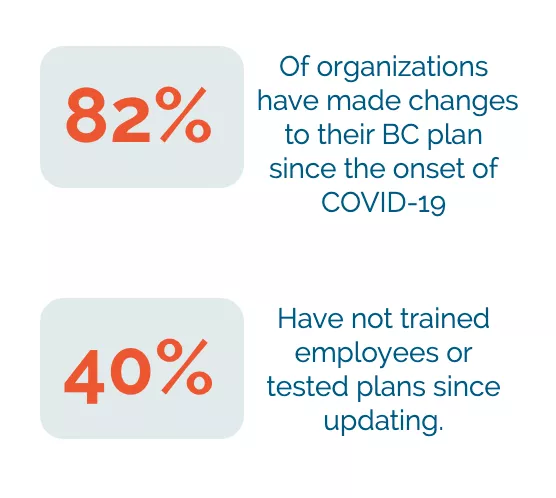
However, if you’ve never tested your plan, it’s hard to be confident that it will meet your expectations. Regularly testing your business continuity plan (BCP) helps to continually improve your company’s ability to withstand and recover from various disruption scenarios successfully. Let’s look into some other arguments for why testing is integral to your organization’s success.
The ROI of Business Continuity Testing
A well-orchestrated test strategy helps protect the brand, its promise, and its value proposition. Suppose your competitors had a poor test performance or made a critical mistake in a real-life situation with a client. In that case, your company can shine by demonstrating its reliability and advance its business forward. So, why test your BCP?
- Identify interdependencies, gaps, and areas for improvement.
- Demonstrate to your clients a higher degree of commitment.
- If you are the supplier to a firm, you rise among competitors, taking on more projects and winning new business.
- Continually validate and improve plans.
- Satisfy compliance requirements and regulators.
- Reduce recovery time and cost.
Reasons to Test Your BCP
1. Test the “New Normal”
-
Regional risk of working from anywhere
-
Isolated issues for staff
-
Solving for one building vs. many locations
2. Validate Recovery Plan/Gap Analysis
-
Confirm RTOs
-
Train your staff – instill confidence of employees + stakeholders in the plan
-
Update procedures
3. Compliance/Regulatory/Legal
-
Plan review
-
Tabletop exercises
-
Drills
Ways Our Customers Are Testing
-
Verify the connection and performance of hosted data/backups from a different location
-
Rebuild critical applications on Agility equipment
-
Establish a working partnership with Agility
-
Evaluate disaster readiness of lines of business
Types of Business Continuity Tests
Every business continuity test in a company has very targeted and specific ways and types of tests used to ascertain information in different areas within the company. The list below gives you some but not all the information about BCP test types and reasons.
- Plan Review: Includes a BCP team with C-level management or department heads to see if their current BCP plan needs revisions. The plan review goes over recovery contract validity, business continuity management, and any disaster recovery scenarios that can be shared with other company teams.
- Tabletop Test: Includes role-playing discussion exercises that are scenario based. You usually have employees participate so they can practice their roles and responsibilities in case of any disruptive emergency, from an active shooter to a hurricane tornado.
There’s also the BCP walk-through, which mimics the tabletop test discussions with planned details but takes those details and turns them into a simulation test that combines real recovery actions. The real scenario ranges from data loss backups and restoring to emergency notifications and physical recoveries.
However, consider deviating from the test script to interject unplanned events, such as the absence of key individuals or services.
Plan Review
-
It’s best practice to walk through your plans quarterly – does not have to be elaborate (an hour or less in a group session).
-
Helps to identify gaps and areas for improvement.
-
Ensures everything is up-to-date with the latest information (employee contact info, regulations, etc.).
Tabletop Exercise
-
Facilitated discussion – 1½ – 2 hours.
-
Participants are seated around a table – all activity is “virtual”.
-
An incident “scenario” is presented to the team along with a series of “How Would You Respond” questions as the scenario unfolds.
-
Use the time to identify gaps and develop confidence.
Drill/Simulation
-
Test individual components (wire transfers, notification system, etc.).
Full Test
-
Moving people and technology to an alternate location.
-
Partner with a company like Agility to go through a full-scale test.

After a Business Continuity Test
-
Ensure you have actionable deliverables and commitments for those responsible for executing.
-
Clearly define timetables and who is responsible for ensuring findings are resolved.
-
Regulators will want to review written documentation and will be checking to make sure issues were addressed.
-
Consider planning and testing as a continuous improvement process.
Protecting Your Organization
Organizations face continuous threats that can put lives in danger and disrupt operations. However, implementing an incident management program that fits your organization is challenging. To help mitigate these threats, Agility offers an integrated business continuity solution that helps businesses plan, test, train, alert, and recover—all in one. It enables organizations to eliminate business impacts and ensure their workforce is safe and informed.

A business continuity program is no longer considered superfluous. Last year, businesses worldwide learned the importance of integrated business continuity testing and planning, especially when it comes to vendor management. In fact, 74 percent of surveyed organizations have faced a disruptive event with third parties in the past three years. A business continuity plan is a company’s roadmap that helps navigate the unknown and unexpected, including natural disasters, communication issues, physical disruption, or other large-scale emergencies. However, having a plan in place is only half the battle. A business continuity strategy also needs to be continuously monitored and tested for gaps or obstacles.
Why Integrated Business Continuity Testing is Critical
Integrated testing moves beyond the testing of individual and isolated components. It includes testing with internal and external parties and supporting systems, processes, and resources.
1. Ensure your plans work
Testing business continuity allows you and your workforce to exercise how to approach an emergency and find gaps in the plan to address where it needs improvement.
2. Expose potential gaps before an incident occurs
Testing your business continuity plan allows you and your team to exercise how to approach an incident and find gaps in the plan to address where it needs improvement. This is a unique opportunity to practice your recovery strategy and update your incident management team on your business’s latest changes.
3. Meet rising client expectations
Customer expectations are getting higher, and your business must keep up with the rising demand for impeccable customer service.
4. Continually validate and improve your plan
Your organization is continuously evolving. So should your business continuity plan. And what’s a better way to improve your plan than through testing it?
5. Reduce recovery time objective and cost
With RTOs, costs increase the faster you want to recover your business after a disaster. For instance, recovering your business in 72 hours will be exponentially less expensive than recovering your business within 24 hours.
6. Preserve reputation
Business continuity management is more than just compliance. It is the foundation of a company’s reputation and stability.
7. Satisfy regulators
Regulatory scrutiny is projected to tighten even more in the coming years. Keeping your business compliant with industry regulations is key to its longevity. Besides, disobeying compliance standards will most likely lead to costly fines.
5 Testing Tips to Increase the Effectiveness of Testing
In striving to increase the effectiveness of test scenarios over time, an institution should, as appropriate, consider the following:
- Perform integrated tests or exercises that incorporate more than one system or application and external dependencies to gauge the effectiveness of continuity plans for a business line or major function.
- Test interdependencies where two or more departments, business lines, processes, functions, and/or third parties support one another.
- Conduct end-to-end exercises to demonstrate your organization’s ability to recover a business process from initiation (e.g., customer contact) through process finalization (e.g., transaction closure).
- Conduct full-scale exercises that involve the recovery of systems and applications in an interactive manner in a recovery environment, including all critical functions and modules.
- Perform exercises that include third-party providers’ subcontractors, vendors, or services.
Core Elements of a Business Continuity Testing Strategy
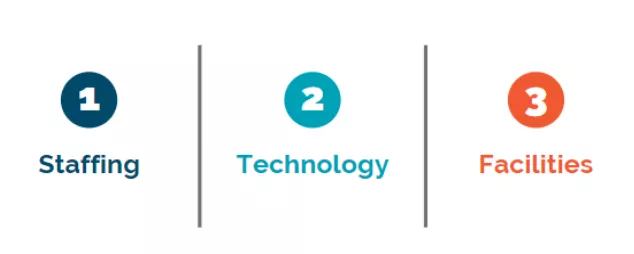
The test strategy should encompass at least three elements: staffing, technology (data, systems, applications, and telecommunications), and the facilities that house the staff and technology environments.
1. Testing elements: Staffing
- Testing strategies should include demonstrations of the staff’s ability to support business processes, including the processing of transactions, communication with key internal and external stakeholders, and any other industry-specific processes.
- Strategies may need to address staff’s ability to support increased workloads resulting from the transfer of processing to alternate sites for extended periods of time. For institutions that have implemented split processing business models, any aspects of the client relationship model that present challenges or complexities to the transfer of workloads across sites, and related dependencies, should be identified and incorporated into testing strategies.
- Testing strategies should demonstrate the effectiveness of a company’s management succession plans.
2. Testing elements: Technology
- Testing technology strategies should include the data, systems, applications, networks, and telecommunications necessary for supporting business activities.
- In the event system recovery depends on retrieving data files, programs, and other items maintained at the backup facility, off-site testing procedures should only include the use of these backup items to properly replicate the loss of any master data files and programs maintained at the main facility.
- Backup data files should also be tested frequently to assess the integrity of the information, determine if the data is being saved in the correct format, and ensure that applicable files can be retrieved promptly. Alternatively, institutions may employ other processes for data replication, such as synchronous and asynchronous data replication. Regardless of the data replication process used, the process for demonstrating data consistency across different processing environments should be included in the testing strategy.
- Strategies should also test processes to recreate any data lost during a switch to alternate processing facilities, and periodic reviews of telecommunications services should be conducted to determine circuit diversity.
3. Testing elements: Facilities
- Testing strategies for business functions should encompass environmental controls, workspace recovery, and physical security to ensure continuity of facilities and environmental systems at primary and alternate processing sites.
- Testing strategies should include the adequacy of backup power generators and heating, ventilation, and air conditioning systems to meet business recovery objectives at operating centers.
- Workspace recovery test strategies should include assessments of the availability and adequacy of workspace, desktop computers, network connectivity, email access, telephone service, and physical security controls. For institutions relying on the physical relocation of hardware, software, or data storage devices to recover the technology infrastructure and applications at alternate locations, the facilities testing strategy should address the secure transportation of these items.
Additional Plans for Business Continuity Testing
Test scenarios, plans, and objectives should include the institution’s crisis management function to demonstrate your ability to respond effectively to contingency events. The crisis management program should be tested, with particular emphasis on the institution’s capability to gather information about the threat or event, initiate the BCP, and communicate relevant information to the appropriate staff, customers, vendors, service providers, regulators, and other public authorities. Crisis management test plans should address crisis management team members’ abilities and their alternates to carry out their designated responsibilities under various event scenarios. Depending on the type of industry, your organization may need to consider testing the following plans:
- Crisis or incident management plans (know how you’ll manage everything)
- Department continuity plans (maintain priority processes)
- Pandemic plan (tracking, planning, execution)
- Life Safety plans (ensure everyone knows what to do)
- Crisis Communications plans (internal and external)
- Service provider plans (validate partners and supply chain resilience)
- Background and risk
- Vendor Due diligence
Reliance on third-party providers, key suppliers, or business partners may expose your organization to points of failure that may prevent the prompt resumption of operations. The risks in outsourcing information include threats to the security, availability, integrity of systems and resources, confidentiality of information, and regulatory compliance. To ensure timely recovery of operations, management should routinely perform vendor due diligence. As part of this due diligence process, management should inquire about the service provider’s physical paths to ensure that system redundancies have been properly implemented. Organizations should also review the service provider’s BCP and ensure that critical services can be restored within acceptable timeframes based on the business’s needs. The service provider’s contract should address the service provider’s responsibility for maintenance and testing of disaster recovery and contingency plans. Management should request a copy of the service provider’s BCP test results and audit reports to determine the adequacy of business continuity plans and the testing program’s effectiveness. If possible, the institution should consider participating in the service provider’s testing process. If the service provider fails to perform satisfactorily during a service disruption, management should determine whether the institution has sufficient resources and capacity to perform these processes internally or if alternate vendor arrangements should be considered.
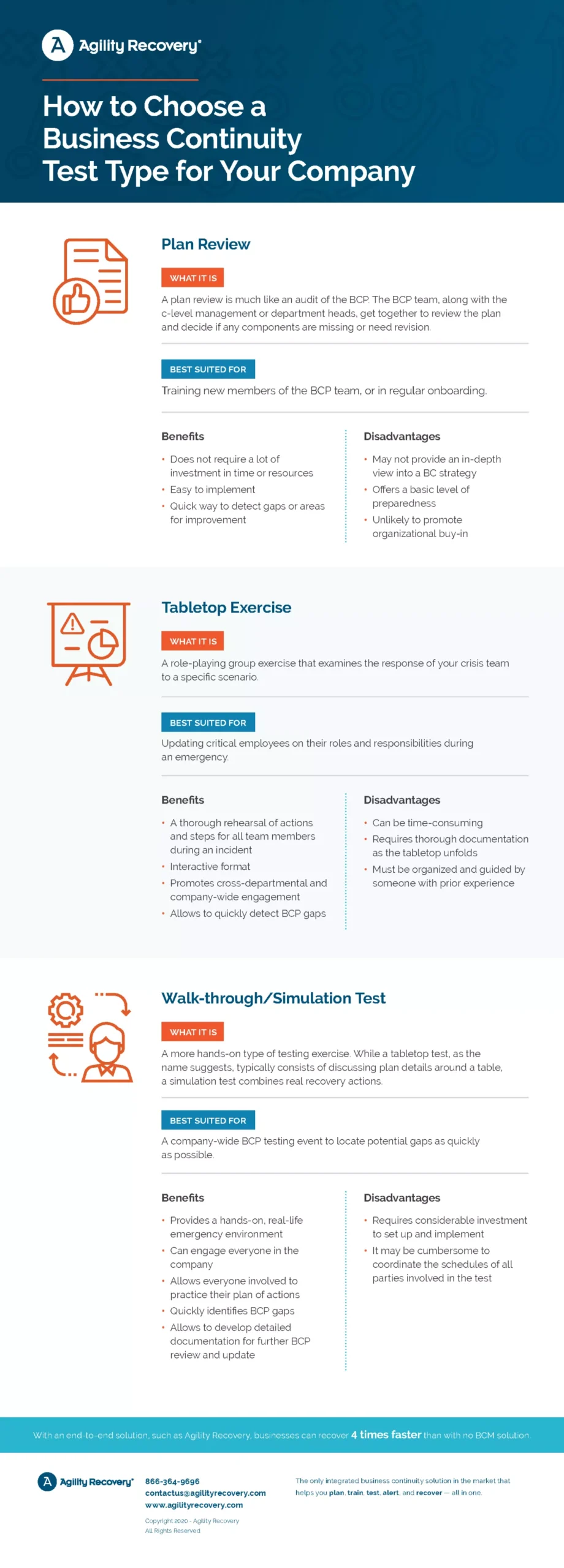
Testing business continuity allows you and your workforce to exercise how to approach an emergency and find gaps in the plan to address where it needs improvement. Every company has very targeted and specific ways and types of tests used to ascertain information in different areas within the department. Our infographic presents some of the most popular and productive ways to test a business continuity plan.
Plan Review
What is a business continuity plan review?
A plan review is much like an audit of the Business Continuity Plan. The BCP team, along with the C-level management or department heads, get together to review the plan and decide if any components are missing or need revision.
What is it best suited for?
Training new members of the BCP team, or in regular onboarding.
Benefits of a plan review
- Does not require a lot of investment in time or resources
- Easy to implement
- A quick way to detect gaps or areas for improvement
Disadvantages of a plan review
- May not provide an in-depth view into a BC strategy
- Offers a basic level of preparedness
- Unlikely to promote organizational buy-in
Tabletop Exercise
What is a tabletop exercise?
A tabletop exercise is a role-playing group exercise that examines the response of your crisis team to a specific scenario.
What is it best suited for?
Updating critical employees on their roles and responsibilities during an emergency.
Benefits of a tabletop test exercise
- A thorough rehearsal of actions and steps for all team members during an incident
- Interactive format
- Promotes cross-departmental and company-wide engagement
- Allows to quickly detect BCP gaps
Disadvantages of a tabletop test exercise
- Can be time-consuming
- Requires thorough documentation as the tabletop unfolds
- Must be organized and guided by someone with prior experience
Walk-through/Simulation Test
What is a walk-through test?
A walk-through or simulation test is a more hands-on type of testing exercise. While a tabletop test, as the name suggests, typically consists of discussing plan details around a table, a simulation test combines real recovery actions.
What is it best suited for?
A company-wide BCP testing event to locate potential gaps as quickly as possible.
Benefits of a walk-through test
- Provides a hands-on, real-life emergency environment
- Can engage everyone in the company
- Allows everyone involved to practice their plan of actions
- Quickly identifies BCP gaps
- Allows to develop detailed documentation for further BCP review and update
Disadvantages of a walk-through test
- Requires considerable investment to set up and implement
- It may be cumbersome to coordinate the schedules of all parties involved in the test
Creating a business continuity plan (BCP) isn’t an ultimate protection against business interruption. A solid BC strategy needs more than just a well-laid out theory. So, how will your plan hold up in a real-world disaster? Can your backup systems withstand a cyberattack? How efficient is your RTO for restoring data? Are your employees familiar with emergency procedures? Do you have an emergency communication strategy to let everyone know about an incident immediately? Testing business continuity plan is the most reliable way to find out, and it is a critical component of continuity planning. By skipping regular testing, you won’t know if your organization is prepared for a disaster—until it’s too late.
Testing in Numbers
According to 2019 BC Benchmark Study, 57% of companies stated that semi-annual or quarterly (consistent) testing helps to gain buy-in throughout the organization, making it more likely to be prepared for an interruption. Testing your business continuity program allows you to validate your BC plan and manage risks. In fact, 88% of our online poll respondents test BCP’s at their companies to identify gaps, and 63% of them do that to validate their plans. However, testing isn’t about pass or fail. It’s about continuous improvement.
How Often Should a Company Test?
Our online survey revealed that 40% of respondents had a BC test in the past year, 35% —in the past 6 months, while 20% of people admitted it’s been well over a year. If you already have a BCP, then it must be filled with a myriad of procedures for various events. But do you need to test everything? Some scenarios, such as an active shooter, are more critical and need to be tested frequently. Tim Mathews, a business continuity practitioner, D. Sc., MBA, MBCI, suggests an approach of “working from the headlines.” When various emergency events take place across the country, it’s a potentially good exercise to include those scenarios in your test plan.
Reasons to Test a BCP
A well-orchestrated test strategy helps protect the brand, its promise, and its value proposition. If your competitors had a poor test performance or made a critical mistake in a real-life situation with a client, your company can shine by demonstrating its reliability and advance its business forward. So, why test your BCP?
- Identify interdependencies, gaps, and areas for improvement.
- Demonstrate to your clients a higher degree of commitment.
- If you are the supplier to a firm, you rise among competitors, taking on more projects, and winning new business.
- Continually validate and improve plans.
- Satisfy compliance requirements and regulators.
- Reduce recovery time and cost.
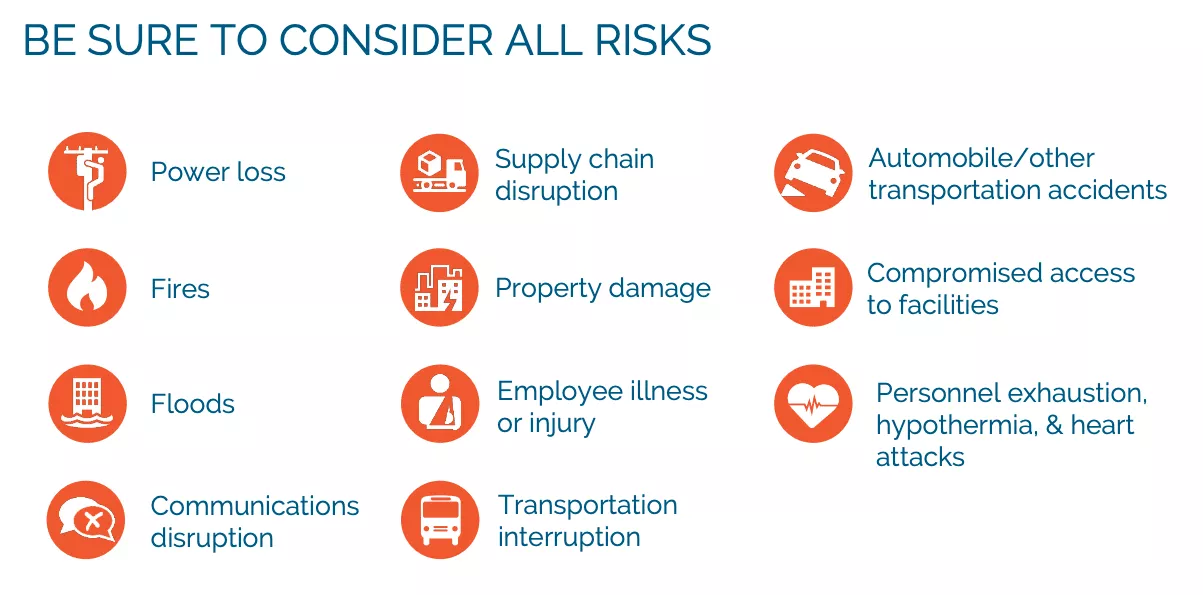
Getting Leadership Involved
The BC Benchmark Study showed that 61% of companies are challenged with a lack of organizational engagement. However, direct involvement of senior executives is what makes your BCP mature. When determining your business’s RTO, take this question to your leadership for input. Every member of a c-level team deals with their own array of challenges. So, to make a case, consider how to package the importance of business continuity based on every leader’s role. Include your management in different forms of test you plan to run. Whether it’s inviting them to a Mobile Recovery Center you set up on your company’s parking lot or sending them a test emergency notification message as part of the training. And always follow up with recognition. It will help them to feel part of the process and will be rewarding.
After a Test
Finally, it’s necessary to document the results of any testing conducted, along with any actionable findings from those tests. Doing so will help your workforce to learn what can and should be improved, and to visualize how much progress has been made. Following up on these items and consolidating recommendations from tests is the most crucial process in the BCP testing lifecycle. Testing, registering the results of your testing, and executing methods to improve your BCP is the most reliable way to strengthen your organization’s response processes.
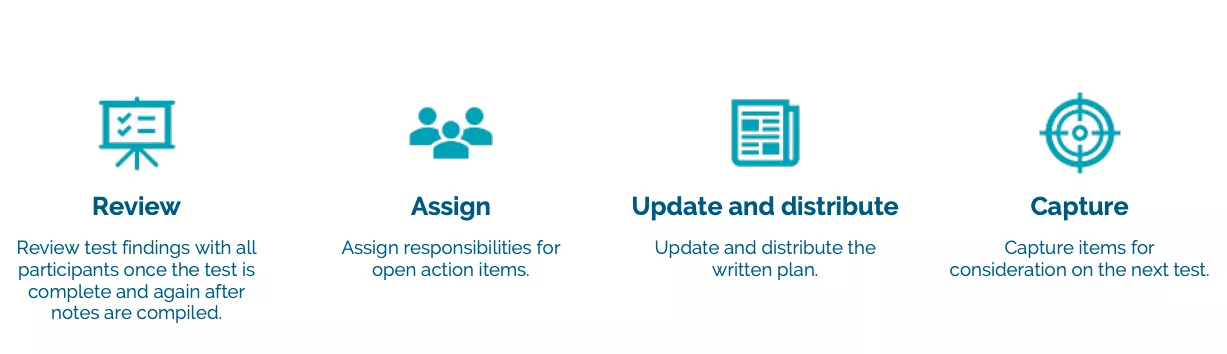
Applying your findings:
- Review test findings with all participants.
- Conduct a BIA.
- Assign responsibilities for open action items.
- Update and distribute the written plan.
- Capture items for consideration on the next test.
In Conclusion
Organizations face continuous threats that can put lives in danger and disrupt operations. However, implementing an incident management program that fits your organization is challenging. To help mitigate these threats, Agility offers an integrated business continuity solution.