
The Atlantic hurricane season started quietly but roared in with Hurricane Ian at the end of September.
The Category 4 storm tore through Florida, South Carolina, and North Carolina, affecting nearly 400 Agility customers. Hurricane Ian was the deadliest hurricane to strike the state of Florida since the 1935 Labor Day Hurricane, taking the lives of more than 100 people, leaving 2.5 million homes and businesses without power, and causing more than $50 billion in damage. About one week in advance of landfall, the Agility Recovery Services team begin proactively providing outreach to both customers and vendors in Florida. Ultimately, about 75% of the recoveries we provided were related to power; Agility also deployed two mobile workspace recovery centers (MRCs) on the heavily damaged Pine and Sanibel Islands.
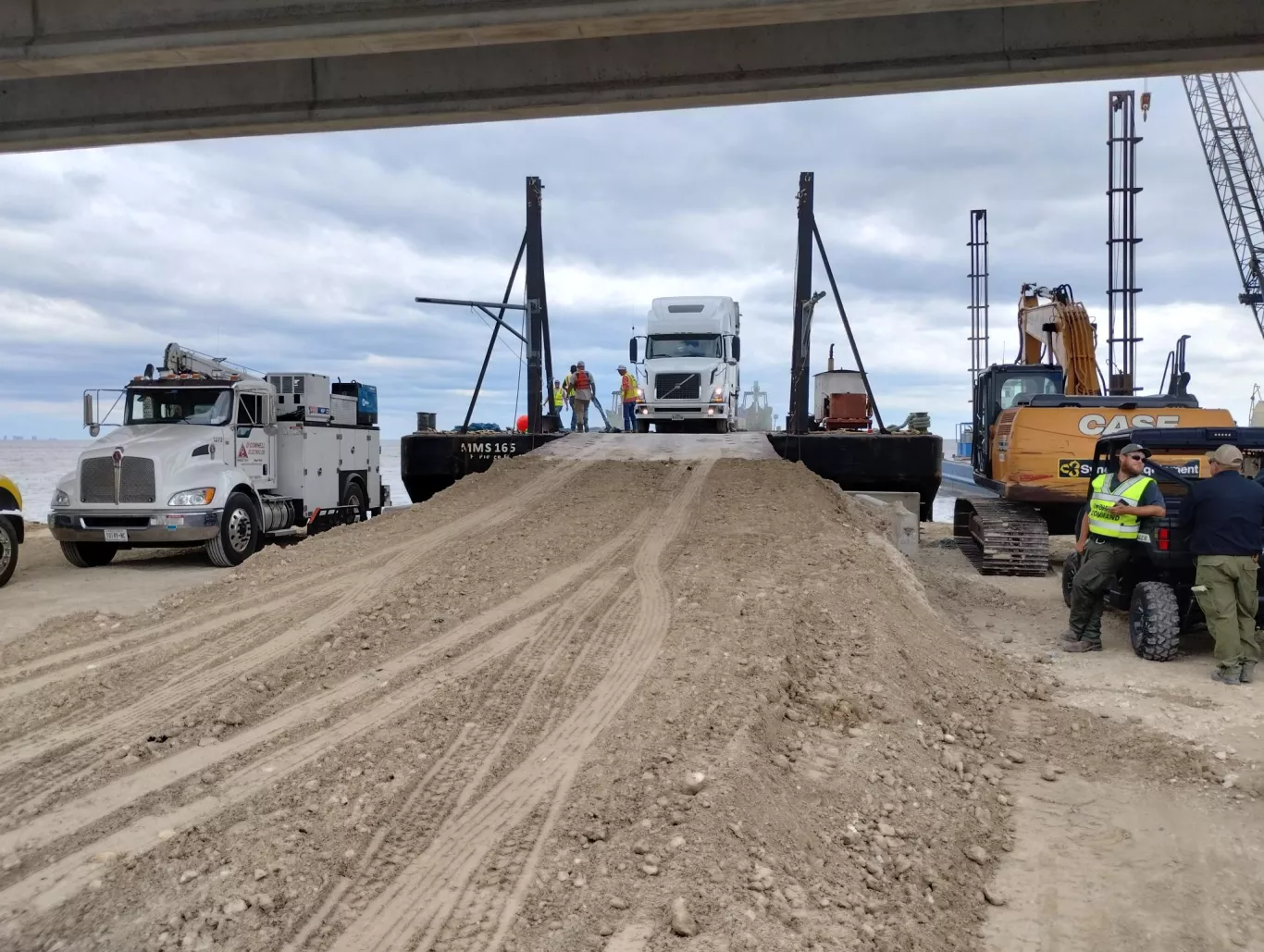
While mobile recoveries are common after hurricanes, these deployments had a unique twist. To get to Sanibel Island, Agility had to coordinate with Lee County to load the MRC onto a barge to access the recovery site, as the Sanibel Causeway between the mainland and the island sustained too much damage to be drivable. The barge was so large that it could hold 15,000 tons and required additional sand to be poured to make the ground and gangplank level for the MRC. This was the first time Agility had transported a recovery center via barge during a recovery. The customer was impressed and comforted by having the Agility team on site to coordinate and manage the setup.
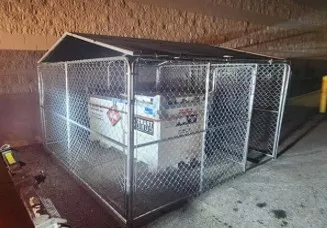
Over the course of the storm and recovery, Agility not only leveraged current solutions but also created a fresh resource for customers: ReadyTank+. This solution helped provide customers’ employees with safe access to gasoline to fuel their cars and continue operations. Deploying ReadyTank+ included setting up a security fence around the fuel pod and light towers to keep the area well lit and safe. ReadyTank+ is just one more example of how we strive to identify what our customers truly need and think outside the box to create solutions to solve those unique recovery challenges. I personally want to thank our recovery services operations teams. While the logistics, operations, technical services, and test and declare teams worked around the clock to recover our customers, they also continued to manage full caseloads of tests without skipping a beat. I’m extremely honored to call these individuals part of the Agility team. Thank you. Though this storm was a harsh reminder of the threat natural disasters pose to all of us, it was also an inspiring example of the power of resilience. We are proud to continue in our mission to help businesses and their communities recover from any interruption.
Regards,
Jon Bahl
CEO, Agility Recovery

Facing a natural disaster that could impact your bank or credit union is daunting. Here’s what you can expect when you work with Agility on a post-disaster recovery.
Monday, October 3
The National Weather Service has issued a statement that an approaching tropical storm has the potential to turn into a hurricane, with landfall on the Louisiana coastline predicted in three days. Several states, including your bank’s home of Louisiana, have been put under a hurricane watch. The storm is estimated to have 150 mph winds and may drop more than three feet of water upon landfall. Due to the likelihood that the hurricane will affect at least one of your bank branch locations, you call Agility and put your company on alert status. Agility talks through costs and benefits of viable solutions should you need to declare and puts equipment and personnel on standby.
Wednesday, October 5
The National Weather Service predicts landfall as a category 4 or 5 hurricane within 36 hours, and Louisiana has been placed under a hurricane warning. The area is facing mandatory evacuations.
Thursday, October 6
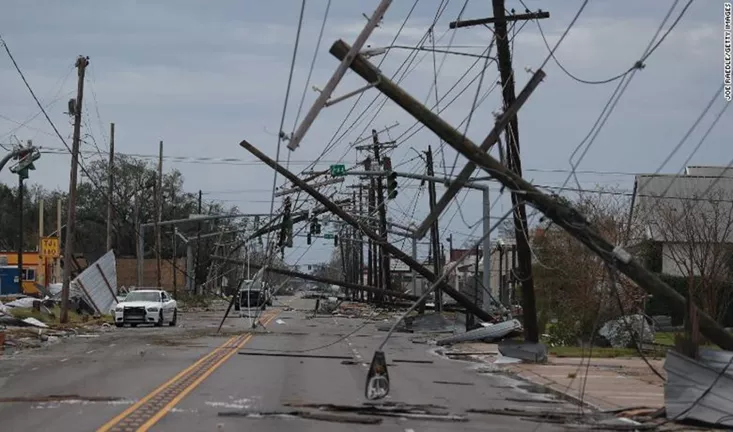
The storm slowly tracks inland towards your branches, dropping more than six feet of water in some areas. The region is affected by severe flooding and damage, including downed power lines, trees blocking roads, and substantial property damage. Local law enforcement has ordered a shelter-in-place and established a curfew until Friday afternoon. Agility is keeping a close eye on the damage to your area and is prepared to deploy equipment as necessary.
Friday, October 7
You are granted access to your facility to assess whether you and your employees can return. There is substantial damage, including to computers, servers, telecommunications hardware , and the overall structural safety of your building. You estimate that your facility will not be operational for at least 2-3 months, or potentially even longer due to supply chain issues . You call Agility and have a conversation with your test and declare manager (TDM) and other members of the operations team to determine your needs based on the equipment and facility’s current state. Once the team has vetted your set of needs, Agility provides your recovery quote and timeline for your backup solution. Agility then mobilizes resources to your site to begin your recovery.
Saturday, October 8-Sunday, October 9
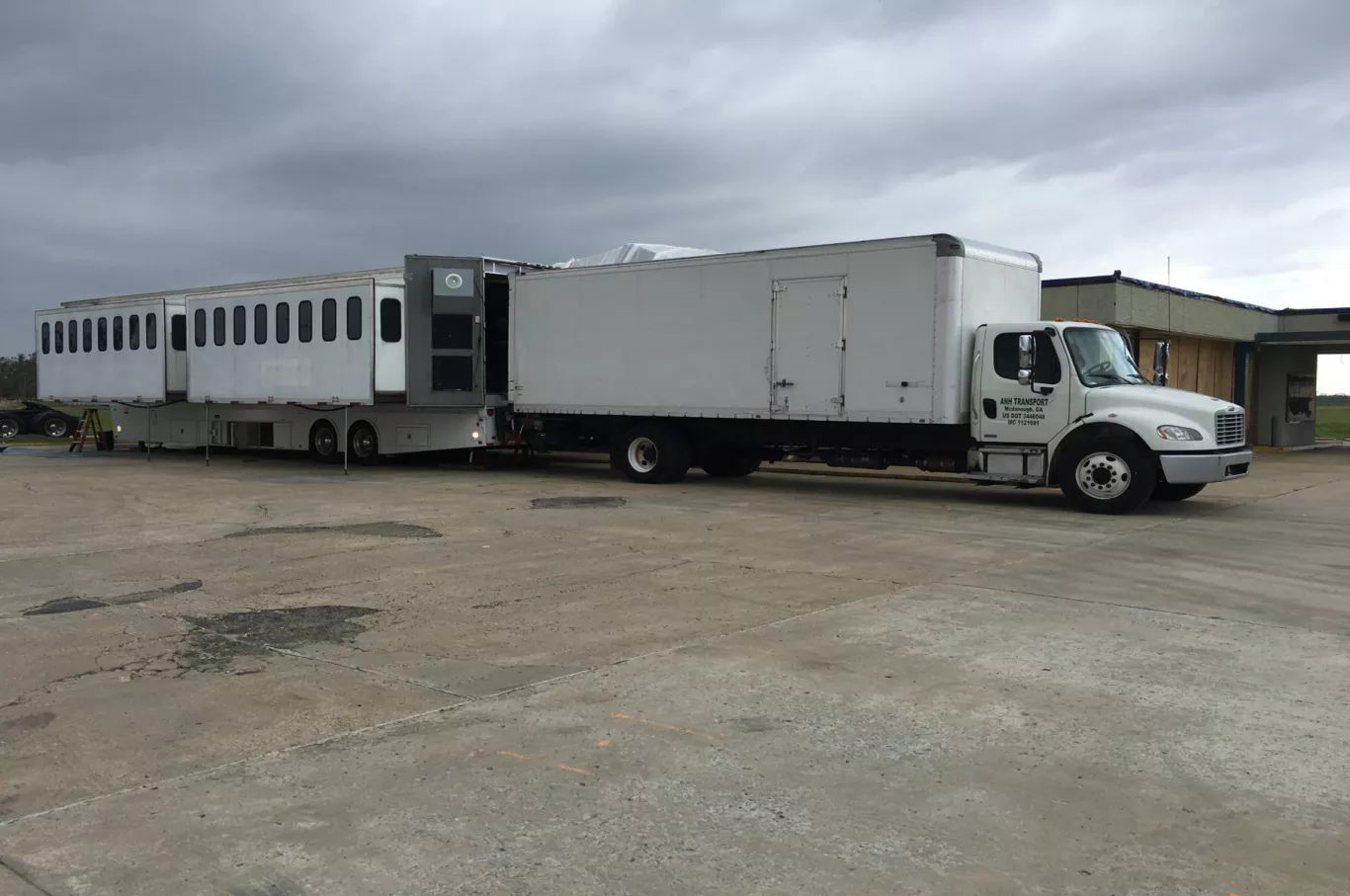
Agility works through the weekend to make sure you and your branch are secure, while you check on the safety of your employees and community and ensure all permitting is ready for your mobile bank unit. Within 48 hours, Agility has deployed a mobile branch unit to your location.
Tuesday, October 11
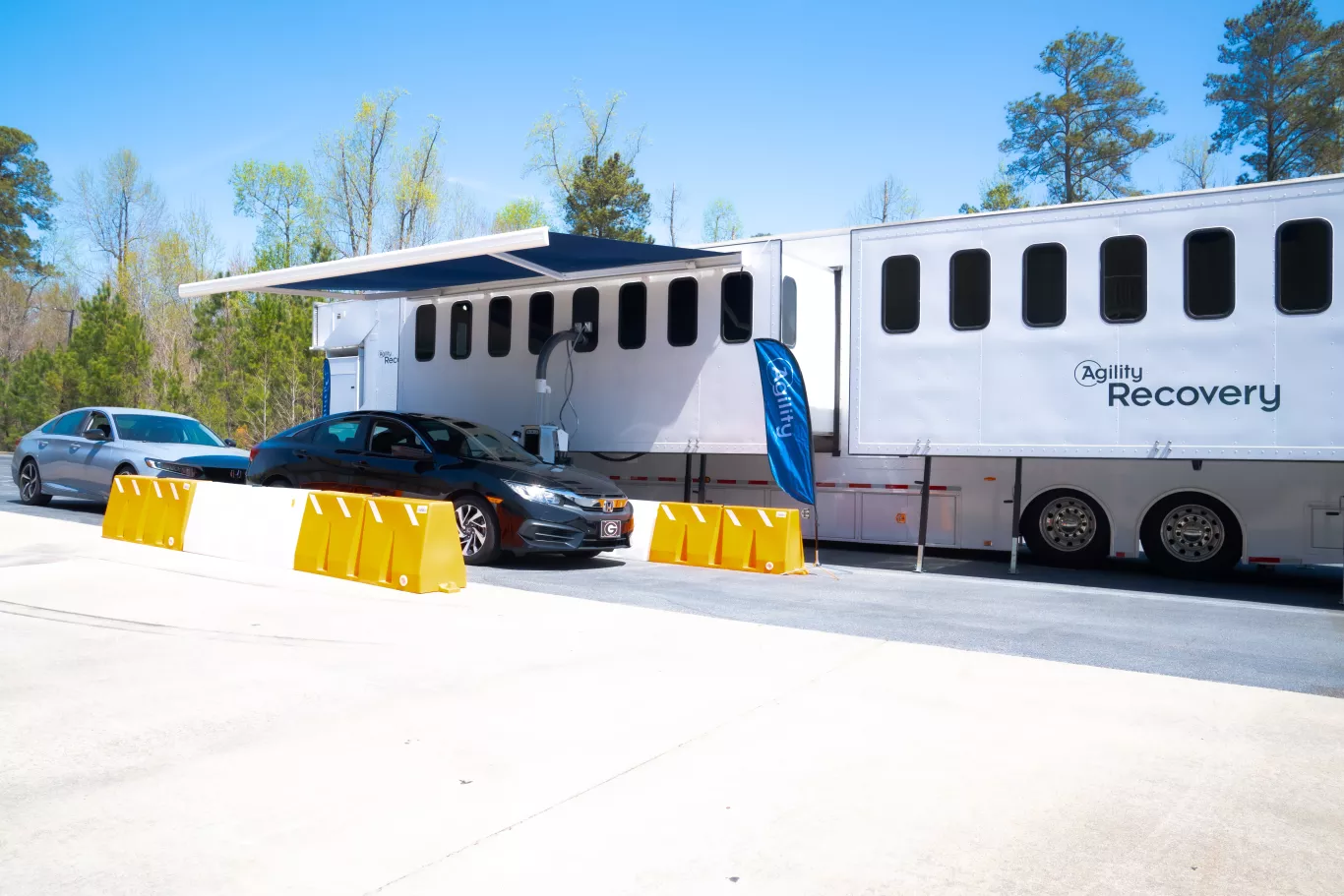
Agility arrives on site with your mobile branch unit, and spends the next 24 hours setting up your remote bank branch, complete with:
- Drive-up window
- Private office space
- Waiting area
- Conference area
- Employee workstations
- Teller stations
- Compliant safe
- Night drop box
- Cash drawers
- Restrooms
- ADA accessibility
- Check-writing stand
- Alarm system
- Satellite and LTE communications
- Computers and printers
Thursday, October 13

Your bank, within the MRC, is now operational. You can assist customers, provide cash advances, and be an overall hub for the community as it recovers from the storm.
Wednesday, February 22
Your brick-and-mortar branch can return to operations after renovations and equipment replacements. Agility returns to pack up the equipment and remove it from your property – no need for you to lift a finger.
Branch Resilience
Over the last 33+ years, Agility has partnered with banks and credit unions to understand your unique business continuity needs and provide tailored recovery services. Our goal is to meet your business challenges and deliver a quick, flexible, and cost-effective solution while keeping you audit ready. Reach out to us today for more information about our purpose-built solutions for the financial industry.
Did you know that the United States experiences the most power outages ? Compared to other developed nations, the U.S. experiences more extensive and severe power outages that can leave people without electricity for an average of four hours; many of these outages result from severe spring weather. Power outages aren't the only impact spring can have on the weather. High risks for flooding and storm damage can harm your business, consumers, and employees. How can you prepare for severe weather this spring? We have put together a complete guide on how you can start prepping now for upcoming weather, so keep reading for more information!
How Severe Weather Affects Businesses
Business continuity starts with expecting the unexpected. Weather can drastically impede how your business functions and, in return, how it performs. Here are a few ways that severe weather hurts your business :
- – Customer habits
- – Prices
- – Employee performance
- – Property
Customers change their habits based on the weather, and you should closely analyze how your business does quarterly for a better idea of how weather plays a role. You might notice an increase in consumer traffic or purchases during certain months, which can affect your staffing and business operations. Price fluctuations and weather can go hand-in-hand. For example, poor weather or winter months can increase oil demand and prices, and agricultural businesses rely heavily on weather patterns that affect crop yield. Employee performance can also tie into the weather since bad weather could affect an employee's ability to get to work or finish a project promptly. Luckily, remote work has helped lessen the effects of poor work performance if your business can adopt flexibility. Lastly, storm damage can directly result in business property damage. Your business's property includes both IT and physical property. Storms can cause power outages and lost data, which is critical for companies requiring 24/7 online support. When your house loses power, you can sit back, light some candles, and enjoy each other's company. With your business, even hours of being down can result in significant losses in revenue.
Spring Predictions
On March 20th, the shift into spring officially begins. What can you expect for spring weather this year? For many, spring weather isn't necessarily something to look forward to when trying to keep a business flourishing. In Southern and Western states and parts of the Midwest, we can expect higher than average rainfall, increasing the chances of flooding . Warmer-than-average weather can draw more people outside and increase online or in-person traffic to your business. Start preparing now for flood and storm damage by ensuring that you have a business continuity plan in place.
Physical Recovery
Physical recovery is relatively straightforward and can help your business recover from power outages, natural disasters, and more. Approximately 40% of businesses who experience power outages never reopen, so don't let that be you! If your business is physically compromised, you have a few options:
- – Backup tech equipment
- – Office space
- – Backup generators
- – Maintaining networks
Spring weather can act similar to the hurricane season with unrelenting winds, rain, and floods. Be sure your business is ready by checking in on these five key business points:
- – Employees and customers
- – Property
- – Processes
- – Products
- – Partners
Ensure your property is physically secure and that your files are safely backed up . Confirm continuity plans and emergency action with your partners and employees so that everyone is on the same page. Lastly, keep tabs on your products and manage customer expectations when preparing for storms this spring.
Remote Work
A business continuity plan can include remote work or options to work from other offices. Look for products like ReadyTechGo technology , which provides:
- – 40 hours of battery life
- – Cellular connectivity
- – WiFi set-up
- – 24/7 technical support
- – Portability (e.g., water-resistant, lightweight)
- – Flexible shipping
It's the ultimate emergency tool to have on hand that can keep your business up and running this spring, useful for critical workers or accessing necessary business documents.
Data Recovery Importance
What is the importance of quick data recovery ? Backing up your data in a cloud or through other means ensures your business is back online within hours versus days or weeks. Small- to medium-sized businesses can benefit from the added cost of data recovery services since minor hiccups can lead to permanent shutdowns or loss of revenue.
Keep Your Business Running This Spring
Is your business ready this spring? Spring weather can bring flooding and storm damage to your business. Not only can you physically not make it into work, but you could experience downed power lines and data crashes. Luckily, you have plenty of time to start developing emergency plans for your business that help you tackle any problem thrown your way. For business continuity testing and recovery solutions, contact us today and let Agility Recovery help you get started.
This year, we’ve seen what feels like countless unprecedented weather events: an ice storm in Texas, heat domes in the Pacific Northwest, wildfires across the country, and a few weeks ago, a major hurricane that decimated states from Louisiana to New York, with additional storms threatening the Gulf Coast yet again this week. In the 1980s, there were fewer than four billion-dollar weather-related disasters each year; in the last five years, the average increased to 16.2, increasing at a fourfold rate. In 2020 alone, there were 22 billion-dollar events, costing $95 billion – the fourth-highest costs on record. Hurricanes, heavy rainfall, and heat waves are likely to continue increasing in the years to come, spurring additional weather-related disasters like flooding, droughts, and wildfires. At Agility, our mission is to help businesses be prepared before, during, and after an incident, so that they can remain in operation and continue serving their communities. We’ve been doing this work for more than 30 years during disasters ranging from the 9/11 attacks to Hurricane Ida. Before any major weather-related event, we supply customers who may be affected with resources, information about the event, and details on how to enlist our support. We remain in close communication with our partners and vendors to ensure the availability of resources and accurate deployment times for our customers. The past few weeks, the Agility Recovery Services team has been helping our community cope with recent disasters and business interruptions. The team responded to organizations activating their coverage as a result of Tropical Storm Henri, and within days, turned around to aid in recovery from Hurricane Ida. We assisted with more than 60 customer locations in the region, restoring power to 50 locations, and are currently working closely with another 70 customer locations in case they need to bring in additional resources. While in the field for Ida recoveries, we were able to put to work our latest mobile productivity pack, ReadyTechGo , when several customers relied on it for their internet connection and power; for some, the ReadyTechGo pack was their only means of communication. Through the years and currently during an active storm season, our operations team supports our customers and communities with around-the-clock coverage. We set up satellite dishes and maintain satellite communications due to poor infrastructure stability; deliver fuel, generators, electrical connections, and locksmiths; even bring in blankets, food, and water; and deploy mobile offices and banking centers. The collective effort across all of Agility’s teams for an event of this magnitude has never been stronger. As we continue seeing these major weather-related disasters occur with increasing frequency in the recent and coming years, Agility will continue its mission of serving our customers and their communities through times of need. If you’ve been meaning to revisit your business continuity and disaster recovery program, now is a good time to make sure your business is well prepared. We are currently doing complimentary high-level plan reviews and scheduling tests into 2022. Feel free to email or call 866-364-9696 to schedule your review today. Jon Bahl, CEO, Agility Recovery

Disasters happen more often than we think. From environmental hazards to digital issues, these disasters are powerful enough to damage your business. That’s why 40-60% of small businesses don’t reopen following a disaster. The classic advice is to develop a business workplace recovery strategy. But is your strategy optimized for the modern-day? What is disaster recovery in modern business? Here’s why disaster recovery fails in the modern workplace and what you can do to modernize your business continuity plan.
Traditional Workplace Recovery Doesn’t Account for Employees’ Personal Lives
This is the era of work-life balance. To create a more competitive workplace, more employers are offering perks for a flexible workplace. Such a strategy includes remote work, flexible working hours, and generous PTO. An average business continuity plan doesn’t focus on your employees’ wants and needs. Even with a workplace recovery strategy, your company will have to put in the time to bring your business back to normal. Your staff will work long hours recovering files, working on projects that were already finished, and other tasks essential to continuing your organization. No employee wants their personal lines compromised because of a business disaster. There’s a good chance you can lose valuable staff members during this process. Disasters are costly to a business of any size. A company can be losing an average of $100,000 each hour its operations are down. And this amount doesn’t include any reputational damage done to the brand that can result in even more negative circumstances. If your staff is expecting a performance bonus, raise, or promotion, there’s no guarantee your business can afford it. But what if something happens to your physical location? In a regional disaster, your employees’ homes can be affected, creating more worries for your workforce about their families and friends. During a time like this, it makes no sense to force staff on a long journey to work. Employees are the essential component of any business entity, and its in the company’s best interest to find a solution that allows people to remain closer to home if disaster strikes , allowing them to prioritize their family while keeping their work projects on the radar. To help your organization find the optimal route, testing of recovery facilities can provide a lifeline. If the recovery site is too close to a disaster, it may become inaccessible. One also needs to consider the number of seats needed to accommodate the team in the recovery site. Lastly, the recovery site shouldn’t be too far away from the primary location. Otherwise, people may be unable to travel long distances.
Disaster Plans Don’t Cover Remote Workers
Half of the U.S. workforce is projected to switch to remote work. Remote work is popular for employees and businesses. Employees love the convenience of working from home. Remote work also reduces overhead expenses for businesses. Besides, working remotely is also seen as a physical business recovery solution. For example, if your office loses power or there’s a network outage, your staff can work remotely to prevent downtime. However, remote work poses many security risks . If your staff works from a vulnerable internet source, such as public WiFi, you’re increasing your risks of an attack. By comparing conventional business continuity plans with the ones that focus on resilience more, the widening gap between companies’ requirements and recovery options available on the market expands. While this gap may be filled by a work-from-home policy or co-working spaces, it can’t be the complete picture. Your critical personnel still needs to be placed in a convenient office with the necessary equipment. With a comprehensive solution focused on technology and people, businesses can safeguard their operations. Your modern business disaster plan should ensure your staff has access to a device (ideally a laptop, but a tablet and even a mobile phone can work) along with the nearest internet access point, whether it’s at their home or a co-working space. The importance of regular remote work safety training is often overlooked. It needs to include only using private WiFi and a VPN connection, not displaying sensitive and financial information in public, and having a strict remote work policy when remote work is used as a backup plan. Very few businesses test their remote work policies for security and efficiency. You can update your disaster recovery plan to ensure your remote work policy has no weaknesses, allowing for productivity and safety in all settings.
Modern Workplace Recovery is Reliant on Technology
It’s apparent we as a workforce are more reliant on technology. It offers more flexibility and many added risks, in both a remote and in-office setting. Our reliance on technology is also risky when your staff works in the office. 40% of employees use a device that’s not monitored by their employers. There’s no guarantee your employees have malware protection and anti-virus software to protect your files and prevent an attack. Your employees are also your biggest risk to your digital security. A staff member can easily download a malicious attachment, allowing hackers to gain access to your systems. Ransomware is one of the most common examples. The best way to counter these attacks is to save your data on a separate hard drive so you can still access your data on a separate device in the event of an attack. However, cybersecurity isn’t your only technological concern. What if a staff member loses their device or their device is stolen? If there’s no backup device or plan, this can result in significant downtime. Technology isn’t always there when we need it. Many factors can cause power outages, lost internet signal, and loss of information access. If your business loses power in the event of a storm, what’s your next working option? What if there are issues with your business WiFi, how can your staff work while staying secure? The digital platforms you use, specifically cloud platforms, can also be at risk. Let’s say the platform is suffering downtime or is updating. What’s your plan B in the event you can’t access crucial information and files? Your disaster recovery plan should include all downtime and disaster possibilities, ensuring a plan B is implemented if you can’t gain immediate access to your systems.
Create a Modern Disaster Recovery Plan
There are many modern working trends, such as remote work and added technological platforms. These make your workplace more efficient and productive. However, these modern work elements pose many risks from hazards and even hackers. To create a successful strategy for operational resilience, an organization needs to have access to a mix of approaches for different types of needs . Most importantly, such a strategy has to address the needs of people and not just IT and business functions. Forward-looking workplace recovery plans need to focus on the services their clients need most. How your customers perceive your brand is often defined by how an organization deals with a crisis, and businesses that take advantage of disasters to provide an exceptional level of service can emerge stronger. Even though a work-from-home strategy will still be an option for some employees, it is not sustainable long term. A much-needed answer can be found in turnkey workplace recovery solutions that are compatible with the requirements of employees, businesses, and their clients. A flexible recovery service allows companies to recover securely and when it’s needed, and an option to activate solutions at short notice in multiple locations is a priceless tool for business continuity.
Our monthly report on the number and types of business interruptions we have responded to and companies we have recovered, providing our unparalleled business continuity and disaster recovery solutions. DOWNLOAD REPORT
Synopsis
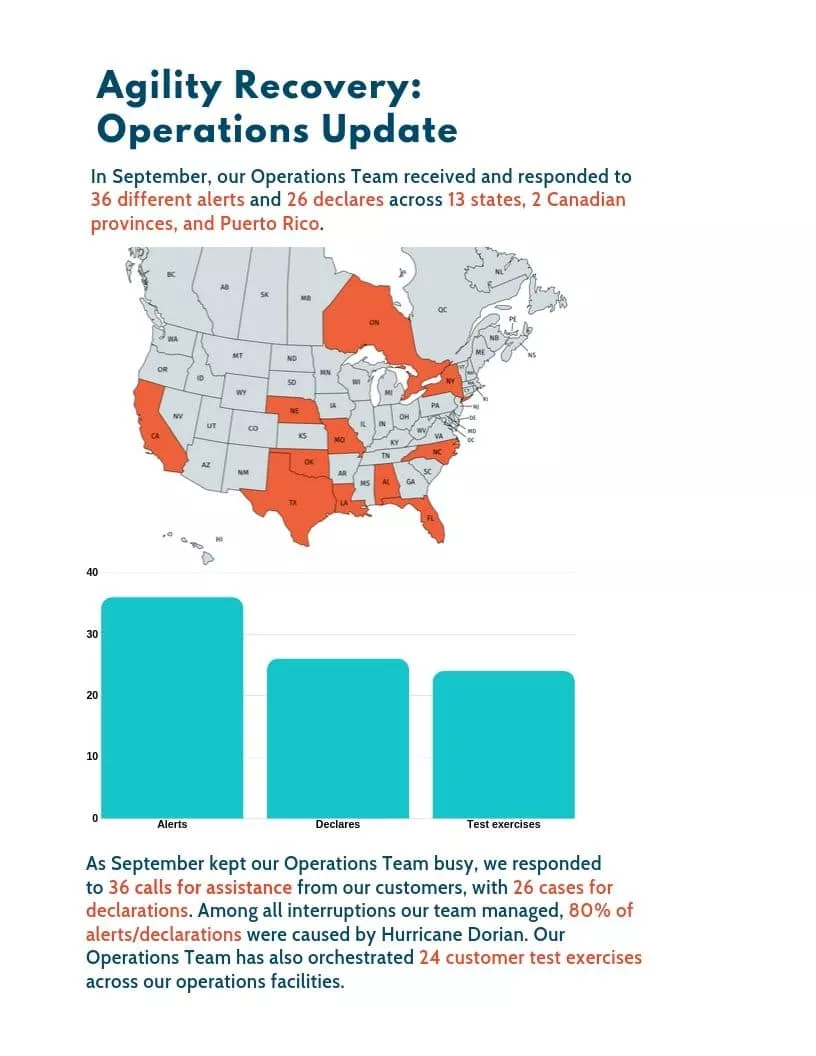
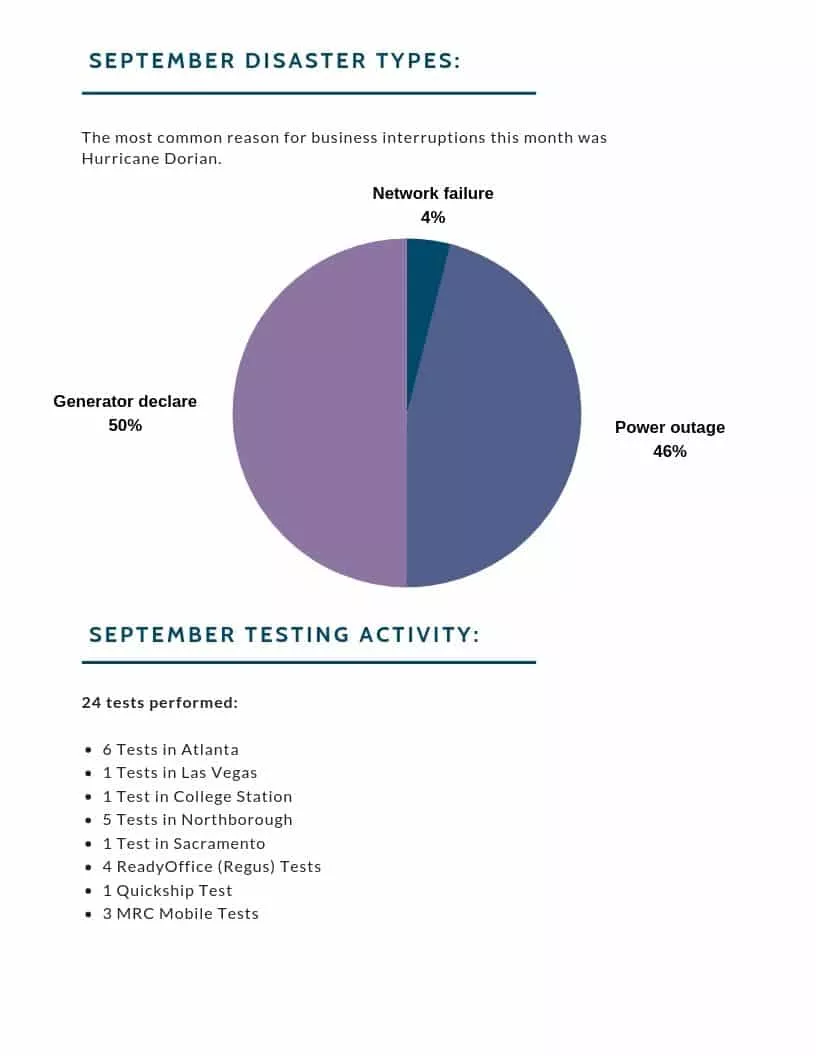
In September, our Operations Team received and responded to 36 different alerts . Matching the unexpected with our exceptional service delivery, our response team helped businesses across 13 states, 2 Canadian provinces, and Puerto Rico to avoid downtime and continue serving their communities. Among all interruptions our team managed, 80% of them were caused by a storm . In addition, the Operations Team also orchestrated 24 customer test exercises across our operations facilities. Here are some of the successful recoveries we’ve completed in September:
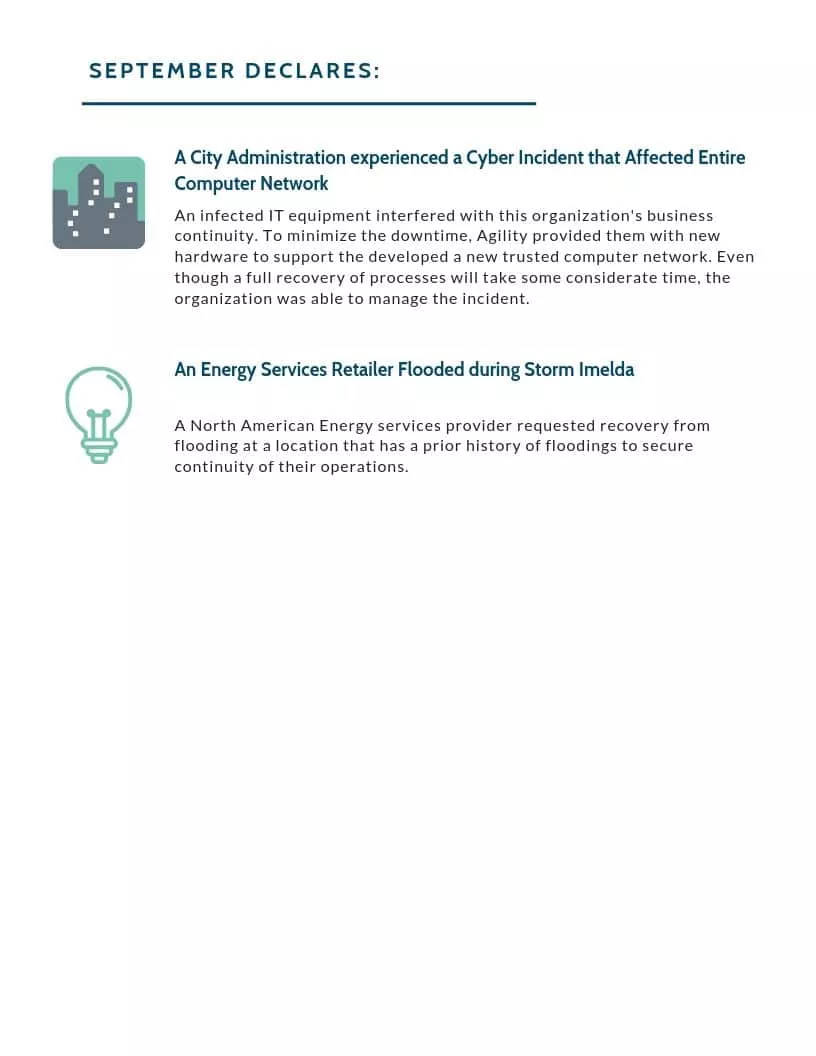
- City Administration Experienced a Cyber Incident that Affected Entire Computer Network Infected IT equipment interfered with this organization’s business continuity. To minimize the downtime, Agility provided new hardware to support their existing computer network. Even though a full process recovery will take some considerable time, the organization was able to successfully manage the incident with Agility’s support.
- An Energy Services Retailer Flooded during Storm Imelda A North American Energy services provider requested recovery from flooding at a location that has a prior history of floodings to secure continuity of their operations.
We invite you to learn more about what we do or connect with us to chat about how we can help your business avoid any interruptions.
Our monthly report on the number and types of business interruptions we have responded to and companies we have recovered, providing our unparalleled business continuity and disaster recovery solutions.
Synopsis
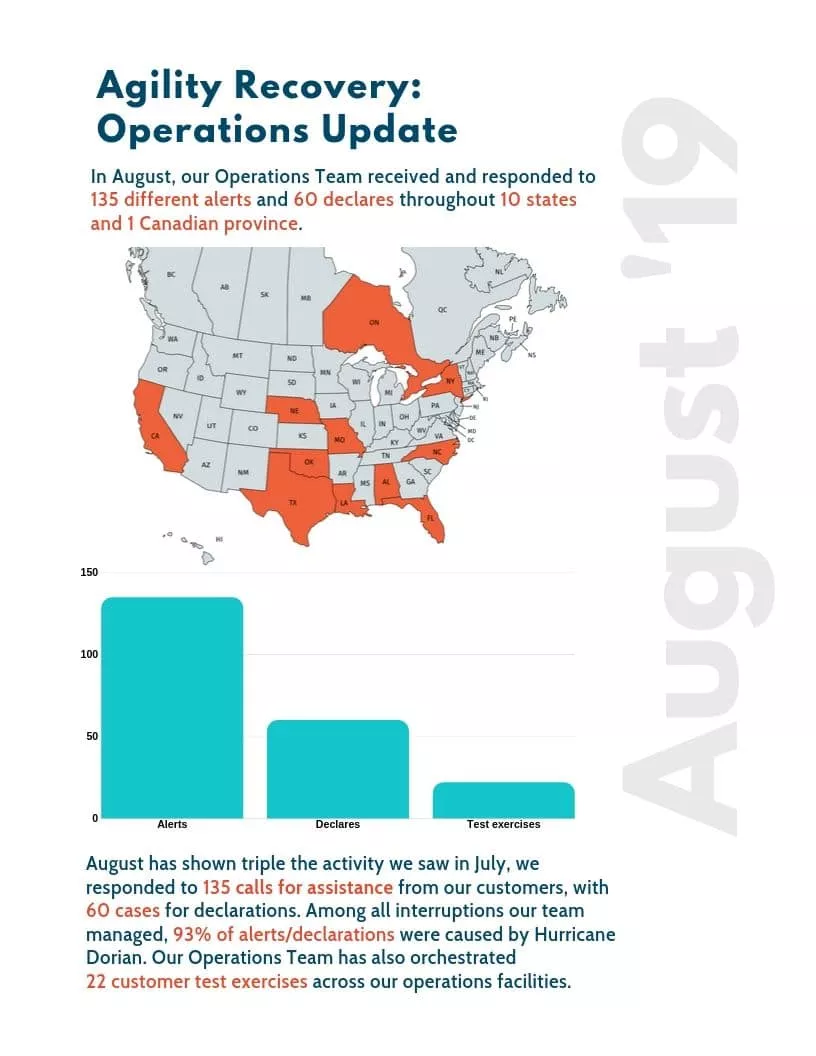
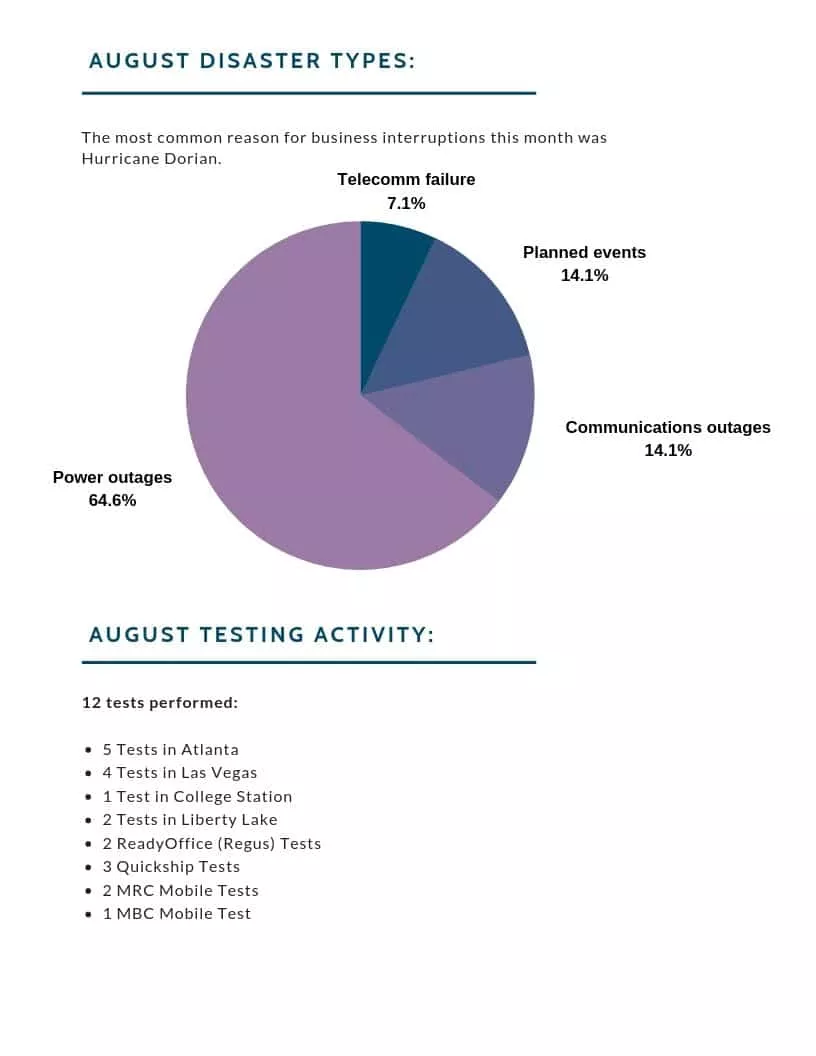
In August, our Operations Team received and responded to three times the number of different alerts compared to the previous month. Matching the unexpected with our exceptional service delivery, our response team helped businesses across 10 different states and 1 province to avoid downtime and continue serving their communities. We’ve responded to an astounding 135 calls for assistance from our customers, with 60 cases for declarations . Among all interruptions our team managed, 93% of them were caused by a storm . Additionally, the Operations Team orchestrated 22 customer test exercises across our operations facilities. Here are some of the successful recoveries we’ve completed in August:
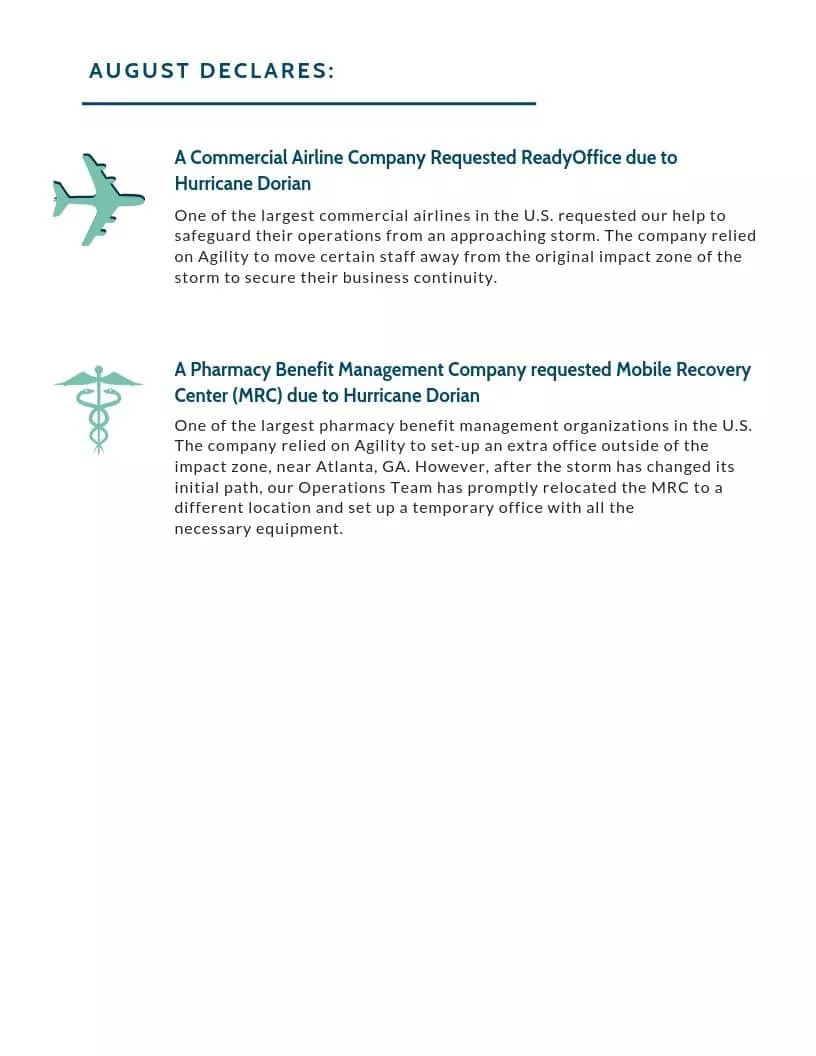
- A Commercial Airline Company Requested ReadyOffice due to Hurricane Dorian One of the largest commercial airlines in the U.S. requested our help to safeguard their operations from an approaching storm. The company relied on Agility to move certain staff away from the original impact zone of the storm to secure their business continuity.
- A Pharmacy Benefit Management Company requested Mobile Recovery Center (MRC) due to Hurricane Dorian One of the largest pharmacy benefit management organizations in the U.S. The company relied on Agility to set-up an extra office outside of the impact zone, near Atlanta, GA. However, after the storm has changed its initial path, our Operations Team has promptly relocated the MRC to a different location and set up a temporary office with all the necessary equipment.
We invite you to learn more about what we do or connect with us to chat about how we can help your business avoid any interruptions.
Active Shooter Statistics
To be able to properly respond to an active shooter situation, one must complete training and practice. Since FBI began releasing their report in 2000, the first seven years demonstrated an average of 6.4 active-shooter incidents, and that figure grew more than twofold to 16.4 the following seven years. The number lingered around 20 incidents every year since then, surging in the last two. Even though the previous year had a lower activity, last year’s results remained consistent with a troubling trend. According to the FBI, there have been 27 active shooter incidents in 2018 . 27 incidents in 16 states. 213 casualties – excluding the shooters. 85 killed: 2 law enforcement officers, 1 unarmed security officer 128 wounded, including 6 law enforcement officers.
Types of locations (2018):
- Sixteen of the 27 incidents took place in areas of commerce and business environment, resulting in 41 killed and 61 wounded.
- Five of the 27 incidents happened in education environments, resulting in 29 killed and 52 wounded.
- Two of the 27 incidents occurred in health care facilities.
- One of the 27 incidents occurred on government property.
- One of the 27 incidents occurred in a house of worship.
How to Respond
- Run – Have an escape route and plan on where to go. – Leave your belongings behind. – Prevent others from entering the area. – Call 911 when it is safe to do so.
- Hide – Shelter-in-place in an area out of the shooter’s view. – Block entry to your hiding place and secure the door. – Silence communications devices. – Remain quiet.
- Fight – As a last resort and only if your life is in danger, attempt to incapacitate the shooter. – Act with physical aggression and throw items at the active shooter. – Commit to your actions.
When Law Enforcement Arrives
- Officers will usually be in teams.
- May be in uniform or tactical gear.
- First responders won’t help victims until the threat is neutralized.
- Remain calm and follow directions.
- Keep hands visible and avoid sudden movements.
- Avoid pointing, screaming, and yelling.
- Expect to be detained.
Get Prepared
- Establish a partnership with local law enforcement and first responders.
- Implement an action plan that addresses active shooter scenarios.
- Designate at least one (two recommended) “safe rooms” on each floor and ensure everyone is aware of the locations.
- Conduct awareness training for personnel to ensure everyone recognizes and understands the warning signs of potential violence.
- Test and drill on your plans.
- And remember, if you see something, say something.
Even the best-laid plans can go terribly wrong with the simple introduction of the “human factor.” Implement this in the emergency response planning, where the stakes are high, and even the most thorough plan can begin to fall apart. The best ways to eliminate the human factor is to test your plans during tabletop exercises.
Our monthly report on the number and types of business interruptions we have responded to and companies we have recovered, providing our unparalleled business continuity and disaster recovery solutions.
Synopsis
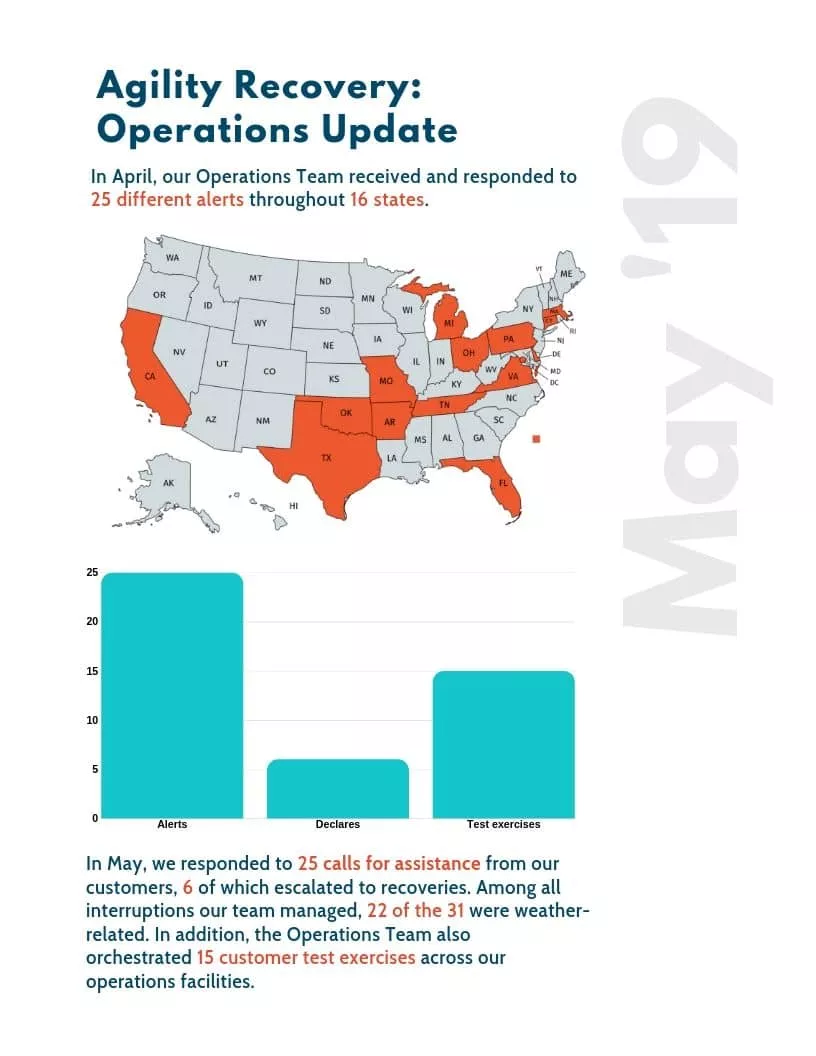
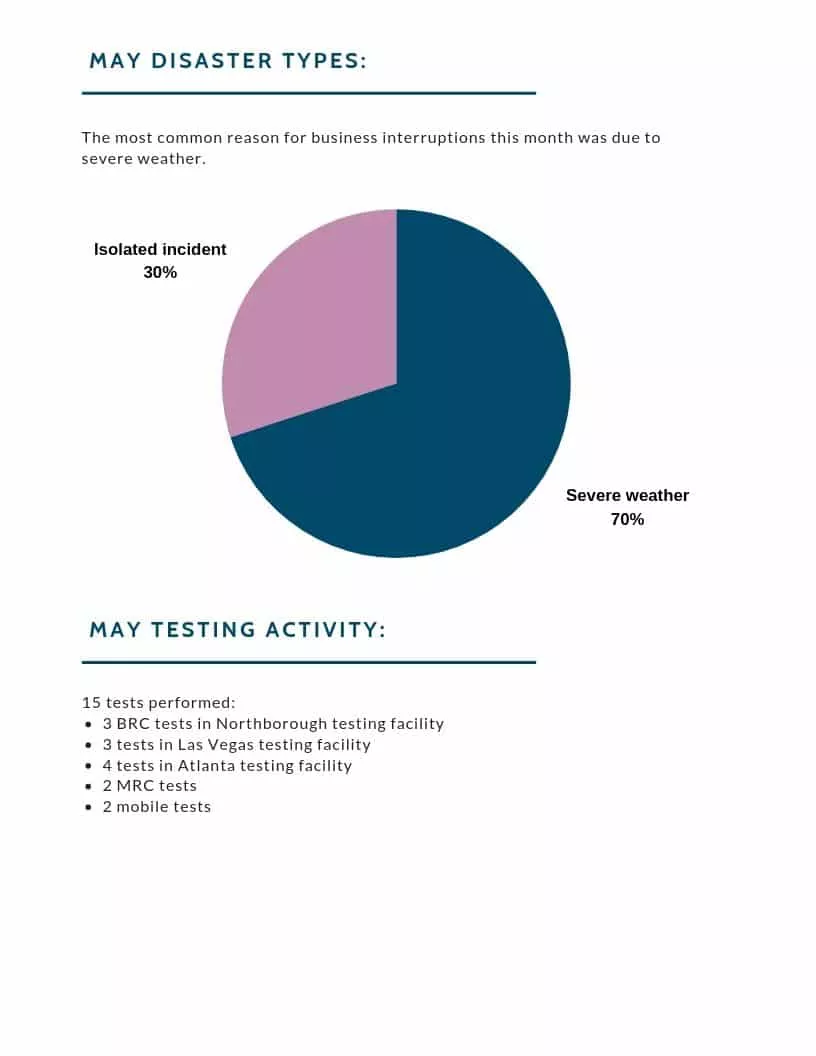
The majority of disruptions were caused by weather-related events, such as tornadoes. With a slight increase in recovery activity, we responded to 25 calls for assistance from our customers, six of which escalated to recoveries. Also, the Operations Team supported 16 customer test exercises across our operations facilities in Las Vegas, Atlanta, and Northborough.
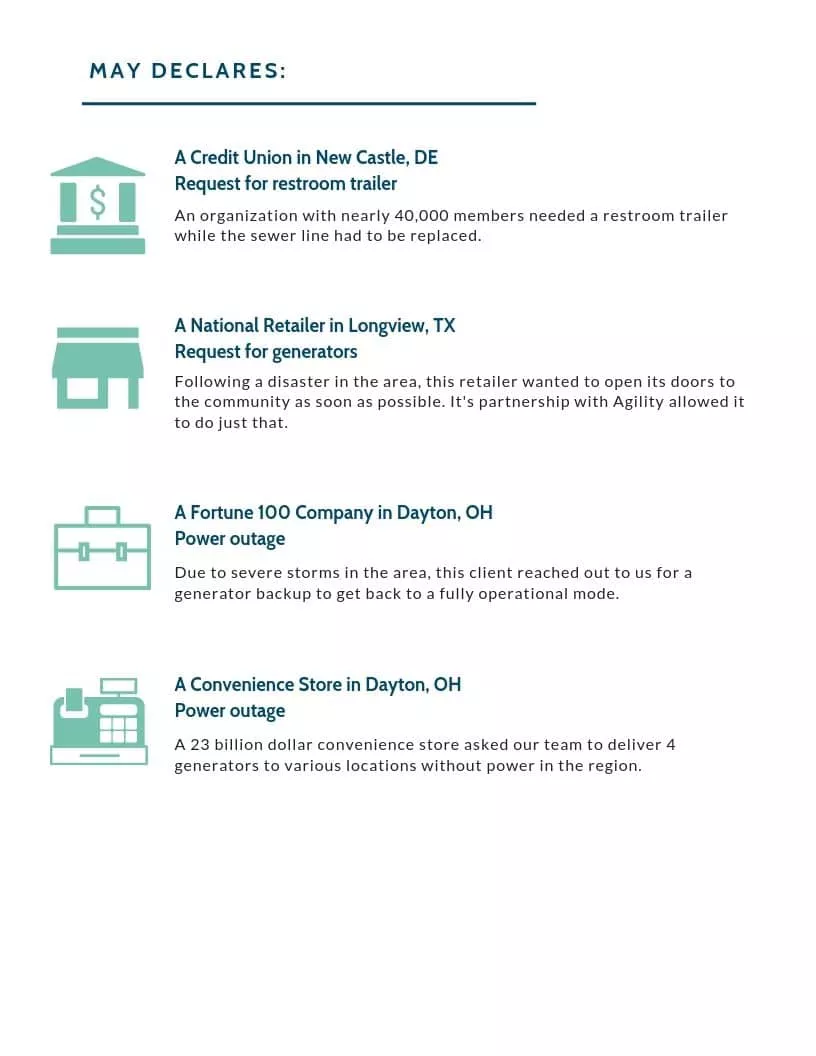
Here are four successful recoveries we’ve completed in May:
-
A credit union in New Castle, DE requested a restroom trailer. As they were undergoing construction, this organization with nearly 40,000 members needed a restroom trailer while the sewer line had to be replaced.
-
A national retailer in Longview, TX requested generators. Following a disaster in the area, this retailer wanted to open its doors to the community as soon as possible. Its partnership with Agility allowed it to do just that.
-
A Fortune 100 company in Dayton, OH experienced a power outage. Due to severe storms in the area, this client reached out to us for a generator backup to get back to being fully operational and be able to service their customers.
-
A convenience store in Dayton, OH faced power outage. A 23 billion dollar convenience store asked our operations team to deliver 4 generators to various locations without power in the region.
Our Operations Team successfully completed 15 different test exercises that involved 3 BRC tests in our Northborough testing facility, 3 tests in Las Vegas, and 4 tests in Atlanta. Besides showcasing the capabilities of our facilities, we also conducted 2 Mobile Recovery Center tests and 2 mobile unit tests.
We invite you to learn more about what we do or to chat about how we can help your business avoid any interruptions.
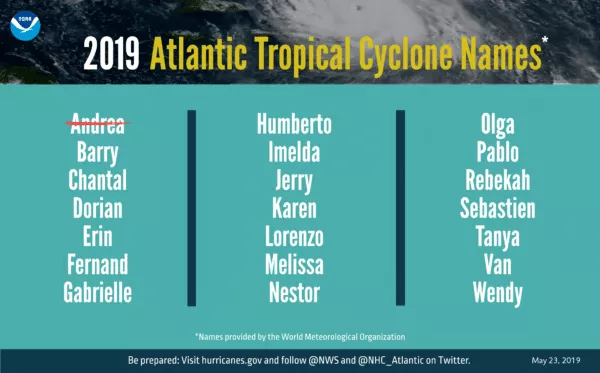
Hurricane season officially starts on Saturday, June 1, and is expected to get more intense later in the summer when things heat up. NOAA defines June 1-Nov. 30 as the timeframe for the hurricane season because it includes more than 97 percent of tropical cyclones. However, there’s a reason that 3 percent exists. Subtropical storm Andrea made a brief appearance to the southwest of Bermuda on May 20.
Based on NOAA’s outlook, it’ll be a near-normal Atlantic hurricane season with a 40% chance of a near-normal season, a 30% chance of an above-normal season, and a 30% chance of a below-normal season.
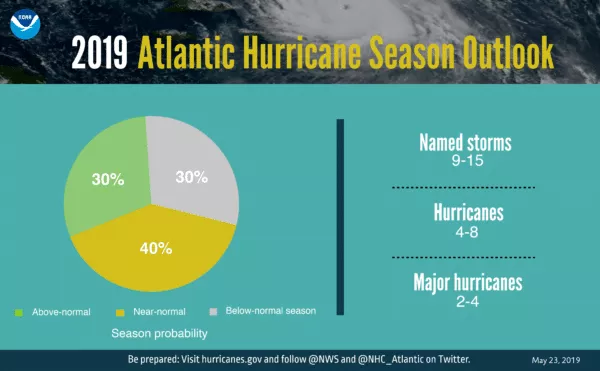
It’s with a 70% confidence that NOAA ranges named storm from nine to 15 with winds of 39 mph or higher. Four to eight of these storms could grow into hurricanes with winds of 74 mph or higher, and two to four major hurricanes.
Create a Plan That Addresses the Entire Business
There’s a common misconception that business continuity planning only affects the IT department. In fact, whether you create a business continuity plan (BCP) internally or choose to outsource it, your BCP should involve strategies for getting critical processes and departments up and running again. If you already have a BCP in place, third-party consultants can provide an objective view of your business and make suggestions for your BCP so that your plan is effective when interruptions occur. Business continuity as a service (BCaaS) uses the expertise of professionals to develop and manage a specific plan tailored to your business’ needs. With a streamlined course of action, your business will be able to remain operational in the event of a disaster.
Prepare Alternate Workspaces
Whether there’s physical destruction to your building or employees and customers are unable to travel, damages from disasters can hinder your ability to maintain normal business activities in your primary office space. If you need to relocate business operations , make sure you have access to an alternate workspace as soon as possible. Fully equipped alternative workspaces like Mobile Recovery Centers (MRCs) can be made available within as little as 24-48 hours of a disaster declaration, while Fixed-site Business Recovery Centers (BRCs) can be made available within as little as four hours of a declaration. Once the alternate location is set up, your company can begin to restore business operations successfully.
Back up and Recover Your Data
Having access to your data and applications is imperative when disaster strikes. A fully managed and monitored cloud recovery platform will protect your IT infrastructure. With secure data vaulting and recovery , your data will be recoverable on- or off-site within your recovery time objectives.