
The Challenge: Category 4 Hurricane
When a Category 4 hurricane struck the Texas Gulf Coast, it caused widespread power outages, infrastructure damages, and mass displacement. Emergency response teams needed a centralized, fully equipped workspace where they could coordinate relief efforts, distribute resources, and maintain uninterrupted communications without delays caused by complex permitting requirements.
The Solution: ReadyCommand Mobile Workspace
Within hours of activation, Agility Recovery deployed a ReadyCommand mobile workspace to serve as the on-site command center for emergency management teams. Unlike traditional structures, mobile command centers do not require complex or time-intensive permits, allowing teams to set up and operate immediately.
“Agility deployed a command center within hours of our call to the Declare Team and stood up a fully operational hub where we could run team meetings, centralize resource distribution, provide respite space for field workers, and maintain critical communications.”
Emergency Response Team
Equipped with storage and meeting space, a break area, and satellite connectivity, the unit provided a secure, climate-controlled environment where response teams could operate efficiently, strategize, and support field personnel.
Results
Rapid Deployment: The unit was on-site and operational within hours, ensuring no delays in response coordination.
No Permitting Delays: ReadyCommand deploys without the need for complex, time-consuming permits, enabling teams to focus on response-not red tape.
Scalability & Customization: The mobile workspace was configured to meet the team’s needs, including with workstations, secure power, and connectivity.
Sustained Operations: ReadyCommand provided a fully functional base for both short-term response and long-term recovery efforts.
Tornado season in the U.S. typically runs from March through June, but destructive twisters can strike at any time of year — and they often arrive with little warning. For businesses, a single tornado can disrupt operations, damage critical infrastructure, and result in thousands (if not millions) of dollars in losses. Without a proactive plan, recovery becomes a race against time.
The Cost of Tornadoes to Businesses
Tornadoes are among the most violent and unpredictable weather events. In 2023 alone, the U.S. experienced over 1,150 confirmed tornadoes. According to the National Oceanic and Atmospheric Administration (NOAA):
- The average commercial tornado claim is $45,000–$100,000, depending on the industry and size of the business.
- Tornado-related damage in the U.S. caused over $1.6 billion in insured losses in 2022.
- Business downtime can range from days to weeks, with small and medium-sized businesses being the most vulnerable to permanent closure after a major disaster.
If you operate in Tornado Alley — or even on the fringe of high-risk zones — preparing ahead of time is essential.
5 Ways Businesses Should Prepare for Tornado Season
1. Assess Facility Vulnerability
Start with a walkthrough of your physical locations. Identify areas where your facility is most at risk — such as large glass windows, roof structures, or equipment stored outdoors. Consider retrofitting or reinforcing key areas, especially in tornado-prone zones.
2. Update Your Business Continuity Plan (BCP)
Your BCP should include specific steps for tornado response:
- Shelter-in-place protocols
- Emergency communication plans
- Remote work contingencies
- Vendor and supplier backups
Ensure all team members know their roles during a severe weather emergency.
3. Back Up Critical Systems
Tornadoes often result in power outages and damage to on-site IT infrastructure. Secure off-site or cloud-based data backup to preserve records, customer information, and operational systems. Agility Recovery offers secure data backup and recovery services to make sure you can bounce back quickly even if your servers go offline.
4. Establish Emergency Power Solutions
Power loss is a common side effect of tornadoes, and restoring power to your facility can take days. With Agility’s backup power solutions , including generator delivery and fuel replenishment, you can avoid costly downtime.
5. Conduct Tornado Tabletop Exercises
Running a tabletop test with your team helps you simulate a real-world tornado event — uncovering gaps in your plan before a storm ever hits. It also ensures that your leadership team, IT staff, and facility managers know how to act quickly and cohesively under pressure.
The Cost of Downtime
Unplanned downtime from tornado damage can devastate a business. According to FEMA and the U.S. Chamber of Commerce:
- 25% of businesses never reopen after a major disaster
- The average cost of IT downtime is approximately $5,600 per minute for mid-size businesses
- Even short-term closures can result in lost customer trust, missed SLAs, and long-term revenue impacts
How Agility Recovery Helps
Agility Recovery offers turnkey business continuity solutions that reduce your vulnerability to tornado-related disruptions. Our services include:
- Backup Power & Fuel Delivery – Keep critical systems running during outages
- Mobile Office & Workspace Recovery – Set up temporary operations fast if your facility is damaged
- Data Backup & IT Recovery – Minimize data loss and restore business systems quickly
- Satellite Connectivity – Maintain communication even if local infrastructure goes down
- Business Continuity Testing & Tabletop Exercises – Prepare your team with expert-led training
Next Steps for Tornado Season Readiness
- Schedule a Business Continuity Assessment with Agility to evaluate your tornado readiness.
- Run a Tabletop Exercise focused on a severe weather event.
- Ensure You Have a Generator Solution in place for emergency power.
- Review Your Data Backup Protocols with Agility’s cyber resilience experts.
Be Ready Before the Sirens Sound
You can’t prevent a tornado — but you can prevent it from shutting down your business. With the right plan, partners, and technology in place, you can weather the storm and keep your organization running.
ReadyFinancial+ provides fully equipped, turnkey temporary branches that keep your institution serving customers during planned closures, renovations, or unexpected disruptions. In this on demand overview, see how our customizable units deliver convenient banking access with teller stations, drive through capability, cash handling, power, connectivity, and ADA accessible layouts so you can maintain operations without missing a beat.
This checklist will help you assess how much support you require when you need to recover your workplace.
It’s a deceiving assumption that a workplace recovery strategy can only consist of a plan for people to work remotely or from home when their current office is inaccessible. How long will the work-from-home strategy be effective? Is it secure?
In fact, 40% of employees use a device that’s not monitored by their employers, which poses cybersecurity concerns. As for your recovery site, is it located in the affected area, and will everyone be able to commute to it? How quickly can you get access to the recovery site? Taking time to prepare now will save you trouble if an incident occurs.
Overview
We hear this a lot: If your primary facility isn’t available, it makes sense to have employees work from home. Thanks to the cloud and adjustments made as a result of the COVID-19 pandemic, a work-from-home (WFH) alternate workspace strategy is cheaper and more doable than ever before. But what happens when your entire workforce needs to work from home?
Before writing off alternate facilities, think about how a WFH strategy would work for your entire business (or branch). Here are the top issues to consider.
Business Processes
For WFH to go smoothly, you must design business processes to accommodate remote work. The three principles of a successful WFH strategy are:
-
Communication
-
Coordination
-
Culture
During a business interruption, all departments must be able to communicate and solve unforeseen business challenges. Is WFH currently a strong part of your business culture? If not, trying to adapt to a remote workflow in the middle of a crisis will not go over well. Don’t forget about factors that might complicate WFH arrangements, such as supply chain interruptions or seasonal demands.
Your branch is a critical pillar of your community, so when disaster strikes, your customers and members look to you to provide leadership, service, and continuity. Watch now to learn more about complete branch recovery from interruptions like severe weather, infrastructure damage, cyberattacks, and more.
Explore various recovery options and hear what steps you can take today to avoid prolonged downtime when an interruption occurs:
- – What interruptions present the greatest threat to bank and credit union branches?
- – What are the benefits of using a mobile branch?
- – How can we best prepare to have a mobile branch deployed? Our staff will either work from home or resume operations at our branch.
- – How can we safeguard employees wherever they work?
Hurricanes can be devastating for businesses, causing power outages, data loss, supply chain disruptions, and facility damage.
Without a solid business continuity plan, your operations could come to a halt, leading to financial losses and customer impact. To stay operational during and after a storm, proactive hurricane preparation is key. Below are the five most important steps your business can take to prepare for hurricane season and solutions to boost your resilience.
Get Ready with our Hurricane Preparedness Checklist
1. Secure Reliable Backup Power
One of the most common risks during hurricanes is widespread power loss, which can last for days or even weeks. Without power, businesses can’t serve customers, process transactions, or maintain critical IT systems.
- Solution: ReadyPower+ provides businesses with priority access to backup generators, ensuring continuous operations. Agility Recovery delivers the right-sized generator when needed, preventing costly downtime.
- Pro Tip: Ensure your generator is regularly tested and has sufficient fuel to operate for extended periods.
2. Establish an Emergency Fuel Plan
During major hurricanes, fuel shortages are common due to supply chain disruptions. If your business relies on backup generators, fleet vehicles, or equipment, securing guaranteed fuel access is crucial.
- Solution: Agility Recovery’s backup fuel services provide priority fuel delivery, ensuring your business doesn’t run out of power when it’s needed most.
- Pro Tip: Work with a fuel provider before hurricane season to secure priority delivery status and avoid last-minute shortages.
3. Protect Your Business Data with Secure Backups
Hurricanes threaten IT infrastructure, leading to data loss, cyber risks, and compliance issues. A DIY backup plan isn’t enough—your business needs a professional disaster recovery strategy.
- Solution: Agility’s data backup & recovery ensures critical business data is securely stored and quickly restorable, minimizing downtime after a disaster.
- Pro Tip: Use cloud-based backups in multiple geographic locations to prevent localized damage from hurricanes.
4. Ensure Workplace Continuity with Alternate Office Solutions
Flooded buildings, structural damage, and unsafe conditions can force businesses to relocate temporarily. Having an alternate workspace plan ensures employees can continue working with minimal disruption.
- Solution: Agility Recovery’s workplace recovery provides access to fully equipped recovery workspaces with power, connectivity, and office essentials, so your team can resume work quickly.
- Pro Tip: Identify critical team members and test remote work capabilities before hurricane season.
5. Create & Test a Hurricane Disaster Recovery & Business Continuity Plan
Many businesses fail to test their hurricane preparedness plans until it’s too late. A well-documented, tested plan ensures employees know their roles and that key recovery processes are in place.
- Solution: Agility Recovery’s business continuity panning & testing helps businesses develop, refine, and test hurricane response plans through tabletop exercises and simulations.
- Pro Tip: Schedule quarterly disaster drills to assess your team’s readiness and adjust response plans accordingly.
Take Action: Plan Now to Protect Your Business Tomorrow
Waiting until hurricane season starts is too late — businesses must proactively plan to minimize disruption and financial loss. By securing backup power, emergency fuel, data recovery, alternate workspaces, and a tested continuity plan, you’ll ensure your business stays resilient when the next storm hits.
Banks and credit unions face unique challenges and requirements for their physical, customer- and member-facing locations. In many cases, the livelihood of an entire community may rely on a branch being open for business despite any disaster, construction, or interruption. Just one hour of downtime can have far-reaching ripple effects.
That’s why banks and credit unions must have a backup for brick-and-mortar locations, particularly those with no other area branches. Mobile recovery solutions can be exactly what's needed to stay in business and serve your community.
Full Capacity and Convenience of a Brick-and-Mortar Branch
If a storm makes a branch unreachable or your institution is planning a long-term renovation, that doesn’t mean there has to be a pause in operations. Instead, by employing an Agility mobile recovery solution , your institution can stay in business without major interruption to your work. You can even remain at the same location your customers and members know and love by setting up the unit right in your parking lot.
The biggest benefit is to remain at the location the institution determined was right to open a branch. This is convenient for both their employees as well as their customers and why nearly all of our branch recoveries take place within the parking lot of the branch impacted by a disaster. Mark Norton, CBCP Sales Enablement Manager, Agility Recovery
Agility’s mobile recovery solutions have all the capabilities needed so you can get back to serving your community quickly.
Productivity

Your employees must be able to serve your clients or members, no matter the circumstance. Our mobile branch is a great solution to a business interruption at your traditional brick and mortar location and can include:
- – Break/conference area for employees to meet
- – Private office space for confidential conversations
- – Employee workstations
- – Restrooms
- – Satellite and LTE communications
- – Power
- – Teller stations (2-3)
Customer and Member Comfort

Especially in times of disaster, ensure your customers/members and employees alike feel comfortable when visiting your mobile branch with:
- – Drive-up window for quick and convenient transactions
- – Lobby/waiting area
- – Teller stations (2-3)
- – Check-writing stand
One client shared that he was extremely pleased with the unit. The unit was more spacious than the institution had expected, and Agility was able to customize the unit to their liking. This particular member had multiple branches but they were geographically inconvenient to their customer base, so the Agility mobile unit provided a quick and effective solution. Agility had their mobile unit up and running just one day after they declared.
Safety and Accessibility

Even in a mobile unit, everyone should feel safe when accessing their work or money. Agility's mobile units are customizable and can be outfitted with safety equipment provided by either Agility Recovery or the financial institution. Many clients opt to put their own door alarms and security cameras up; some choose to have Agility set them up. Safes are kept in areas with reinforced flooring. Units may include:
- – ADA accessibility
- – Alarm system
- – Compliant Diebold safes
- – Safe room
- – Night drop box
- – Cash drawers
All this and more ensures your customers, members, and employees see the value of your branch and all it can provide.
Customizable Layouts

What works for one financial institution may not work for another, which is why Agility’s mobile recovery units include customizable layouts, providing the flexibility you need to support your customers or members when they need it most. The unit arrives empty, but upon arrival, Agility will build partitions, run network cabling, and place furniture according to your institution's needs. Recoveries are stressful enough; let Agility configure and install equipment in a way best suited to your institution. We can adjust these layouts based on the size of your workforce or expected customer/member volume.
No Requirements for Special Permits
The last thing financial institutions need to worry about during a disaster is permitting for a mobile unit. If an institution plans to put down a building that will be block and leveled, they will need to go to the county for a permit; however, with Agility's mobile units, there is no additional hurdle of gaining county permission when setting up unit in your parking lot or an alternative site. We encourage advance site visits so our team can spring into action when you need us.
A client of ours in Texas had to wait over two months and submit numerous drawings before the county gave them the green light to move forward. In a time of recovery, the extra variable of going to the county for permission and waiting weeks to months is incredibly difficult given all the other tasks needed to get back to business as usual. Damian Hunter Solutions Consultant, Agility Recovery
Remain Compliant
Agility can provide fully compliant safes, night drop boxes, and more. We will make any changes necessary to our units and positioning and provide any documentation needed to ensure your full compliance.
Efficiency
Agility's recovery solutions are efficient. We don't require a bank or credit union to take ownership of assets you may never use, nor do we require a bank or credit union to pay vendors and service providers to be on retainer for a bad day. Agility Recovery is the best solution to save your institution money now and save the business later.
Expertise and Proven Success
Agility is the expert at performing branch recoveries within 48-72 hours. By partnering with Agility, your institution can take advantage of our expertise while your employees can focus on theirs: serving the community. Agility has been in the recovery business for 35 years. Most of our recoveries with banks and credit unions take place during the first disaster they've experienced; by recovering with Agility, institutions don't have to try to save their business with little experience at high-stakes moments. Ready to get started? Learn more about our mobile recovery solutions and our full ReadyFinancial+ program and reach out to us for a free quote.
The 2024 hurricane season is here, and businesses in hurricane-prone regions need to be prepared.
This year, the National Oceanic and Atmospheric Administration (NOAA) predicts an above-average season, with 17-25 named storms, 8-13 hurricanes, and 4-7 major hurricanes. AccuWeather agrees, “forecasting 20-25 named storms across the Atlantic basin in 2024, including 8-12 hurricanes, four to seven major hurricanes and four to six direct U.S. impacts.” This article will cover when hurricane season is, what regions are impacted, predictions for the 2024 hurricane season, learnings for businesses from past hurricane seasons, and how businesses can prepare for the 2024 hurricane season.
When Is Hurricane Season and Which Regions Are Impacted?
The Atlantic hurricane season, which officially begins on June 1 and concludes on November 30 each year, is a period of heightened activity during which tropical cyclones, including hurricanes, are most likely to develop over the Atlantic Ocean. Historically, peak activity occurs in August and September. The areas that are most frequently affected by hurricanes are located near the Atlantic Ocean and the Gulf of Mexico, including the southeastern and coastal states of the United States, as well as Mexico, Central America, and the Caribbean islands. These regions bear the brunt of severe weather conditions such as torrential rainfall, high winds, storm surges, flooding, and significant property damage. Businesses located in hurricane-prone regions must be well prepared to minimize disruptions and ensure their safety during the hurricane season. Proper preparation involves staying informed about hurricane forecasts, developing comprehensive disaster response plans, and implementing measures to protect employees, property, and assets.
2024 Hurricane Season Predictions
As the 2024 hurricane season approaches, experts are predicting another active year in the Atlantic basin. The National Oceanic and Atmospheric Administration (NOAA) recently forecasted 17 to 25 named storms , with 8 to 13 of them becoming hurricanes, including 4 to7 major hurricanes with winds of 179 mph or higher. Colorado State University predicts , with "above-normal confidence," a "well-above average probability for major hurricanes making landfall along the continental United States coastline and in the Caribbean," with 23 named storms . These numbers are above the 30-year average of 14 named storms, 7 hurricanes, and 3 major hurricanes. The Texas coast, Florida Panhandle, South Florida, and the Carolinas are most likely to experience direct hits. AccuWeather meteorologists, too, warn of increased activity and the potential for a “blockbuster” hurricane season and " forecasting 20-25 named storms across the Atlantic basin in 2024, including 8-12 hurricanes, four to seven major hurricanes and four to six direct U.S. impacts." This is due to several factors, including:
- – Favorable oceanic and atmospheric conditions
- – Warmer-than-average sea surface temperatures: Mid-February Atlantic water temperatures were the same as those typically experienced in July and temperatures at the end of January were 65% higher than the next closest year
- – Reduced wind shear as El Niño transitions to La Niña
These conditions could create a conducive environment for the formation and intensification of hurricanes, potentially leading to more frequent and powerful storms. If La Niña doesn't officially develop until August or September, the fall months will see the highest hurricane activity. Furthermore, long-term climate change remains a significant factor, driving sea levels higher, intensifying storm impacts, and making coastal communities more vulnerable to severe hurricane damage. NOAA emphasizes the continued significance of ongoing monitoring, planning, and preparedness measures to minimize the potential damage and risks associated with the 2024 hurricane season. While this initial forecast provides a general outlook, the specific tracks and intensities of individual storms can only be forecasted closer to the time of their formation.
Plan, Prepare, and Test Your Plan
Download our hurricane tabletop exercise to test your emergency preparedness plan.
2024 Hurricane Names
The 2024 hurricane names list has been released by the World Meteorological Organization (WMO):
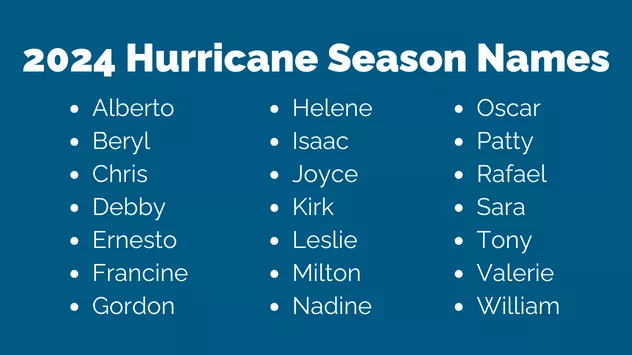
These names will be used when tropical storms and hurricanes develop in the Atlantic Ocean and Eastern Pacific Ocean during the 2024 season. The list of names is generated by the WMO's Hurricane Committee, which consists of representatives from all the countries in the Atlantic and Eastern Pacific hurricane basins. The committee meets every year to review the previous hurricane season and make recommendations for the next one. The names are chosen from a rotating list of English, French, Spanish, and Portuguese names. Names that have been used in previous years are retired from the list, and new names are added to replace them. In the event that all names are used, the WMO will turn to supplemental lists.
Lessons from Past Hurricane Seasons
The impact of past hurricane seasons on businesses provides valuable lessons for proactive preparedness.
Importance of Real-Time Data
One significant learning is the importance of continuous monitoring and real-time information. Businesses that invest in robust weather tracking and monitoring systems can stay ahead of developing weather patterns and make informed decisions based on reliable forecasts. Real-time data empowers them to take timely actions such as implementing emergency response protocols, evacuating personnel, or securing critical infrastructure, minimizing potential damage and disruptions.
Need for Thorough Disaster Recovery and Business Continuity Plans
Past hurricanes also highlight the need for robust disaster recovery plans that ensure business continuity. Companies should proactively collaborate with relevant stakeholders to develop comprehensive plans that address every aspect of post-hurricane recovery. This includes assessing potential damage, outlining restoration procedures, securing supply chains , and establishing backup facilities. By doing so, businesses can mitigate downtime and restore operations swiftly, reducing financial losses and maintaining customer satisfaction.
Establishment of Effective Emergency Communication
Furthermore, past hurricanes have highlighted the significance of effective communication during emergencies . Establishing clear communication channels and protocols ensures that all employees receive timely updates, instructions, and safety guidelines. Businesses should regularly conduct drills and training sessions to ensure that employees understand and adhere to these protocols, enhancing overall safety and minimizing confusion and panic in critical situations.
Maintenance of Records and Documentation
Lastly, post-hurricane recovery often involves interactions with insurance companies , government agencies, and various contractors. Businesses that maintain accurate records and documentation, including photographs, estimates, and receipts, streamline the claims and reimbursement process. Proactively assembling these records can significantly expedite the recovery process, reducing financial burdens and facilitating smoother operations.
How to Prepare for the 2024 Hurricane Season
As the 2024 hurricane season approaches, businesses must take proactive measures to ensure their continued operations and protect their assets. Here are some essential steps that businesses should consider to prepare for the upcoming hurricane season.
1. Establish a Hurricane Readiness Plan
Develop a comprehensive hurricane preparedness plan that outlines specific protocols and procedures to be followed before, during, and after a hurricane. Clearly define roles and responsibilities for employees, ensuring that everyone knows their tasks and has access to necessary resources. This plan should include steps such as securing facilities, managing inventory, and maintaining communication channels.
2. Invest in Disaster Preparedness Supplies
Stock up on essential disaster preparedness supplies such as flashlights, batteries, non-perishable food, and water. Ensure that your business has sufficient supplies to sustain operations and support employees in the event of a prolonged power outage or disruption of supply chains.
3. Secure Physical Infrastructure
Conduct a thorough inspection of your business premises to identify potential vulnerabilities to hurricane damage. Reinforce or repair any weak points in the structure, including roofs, windows, and doors. Trim trees and branches near your property to minimize the risk of damage from falling debris.
4. Protect Critical Data and Equipment
Back up critical business data regularly and store backups off-site to protect against data loss in case of flooding or severe damage. Consider investing in surge protectors and power generators to keep essential equipment operational during power outages.
5. Plan for Evacuation and Employee Safety
Develop an evacuation plan that outlines the designated evacuation routes and assembly points for employees. Ensure that employees are familiar with the plan and know how to reach these designated locations quickly in case of an emergency. Regularly conduct evacuation drills to ensure that employees are prepared and can respond effectively.
6. Foster Effective Communication
Establish clear communication channels to keep employees, customers, and suppliers informed about your business status during a hurricane. Regularly update your website, social media platforms, and designated communication channels with accurate and timely information. Don't forget remote and hybrid employees ; ensure you have a way to communicate with anyone in the storm's path and confirm their safety.
7. Educate Employees Through Training and Exercising
Conduct training sessions for employees to educate them about hurricane risks and safety measures. Emphasize the importance of staying informed, following instructions, and being prepared at all times. Beyond training sessions, your organization should exercise its preparedness plans through tabletop or live tests to make sure everyone understands their roles and identify any gaps in the plans.
8. Coordinate with Local Authorities
Stay informed about local hurricane preparedness plans and guidelines, as well as relevant regulations and restrictions that may be imposed during a hurricane event. Build strong relationships with local emergency management agencies and community organizations to access critical resources and support when needed. By taking these proactive measures, businesses can significantly enhance their preparedness for the 2024 hurricane season, minimizing potential disruptions, and safeguarding their operations, employees, and assets.
Every business faces various winter weather threats during the snowy season, from strong rainstorms and ice to plummeting temperatures. Knowing the tactical steps to prepare your business for winter weather is essential to avoid downtime. Being prepared with an actionable plan will minimize the impact inclement weather can have on your employees, customers, and revenue. Having actionable resources at hand will help your team be educated on what to do in extreme winter weather conditions and actions they need to avoid to stay safe. An effective way to strategize is to enlist a team of people to perform a winter weather tabletop exercise. This exercise should last between two to three hours, spending time as a group defining the risks of extreme winter weather, exploring different scenarios, and putting together a plan of action to use when winter weather strikes. Performing this task as a group is an excellent way to cover the entire scope of possibilities and solutions during a winter weather crisis. If you want to ensure you remain in business all winter, this exercise will help you formulate your business’s best plan.
Consider All Risks
The first step when preparing for winter weather disruptions is to define all of the possible risks of not being ready for a storm and how they will impact your organization as a whole. With proper preparation, the avoidance of these risks If severe winter weather hits the area where your business is located, the following could potentially occur:
- Power loss
- Fires
- Floods
- Communications disruptions
- Supply chain disruption
- Property damage
- Employee injury or illness
- Transportation disruption
- Automobile/other transportation accidents
- Compromised access to facilities
- Personal exhaustion, hypothermia, heart attack
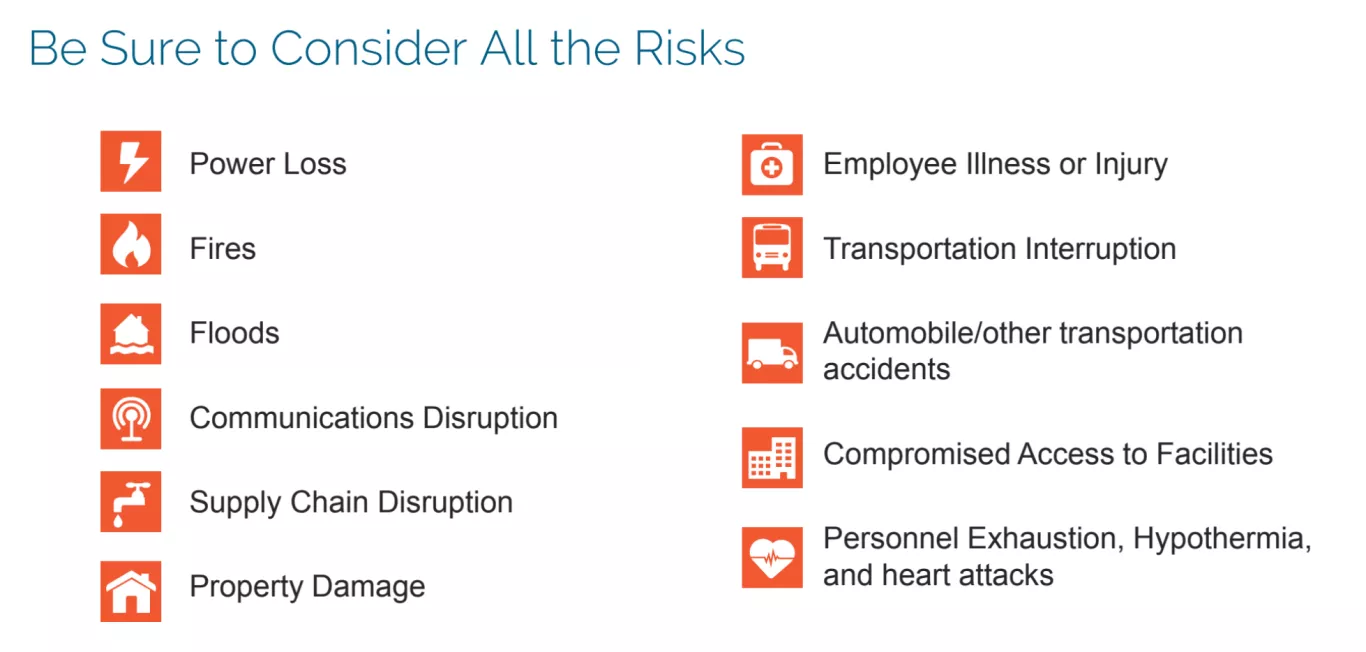
It is essential to evaluate potential risks and outcomes to create an efficient inclement weather plan. Each business will have unique risks, so defining the possible scenarios ahead of time is important. Troubleshooting will eliminate most of the risks, and having risk management strategies outlined will ensure handling the events will be managed quickly and effectively. Once you have isolated and defined individual risks, it is good to prepare a plan of action for each incident. Having all bases covered is key to keeping business continuity intact during the winter months.
Drafting Winter Storm Plans in Stages
Before the Storm
The worst possible scenario for a business is to attempt to cobble together a plan when a storm is on its way or already in your area. Covering these elements ahead of time will enable you to move straight to your plan of action when the storm hits:
- Review insurance coverage (flooding)
- Evaluate the potential risks to determine your business’s most detrimental risks and their potential outcomes: loss of heat, frozen pipes, and inability to access your business site due to snow and ice.
- Identify who will be in charge of clearing the snow and ice from the property – the business owner or landlord.
- Establish a procedure for restoring electrical service on an item-by-item basis (know your electrical load demands ahead of time)
- Determine alternate routes to access business in the event ice or snow blocks main entrances
- Establish an inclement weather attendance policy for employees
- Meet with and discuss your winter weather preparedness plans with your vendors
- Stockpile emergency supplies as needed
- Rocksalt, snow equipment remover, kitty litter, and sand
- Service generators and top off fuel reserves
- Ensure all battery-powered devices have new batteries or crank/solar chargers
- Establish shelter locations and stockpile supplies on location for your employees
- Know ahead of time what local broadcasters will publish the status of your business to the public
- Ensure redundant communication channels (phone lists of employees and their relatives/spouses, backup email addresses, etc.)
- Establish remote access to your corporate website to update your business’s status to vendors
Winter weather is challenging to plan for due to its unpredictable nature. Winter storms are apt to occur with little to no warning, so creating and reviewing a solid plan will prevent panic, leading to serious mishaps and consequences.
During the Storm
Now that you are in the midst of the storm, it is time to implement your plan. If your business has participated in a winter weather tabletop exercise, you can handle events associated with harsh weather as they occur.
- Stay informed and communicate regularly.
- Watch for rapidly changing weather conditions.
- Ensure employee and customer safety and well-being.
- Stay indoors as much as possible.
- Work periodically to keep doorways, walkways, and driveways clear of ice.
- Let faucets drip to keep water flowing in the case of prolonged, low temperatures.
- Keep the contact information for your heating contractor, plumber, fire department, insurance agent, and building owner accessible.
- If your building will remain vacant for a long period of time, assign someone to check indoor temperatures
- Do not overload circuits in your facility with space heaters or other large appliances.
- Locate your emergency weather radio.
- Conserve fuel if necessary.
- Locate water, gas, and power shut-off locations.
Knowing your business’s specific protocol for handling winter weather is imperative to keeping your business up and running during a storm and maintaining operations during prolonged bad weather.
ZERO HOUR: When a Storm is Imminent
You and your team have done the work, researched, and created a safety plan tailored to your business’s operations. Now it is time to implement the procedure and watch as your business weathers the storm.
- Follow the plan. Be decisive and trust the plan.
- Stay abreast of the storm’s status to avoid surprises.
- Alert 3rd party crisis response providers.
- Enact emergency evacuation or shelter-in-place plans for employees.
- Activate your crisis communication plan.
- Secure facilities, buildings, and inventories.
- Don’t be complacent during downtime (losses can incur quickly).
- BE PREPARED TO SELF-SUSTAIN FOR 72 HOURS OR MORE.
Common Mistakes Made During Crisis
- Ignoring warnings
- Being unprepared for long-term power and communication outages
- Unprepared for generation connection (no transfer switch, fuel provider, spider box, or working knowledge of load requirements)
- Failure to prepare for supply chain disruptions
- Failure to adequately stock emergency supplies
- Failure to communicate
- Failure to obtain adequate insurance coverage for loss of use, loss of revenue, and added expense
- Failure to establish emergency procedures and providers for call forwarding, temporary power, communications provider, etc.
It is very easy to panic when wintery weather threatens your business’s continuity. Knowledge of potential mistakes that happen gives the team working on this exercise the power to make the plan as failsafe as possible.
Winter Weather Preparedness Checklist
Our team of experts has put together a brief yet comprehensive winter weather preparedness checklist for your convenience. Use it to help guide your workforce through the most basic safety steps. Aside from the tactical steps, supplies, such as non-perishable foods, need to be prepared in advance:
- Bottled water (at least one gallon per person per day for at least three days)
- Canned goods, especially cozy, warming foods like soups and stews
- Snack foods like chips, crackers, and cookies in sealed packages
- Cereal and granola
- Anything jarred, from jellies to pickles to meats
- Canned tuna and salmon
- Dried pasta and jarred sauce
- Wax-sealed hard cheeses
- Salted butter, which lasts longer at room temperature than unsalted butter
- Dried fruit
- Nuts
- Jerky
- Energy bars
- Shelf-stable juice
- Coffee, tea, and hot cocoa mix (and maybe some marshmallows)
- Extra paper products like toilet paper and paper towels
Learn the Difference Between Winter Weather Advisories, Watches, and Warnings
According to FEMA, these define the three winter weather advisories: Winter Weather Advisory is issued when snow, blowing snow, ice, sleet, or a combination of these wintry elements is expected, but conditions should not be hazardous enough to meet warning criteria. Be prepared for winter driving conditions and possible travel difficulties. Use caution when driving. Winter Storm Watch is issued when conditions are favorable for a significant winter storm event. Heavy sleet, heavy snow, ice storms, blowing snow, or a combination of these events are possible. Winter Storm Warnings are issued for a significant winter weather event, including snow, ice, sleet, blowing snow, or a combination of these hazards. Travel will become difficult or impossible in some situations. Delay your travel plans until conditions improve. If you are armed with this information, you and your team will be able to plan for the worst and expect the best. Agility Recovery Solutions helps businesses plan for unexpected business interruptions, avoid unexpected interruptions, and become resilient. In the event your business is affected by a disastrous winter storm, Agility Recovery Solutions is there to help you remain in business. Our mission is to reduce the impact of business interruptions on organizations and the communities they serve. We help businesses stay in business. Our purpose is to help businesses be prepared before, during, and after an incident. After decades of helping businesses recover from real disasters and manage through emergency messaging incidents, we bring the collective experiences of thousands of hours in the field. We’ve evolved into the leading business continuity and disaster recovery end-to-end solution in the market.
Though rural bank and credit union branches typically serve comparatively smaller communities than their metropolitan counterparts, remote and rural communities tend to rely on their local brick-and-mortar branches much more than city dwellers – making prompt recovery from an interruption that much more critical for those locations.
Physical branch recovery innovations like mobile recovery branches , quick-ship equipment , and rapid data recovery allow a branch to quickly restore most critical operations with relative ease. Still, broadband limitations in rural areas continue to present challenges for branches dependent on satellite connectivity.
Old Challenges
The Federal Communications Commission (FCC) establishes broadband minimum benchmark speeds for communications providers to ensure every community has adequate access to internet connectivity. Currently, the FCC standard is 25 megabits per second (Mbps) for downloading and 3 Mbps for uploading. Unfortunately, those speeds are far too slow to meet most small businesses’ needs. To address this issue, in July 2022, the FCC proposed increasing the benchmark to 100 Mbps for download and 20 Mbps for upload. This significant increase is still less than a professional office with at least 20 employees online would require for typical use, meaning many businesses and financial institutions in rural communities may still struggle to access the broadband connectivity they need to maintain critical operations.
How Connectivity Loss and Subpar Mbps Speeds Threaten Branch Resilience
- – Inability to access and execute incident response plans, impeding both physical and remote branch recovery
- – Compromises remote control and access capabilities
- – Increases vulnerability to cyberattacks
- – Inability to provide secured service to customers and members; loss of digital banking mechanisms, including ATMs
New Solutions
Technology has answered the call as the need for faster connectivity has increased. Smaller, more efficient satellites offer speeds up to 350 Mbps (and up to 40 Mbps latency) and are becoming increasingly accessible to businesses everywhere, including those in rural communities. Most impressive, though, is that some of these faster satellite solutions offer substantially easier setup and use. While traditional satellites require a certified technician and a lengthy on-site installation process, modern broadband recovery solutions can be shipped directly to a branch and set up in minutes without any previous experience or expertise required. These new portable solutions support faster recovery from connectivity interruptions and are more reliable and less vulnerable to severe weather and line-of-sight challenges.
Looking Ahead
Though the FCC’s proposed minimum benchmark speed has not been widely implemented yet, remote and rural communities can look forward to increased broadband speed availability soon. Roughly $42 billion in funding through the Federal Infrastructure Investment and Jobs Act will help states build new broadband networks in previously underserved, low-population areas. As businesses and financial institutions look forward to enhanced standard connectivity speeds and reliability, faster, easier-to-use branch recovery options are available now. Together, these advancements mean increased resilience for rural bank and credit union branches and sustainable access to critical community services for individuals in rural and remote parts of the country.