

Whether or not your business has been impacted by power loss in the past, preparing for fast power restoration is an absolute foundation in business sustainability. On average, losing power for just four hours costs an organization between $10,000 to $20,000 , so the question is no longer whether companies can afford planning and recovery, but instead, how much will a business save by investing in a comprehensive business continuity plan that includes power restoration support? Your company’s safety, productivity, and revenue should never be left vulnerable to power loss. An effective power recovery plan includes strategies to address many contingencies. To do this, planners must avoid outdated power recovery myths and consider these critical facts:
Myth #1: Local vendors will be able to assist in the event of a major outage.
Fact: Without a formal agreement that includes guaranteed access to generators, fuel, and connection services, local vendors may allocate their inventory to larger organizations. We recently supported a small business that believed their agreement with a local provider was all they needed to secure a backup power solution. Unfortunately, as storms took out critical lines throughout their community, the provider was approached by a larger corporation that needed all available generator inventory to support its various locations. Because the small business lacked buying power compared to their enterprise-sized competition, the vendor canceled their agreement with the small business to serve a larger customer with a bigger budget. Fortunately, Agility was able to step in and quickly source, service, and connect a generator for this small business. Otherwise, the vendor’s questionable business practices could have meant a critical loss of revenue and reputation for the small business. While it may seem safe to assume that what you need will be available when you need it, unpredictable storm seasons, supply chain issues, and inflated demand lead to severe resource scarcity and price gouging. When local availability is compromised, this could cost you days, weeks – or even longer – of downtime. If we’ve learned anything from disasters like Hurricanes Harvey and Ida, 9/11, and the initial panic of the COVID pandemic, local fuel scarcity can cause incredible delays and increases in the cost of recovery. Unless you manage a large fuel storage unit on site, your power recovery plan must include quick access to the kind of fuel you need to operate your business’s gasoline- and diesel-dependent equipment. Lesson: While Agility guarantees rapid deployment of power recovery assets to all contracted customers, many providers do not offer this promise. Be sure to get your power recovery agreement in writing and review contracts for clauses that allow vendors to prioritize larger customers. When securing power recovery assets, be sure to include a plan for quick delivery of fuel to keep your generators , vehicles, and other equipment operational.
Myth: Buying our own generator will provide our company with the best value and fastest power recovery.
Fact: The initial investment you make in a generator is just that – initial. Cost over time will only increase as the reliability of your unit inevitably decreases. The investment made when a generator is purchased is only the beginning. Several factors significantly increase the total cost of a backup generator over time, including:
- Delivery and connection fees
- Ongoing maintenance
- Storage
- Training and testing
- Fuel
- Repairs
Even regularly serviced generators and other power recovery resources are vulnerable to damage caused by severe storms and other natural disasters. If your power restoration plan is entirely dependent on an on-site generator, you need to ensure that you have a reliable backup plan for your backup plan. Lesson: Purchasing one or more backup generators may seem like an easy, cost-effective solution, but power equipment requires regular maintenance, servicing, and fuel, which could drive costs up year-over-year compared to securing power recovery services with fixed, pre-negotiated rates. And when an unexpected storm or disaster causes a major outage, there’s no guarantee that on-site generators and fuel won’t be impacted, too. An effective power restoration plan accounts for these contingencies and includes assured alternative access to generators, fuel, and licensed electrical support.
Myth: Storm-related outages haven’t impacted our business before, so we don’t need to invest in a power recovery plan.
Fact: Historically, storm-prone regions are no longer the only parts of North America where storms cause significant power outages. In addition to storm-related outages, non-weather-related power loss is also rising. In recent years, some of the most damaging storms have been completely unseasonable and largely unpredictable. Lack of preparedness for these events – including the 2021 Texas ice storm – has resulted in critical community damage, economic loss, and permanent business closures. The United States’ aging power grid means that storm-related power outages are more of a threat to all regions and that non-weather-related outages are a growing threat every business should be prepared for. Common non-weather power outages are caused by various disruptions, including vehicles/accidents, animals, vandalism, trees, cyberattacks , and planned outages . Combined with a power grid in desperate need of an overhaul, these events are linked to more frequent, longer-lasting outages . Lesson: Unseasonable and unpredictable storms will increase in regions not traditionally impacted by severe weather. As the threat of non-weather-related outages grows across North America, businesses everywhere are vulnerable to revenue and productivity impacts caused by power loss. An effective recovery plan with services that include access to generators, fuel, connection, and testing will return thousands over the program’s cost after only one power-loss event.
While most of us are used to the idea of reliable constant electrical energy, the reality is that it can be one tenuous string. In many parts of the country, storms, deep freezes, snow, and other natural disasters can rapidly cut regional electricity for hours or even days. Furthermore, even if your business is located in a reasonably weather-stable area, there’s always the possibility of freak accidents, human error, or planned outages. The reality is that there’s no way to be sure about the constant reliability of any externally derived electrical source. For businesses and organizations of many kinds, a loss of electricity can be catastrophic, even if it lasts for just a few minutes; a multi-day electrical shortage can cause financial, data, and logistical effects on any organization. Just how costly can these events be? Research estimates indicate that power outages cost U.S businesses more than $27 billion per year, and the cost trend is growing upwards, not downwards. You need to protect yourself and maintain business continuity, and the one surefire way to do that is by maintaining your own internal backup power supply, ideally, one that’s capable of keeping the lights on and your systems running for several days or longer if needed. This guide explains the five crucial things you need to consider for achieving just this sort of secure redundancy.
Maintain a Robust Portable Generator
Depending on the size of your business installations and power needs, your quickest, best, and most useful source of emergency electrical power will be a compact portable generator that you keep on standby. These can be bought in almost any hardware store, and larger, truck-mounted models are capable of supplying electricity for days. The critical thing to keep in mind for these generators is to buy and have them ready before the next power outage occurs. Once disaster strikes, retailers tend to run out of items like generators of any kind rapidly (as we saw during recent hurricanes and wildfires), and even fuel can rapidly become scarce. For these reasons, you should have your portable generator ready well in advance, have it inspected regularly, and always keep it fully fueled, or contract with a company that guarantees this preparation.
Maintain Long-Term Standby Generators
While portable generators are a rapid and often highly affordable solution to power outages, they’re far from appropriate for all situations or power needs. Furthermore, many of them require you to plug equipment directly into them and turn them on manually. All of these measures will take time and can cause unexpected problems. A standby generator is an even more robust solution for emergency power. These power systems work much like portable generators but do so on a larger scale. They’re also crucially different in that they’re installed directly into your organization’s internal electrical system so that they can kick into gear as soon as the power goes out. Standby generators tend to be much costlier to buy, install, maintain and often require permits for their specialized installation, which is why we recommend partnering with a company that takes care of this for you and minimizes the chances of a supply shortage. With all that in mind, if your business needs genuinely robust, long-lasting emergency electricity, these devices are an extremely effective option.
Ensure Uninterruptible Power Supplies (UPS)
Even with the best standby generators waiting to kick into gear automatically, most grid power failures will mean at least a few seconds or minutes of zero electricity for your facilities and equipment. This isn’t a problem for many businesses, but if you have time-critical computer systems running, even a single moment of electrical loss can mean enormously costly data losses. There are also susceptible electronic devices running in some facilities, which cannot be suddenly shut down without the risk of damage. For these contexts, you should also invest in what are called Uninterruptible Power Supplies, or UPS devices. These are generally inexpensive and can integrate with your existing emergency power systems to provide those few crucial minutes of continuous electricity when the power grid dies and your alternative power system kicks into life.
Work Towards Long-Term Alternative Power Sources
While generators and continuous power supply systems are superbly helpful for most business needs, your best bet for secure long-term electrical power will be to switch over to alternative renewable electrical sources if at all possible. By these, we’re referring to systems such as roof-top solar power arrays, wind energy devices on your property, or possibly even other sources of ultra-localized, consistent, and renewable electricity. Your transition to your own renewables doesn’t need to be total. As a middle choice, it’s possible to invest in them for the sake of crucial systems power provision. This way, you’ll have peace of mind knowing that even if the general grid goes down, the most critical part of your electrical needs was never relying on it in the first place. Your own renewable power sources, combined with emergency generators in the case of extreme emergencies, should make your organization all but impervious to even the worst power cuts.
Further Solutions for Reducing the Effects of Power Outages
Ensuring a robust and continuous supply of emergency energy is a powerful tool against disaster in almost any context. Still, there are also ways to lighten your possible harm if your electrical systems fail. Keep some of these tips in mind for achieving this: Minimal perishable inventory: If you’re in a business that involves highly perishable products that are only kept fresh with constant electrical resources, work to keep a reduced inventory that will minimize your losses in the event of an energy cut. External cloud solutions: If your company depends on a heavy dose of software and data storage to function, one solution is to invest heavily in cloud-based data backup and business-data management systems. By having these active in the background at all times, power losses don’t need to become data losses, and you might even be able to rapidly relocate your business functions to a place where electricity still works. You can then reconnect with your cloud provider accounts. Emergency response exercises: When the power goes out, and especially if it does so in the middle of a general emergency, you should have your staff trained on handling all the needed tasks for activating generators, saving data, and saving crucial capital assets or inventory. This means training them beforehand and ensuring that the training has been internalized.
Seek Professional Help and Installation
Setting up a truly robust, professionally installed recovery protocol for power outages can be a complicated task, and choosing to do so yourself can open your organization up to vulnerabilities and high costs. This applies especially if your business is more complex or has unique needs. For these situations and in any context in which you need emergency power sources, calling in professional assistance for your power backup needs is an ideal choice that will save you time, money, and stress. Agility experts can help and have the tools for a robust backup energy system for your business.
Our monthly report on the number and types of business interruptions we have responded to and companies we have recovered, providing our unparalleled business continuity and disaster recovery solutions.
Synopsis
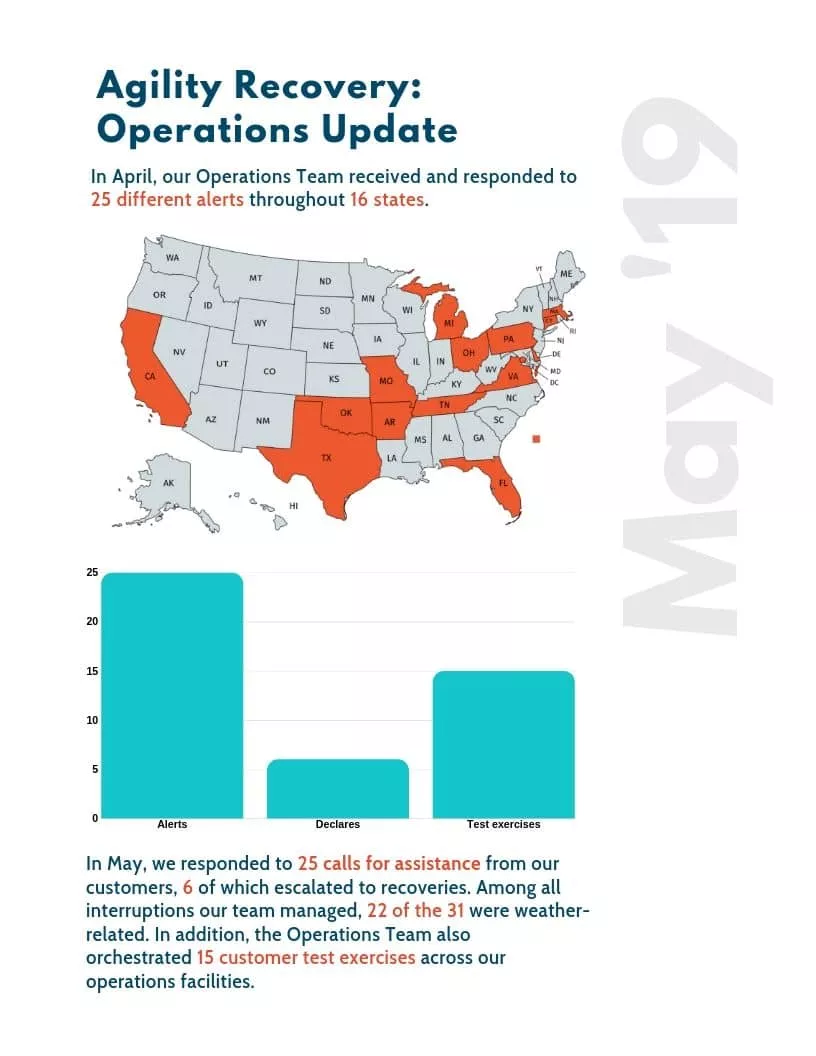
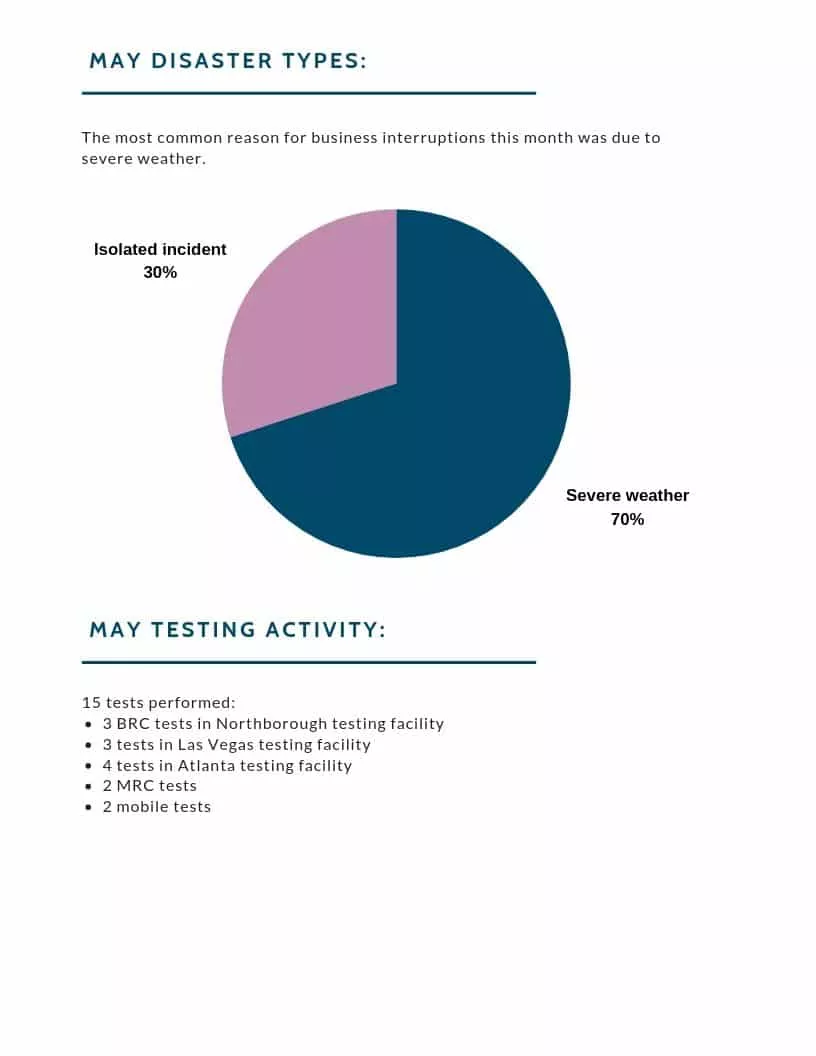
The majority of disruptions were caused by weather-related events, such as tornadoes. With a slight increase in recovery activity, we responded to 25 calls for assistance from our customers, six of which escalated to recoveries. Also, the Operations Team supported 16 customer test exercises across our operations facilities in Las Vegas, Atlanta, and Northborough.
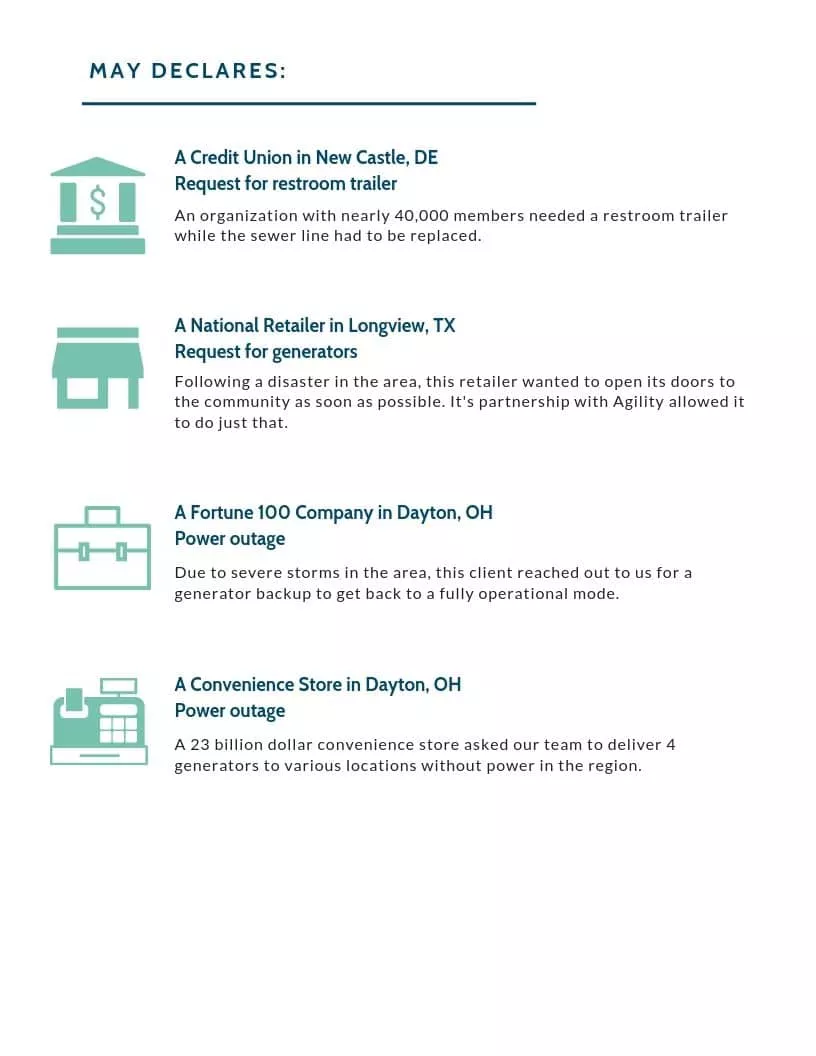
Here are four successful recoveries we’ve completed in May:
-
A credit union in New Castle, DE requested a restroom trailer. As they were undergoing construction, this organization with nearly 40,000 members needed a restroom trailer while the sewer line had to be replaced.
-
A national retailer in Longview, TX requested generators. Following a disaster in the area, this retailer wanted to open its doors to the community as soon as possible. Its partnership with Agility allowed it to do just that.
-
A Fortune 100 company in Dayton, OH experienced a power outage. Due to severe storms in the area, this client reached out to us for a generator backup to get back to being fully operational and be able to service their customers.
-
A convenience store in Dayton, OH faced power outage. A 23 billion dollar convenience store asked our operations team to deliver 4 generators to various locations without power in the region.
Our Operations Team successfully completed 15 different test exercises that involved 3 BRC tests in our Northborough testing facility, 3 tests in Las Vegas, and 4 tests in Atlanta. Besides showcasing the capabilities of our facilities, we also conducted 2 Mobile Recovery Center tests and 2 mobile unit tests.
We invite you to learn more about what we do or to chat about how we can help your business avoid any interruptions.
Our monthly report on the number and types of business interruptions we have responded to and companies we have recovered, providing our unparalleled business continuity and disaster recovery solutions.
Synopsis
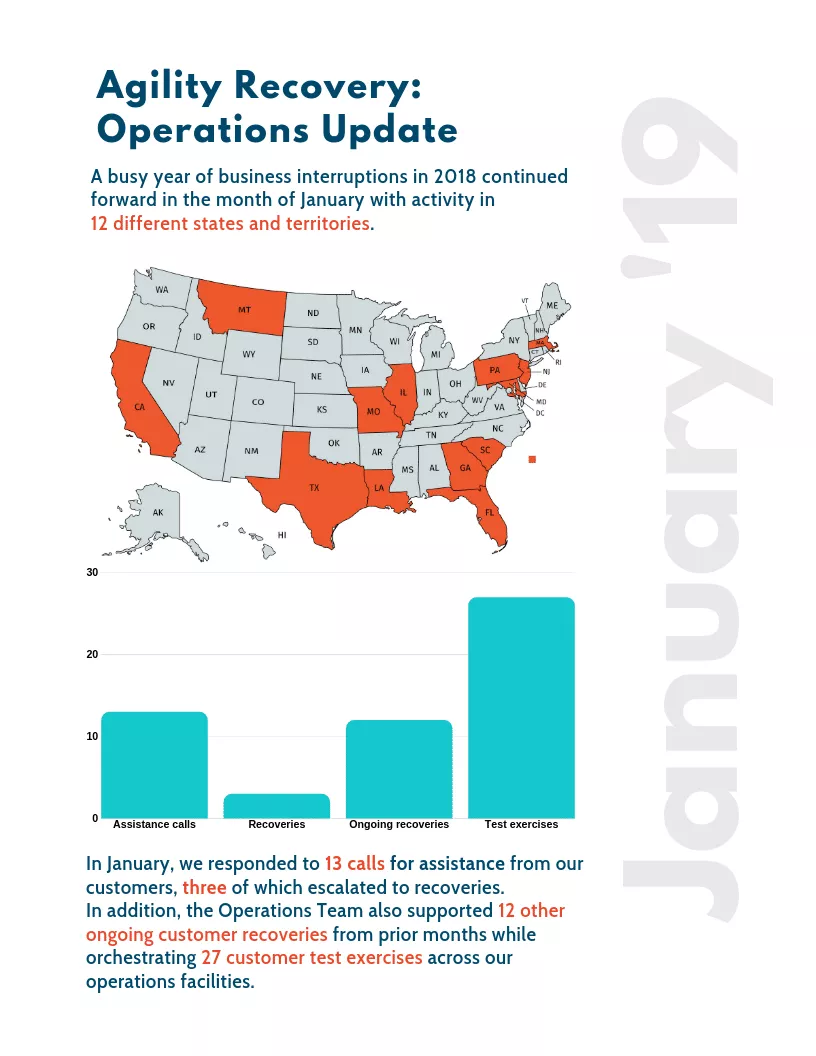
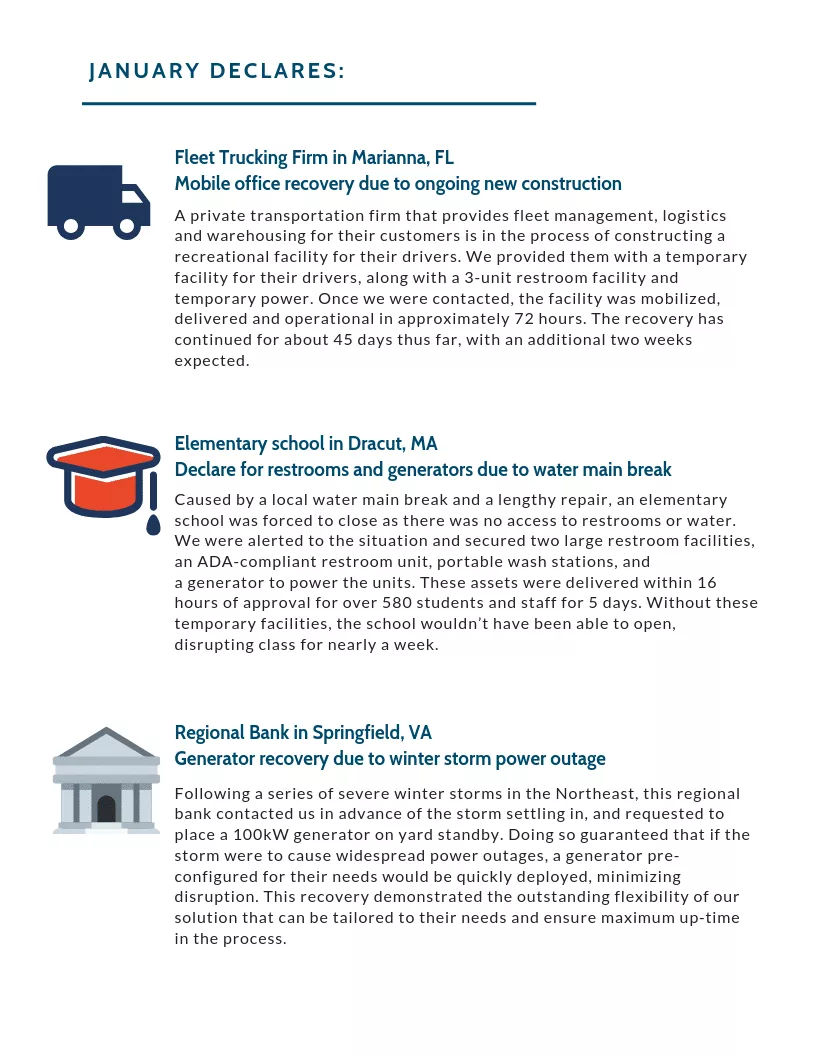
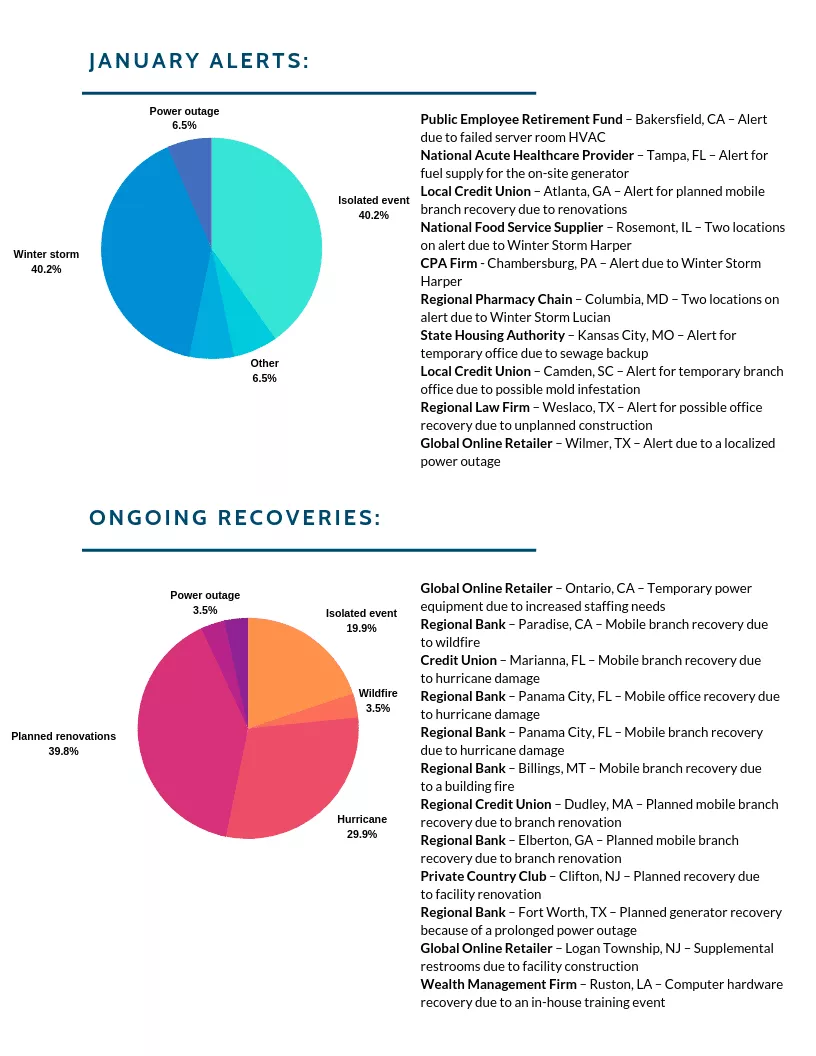
Business interruptions aren’t always mother nature’s plot. However, regardless of the type of interruption event, it’s never on a company’s agenda. From California to Florida, our response team helped businesses across 12 different states to minimize downtime and get back to serving their communities.
The Operations Team had a busy beginning of the year. As many as 13 businesses reached out to us for assistance, which is something we refer to as an alert. More specifically, an alert is a warning notice coming from our customer of a potentially dangerous situation their business may be facing. Placing a customer on alert helps our response team assemble all the necessary resources and, should the case escalate to an emergency situation (Declare Alert), our operations team will be deployed to the customer’s location to prevent business interruption. As for our customers, notifying Agility of a potential business threat provides them with a piece of mind.
Here are three successful recoveries we’ve completed in January:
-
A fleet trucking firm in Marianna, FL, needed a mobile office recovery as they launched a new construction project. Once we were contacted, the facility was deployed, mobilized, delivered, and operational in approximately 72 hours.
-
An elementary school in Dracut, MA, declared restrooms and generators due to a water main break. In 16 hours, our response team delivered the assets that services over 580 students and staff members for 5 days.
-
A regional bank in Springfield, VA, requested a generator recovery after learning about winter storm power outages in their region. Giving us notice in advance, we pre-configured a generator specifically for their needs allowing it to be quickly deployed in case of disruption.
In the meantime, we also supported 12 ongoing recoveries from previous months, making sure our clients have everything they need when they need it.
We invite you to learn more about what we do or connect with us to chat about how we can help your business avoid any interruptions.
JUNE OPERATIONS REPORT ON BUSINESS INTERRUPTIONS
In June, we deployed resources to three of our customers experiencing business interruptions. Seven additional customers placed us on standby after potential disruptions to critical business operations. Our teams faced a few planned interruptions, some weather related events, and even a bat infestation. There’s never a dull moment when it comes to supporting our customers and delivering on our promise. It truly isn’t a question of IF, but WHEN. – Agility CIO, Operations We also supported 12 ongoing customer recoveries and facilitated 30 customer test exercises throughout the month.
Our Team Performed Three Physical Recoveries
-
Training Class Needs Laptops
When this state government organization has a new training class, they need temporary laptops. They use our QuickShip technology service to smoothly run training operations without the cost of owning, maintaining, and replacing extra IT equipment. When they called us in June, we immediately shipped them 15 laptops with their computer image already loaded. Because we do not charge our customers a usage fee for our technology hardware, they paid only the shipping costs. -
Retailer Loses Power
This national retailer received notice about 3 days in advance of some nearby utility work that would cause a 7-day outage to their location in Torrance, CA. The store could not afford to close and did not want to force hourly wage workers to forgo a week’s paycheck. They called our operations team to request an on-site generator to power the store and remain open with no disruption. Our team deployed a 300kW generator the evening prior to the planned outage, ensured proper connection, and scheduled multiple fuel drops throughout the event. -
Insurance Firm Confronts Internet Loss
Our Fort Worth customer was in the process of moving offices when they learned they could not have internet service in the new building for two weeks. As with many commercial construction projects, there are inevitable delays. The firm needed connectivity to perform all of their critical business functions, especially their core service: verifying insurance coverage for commercial entities doing business together. A two-week interruption would have been catastrophic to their bottom line and their customers’ business processes. Their operations manager called our hotline and explained their needs. Our operations team shipped a switch and two LTE Cradlepoint devices the same day. They used the devices until their local internet was connected, saving their reputation and revenue.
We Saw These Other Unexpected Events
-
Colony of Bats Makes New Home in Insurance Agency
This local affiliate of an independent insurance agency recently discovered a bat infestation in their offices. Because bats create waste that causes contamination and disease, local authorities condemned the building until remediation could take place. -
Rain Floods Credit Union
This regional credit union in southwestern Texas near the Rio Grande River Valley operates 13 branch offices and serves more than 45,000 members. Following the largest rainstorm in the area in 15 years, their Mission, Texas location was forced to close its doors.The water damage to this location caused our customer to close and redirect members to an alternate branch nearby.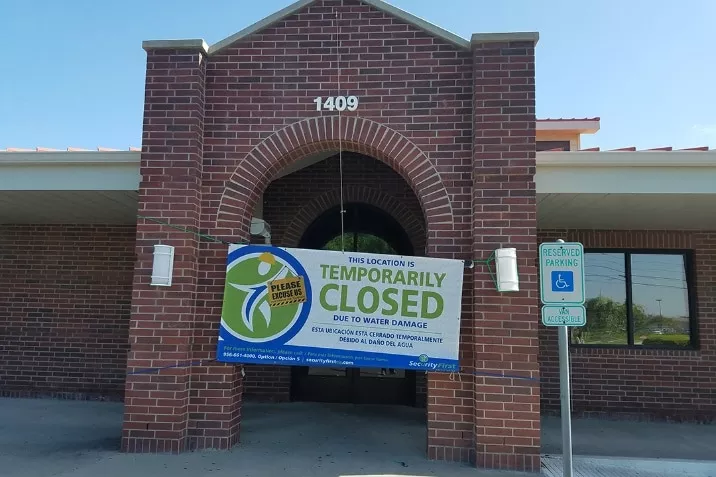
-
Water Shut Off at Insurance Firm
This Toronto non-profit covers dental providers with insurance and investment services. A massive water main break nearby left them with no water service, forcing them to consider shuttering the office of over 70 employees. Without water, no bathroom facilities would function properly. -
Online Retailer Loses Power
This customer learned a critical lesson about the importance of planning during a power outage at their Seattle, Washington location. A local distribution facility for this global online retailer experienced multiple rolling brown and blackouts forcing them to halt operations. This facility housed large refrigeration units to allow for fresh food delivery in local markets. Unfortunately, this location wasn’t covered under our services and they had not submitted their specifications for temporary generator power. Luckily local power was restored in time to prevent any loss of inventory, but on-site leadership made sure to request coverage by us and completed their generator requirements worksheet for the next time temporary power is needed.
Additional Notable Alerts
- Large Investment Firm – Warrendale, PA – Alert for replacement technology due to water damage caused by power fluctuations
- National Retailer – Wilkes-Barre, PA – Alert for temporary power due to nearby tornado damage
- Regional Credit Union – Perry Point, MD – Alert for mobile bank branch recovery due to a vehicle vs. building accident
Ongoing Business Recoveries from Prior Months
We also supported 12 other ongoing recoveries during the month of June including the following:
- Regional Bank – Billings, MT – ReadyFinancial mobile bank branch to a building fire
- Regional Credit Union – Dudley, MA – Planned relocation due to branch renovation
- Regional Bank – Elberton, GA – Planned relocation due to branch renovation
- Medical Equipment Supplier – Jacksonville, FL – Site-to-site VPN Cradlepoint device due to ISP outage
- Global Logistics Firm – Atlanta, GA – Communications recovery due to an office relocation
- Global Online Retailer – Seattle, WA – Temporary restrooms due to increased staffing
- Private Country Club – Clifton, NJ – Planned relocation due to facility renovation
- Local Credit Union – Gadsden, AL – Planned recovery due to new employee training
- Regional Credit Union – St. Petersburg, FL – Planned recovery due to new branch construction
- Regional Bank – Houston, TX – Planned long-term relocation due to closure of an existing location
- Small Municipality – Cavendish, VT – Office space recovery due to a building fire at a garage facility
- Small Municipality – Lafayette, OR – ReadySuite mobile recovery due to a building fire at one of their utility plant locations