
Dear Valued Members,As CEO of Agility Recovery, I am thrilled to announce an exciting milestone in our journey to support your business continuity and resilience. On December 2, 2024, we launched MyAgility, our new continuity planning and recovery platform designed to empower your organization like never before.
A Platform Built with You in Mind
The MyAgility platform is the result of direct collaboration with you—our valued members. Your insights and feedback have shaped every aspect of MyAgility, ensuring it meets the unique challenges of today’s dynamic business environment. MyAgility is more than just a tool; it is your partner in preparedness and recovery. Its intuitive design makes it easy to organize contacts, store vital documents, and access planning resources—all from a centralized platform. With enhanced features like emergency messaging and pre-set notification lists, MyAgility ensures you’re ready to respond swiftly to any disruption.
Seamless Onboarding & Support
We’re here to make your transition to MyAgility smooth and hassle-free. To support your onboarding, we’ve prepared these helpful resources:
- MyAgility Set-Up Guide
- Live Webinar on December 3, 2024 (Access the recording here)
- 24/7 Support from our dedicated account managers and customer success team
No Additional Cost, Just Added Value
MyAgility will be available to all existing members at no additional cost. This reflects our unwavering commitment to delivering value and ensuring you have the tools to navigate challenges with confidence. At Agility Recovery, we believe in empowering you to protect what matters most: your people, your operations, and your reputation. MyAgility is a cornerstone of that mission, and we are excited to take this next step forward together. If you have any questions or would like more information, please don’t hesitate to contact your dedicated account manager or email us. With gratitude, Mark San Fratello CEO, Agility Recovery
The 2024 hurricane season is here, and businesses in hurricane-prone regions need to be prepared.
This year, the National Oceanic and Atmospheric Administration (NOAA) predicts an above-average season, with 17-25 named storms, 8-13 hurricanes, and 4-7 major hurricanes. AccuWeather agrees, “forecasting 20-25 named storms across the Atlantic basin in 2024, including 8-12 hurricanes, four to seven major hurricanes and four to six direct U.S. impacts.” This article will cover when hurricane season is, what regions are impacted, predictions for the 2024 hurricane season, learnings for businesses from past hurricane seasons, and how businesses can prepare for the 2024 hurricane season.
When Is Hurricane Season and Which Regions Are Impacted?
The Atlantic hurricane season, which officially begins on June 1 and concludes on November 30 each year, is a period of heightened activity during which tropical cyclones, including hurricanes, are most likely to develop over the Atlantic Ocean. Historically, peak activity occurs in August and September. The areas that are most frequently affected by hurricanes are located near the Atlantic Ocean and the Gulf of Mexico, including the southeastern and coastal states of the United States, as well as Mexico, Central America, and the Caribbean islands. These regions bear the brunt of severe weather conditions such as torrential rainfall, high winds, storm surges, flooding, and significant property damage. Businesses located in hurricane-prone regions must be well prepared to minimize disruptions and ensure their safety during the hurricane season. Proper preparation involves staying informed about hurricane forecasts, developing comprehensive disaster response plans, and implementing measures to protect employees, property, and assets.
2024 Hurricane Season Predictions
As the 2024 hurricane season approaches, experts are predicting another active year in the Atlantic basin. The National Oceanic and Atmospheric Administration (NOAA) recently forecasted 17 to 25 named storms , with 8 to 13 of them becoming hurricanes, including 4 to7 major hurricanes with winds of 179 mph or higher. Colorado State University predicts , with "above-normal confidence," a "well-above average probability for major hurricanes making landfall along the continental United States coastline and in the Caribbean," with 23 named storms . These numbers are above the 30-year average of 14 named storms, 7 hurricanes, and 3 major hurricanes. The Texas coast, Florida Panhandle, South Florida, and the Carolinas are most likely to experience direct hits. AccuWeather meteorologists, too, warn of increased activity and the potential for a “blockbuster” hurricane season and " forecasting 20-25 named storms across the Atlantic basin in 2024, including 8-12 hurricanes, four to seven major hurricanes and four to six direct U.S. impacts." This is due to several factors, including:
- – Favorable oceanic and atmospheric conditions
- – Warmer-than-average sea surface temperatures: Mid-February Atlantic water temperatures were the same as those typically experienced in July and temperatures at the end of January were 65% higher than the next closest year
- – Reduced wind shear as El Niño transitions to La Niña
These conditions could create a conducive environment for the formation and intensification of hurricanes, potentially leading to more frequent and powerful storms. If La Niña doesn't officially develop until August or September, the fall months will see the highest hurricane activity. Furthermore, long-term climate change remains a significant factor, driving sea levels higher, intensifying storm impacts, and making coastal communities more vulnerable to severe hurricane damage. NOAA emphasizes the continued significance of ongoing monitoring, planning, and preparedness measures to minimize the potential damage and risks associated with the 2024 hurricane season. While this initial forecast provides a general outlook, the specific tracks and intensities of individual storms can only be forecasted closer to the time of their formation.
Plan, Prepare, and Test Your Plan
Download our hurricane tabletop exercise to test your emergency preparedness plan.
2024 Hurricane Names
The 2024 hurricane names list has been released by the World Meteorological Organization (WMO):

These names will be used when tropical storms and hurricanes develop in the Atlantic Ocean and Eastern Pacific Ocean during the 2024 season. The list of names is generated by the WMO's Hurricane Committee, which consists of representatives from all the countries in the Atlantic and Eastern Pacific hurricane basins. The committee meets every year to review the previous hurricane season and make recommendations for the next one. The names are chosen from a rotating list of English, French, Spanish, and Portuguese names. Names that have been used in previous years are retired from the list, and new names are added to replace them. In the event that all names are used, the WMO will turn to supplemental lists.
Lessons from Past Hurricane Seasons
The impact of past hurricane seasons on businesses provides valuable lessons for proactive preparedness.
Importance of Real-Time Data
One significant learning is the importance of continuous monitoring and real-time information. Businesses that invest in robust weather tracking and monitoring systems can stay ahead of developing weather patterns and make informed decisions based on reliable forecasts. Real-time data empowers them to take timely actions such as implementing emergency response protocols, evacuating personnel, or securing critical infrastructure, minimizing potential damage and disruptions.
Need for Thorough Disaster Recovery and Business Continuity Plans
Past hurricanes also highlight the need for robust disaster recovery plans that ensure business continuity. Companies should proactively collaborate with relevant stakeholders to develop comprehensive plans that address every aspect of post-hurricane recovery. This includes assessing potential damage, outlining restoration procedures, securing supply chains , and establishing backup facilities. By doing so, businesses can mitigate downtime and restore operations swiftly, reducing financial losses and maintaining customer satisfaction.
Establishment of Effective Emergency Communication
Furthermore, past hurricanes have highlighted the significance of effective communication during emergencies . Establishing clear communication channels and protocols ensures that all employees receive timely updates, instructions, and safety guidelines. Businesses should regularly conduct drills and training sessions to ensure that employees understand and adhere to these protocols, enhancing overall safety and minimizing confusion and panic in critical situations.
Maintenance of Records and Documentation
Lastly, post-hurricane recovery often involves interactions with insurance companies , government agencies, and various contractors. Businesses that maintain accurate records and documentation, including photographs, estimates, and receipts, streamline the claims and reimbursement process. Proactively assembling these records can significantly expedite the recovery process, reducing financial burdens and facilitating smoother operations.
How to Prepare for the 2024 Hurricane Season
As the 2024 hurricane season approaches, businesses must take proactive measures to ensure their continued operations and protect their assets. Here are some essential steps that businesses should consider to prepare for the upcoming hurricane season.
1. Establish a Hurricane Readiness Plan
Develop a comprehensive hurricane preparedness plan that outlines specific protocols and procedures to be followed before, during, and after a hurricane. Clearly define roles and responsibilities for employees, ensuring that everyone knows their tasks and has access to necessary resources. This plan should include steps such as securing facilities, managing inventory, and maintaining communication channels.
2. Invest in Disaster Preparedness Supplies
Stock up on essential disaster preparedness supplies such as flashlights, batteries, non-perishable food, and water. Ensure that your business has sufficient supplies to sustain operations and support employees in the event of a prolonged power outage or disruption of supply chains.
3. Secure Physical Infrastructure
Conduct a thorough inspection of your business premises to identify potential vulnerabilities to hurricane damage. Reinforce or repair any weak points in the structure, including roofs, windows, and doors. Trim trees and branches near your property to minimize the risk of damage from falling debris.
4. Protect Critical Data and Equipment
Back up critical business data regularly and store backups off-site to protect against data loss in case of flooding or severe damage. Consider investing in surge protectors and power generators to keep essential equipment operational during power outages.
5. Plan for Evacuation and Employee Safety
Develop an evacuation plan that outlines the designated evacuation routes and assembly points for employees. Ensure that employees are familiar with the plan and know how to reach these designated locations quickly in case of an emergency. Regularly conduct evacuation drills to ensure that employees are prepared and can respond effectively.
6. Foster Effective Communication
Establish clear communication channels to keep employees, customers, and suppliers informed about your business status during a hurricane. Regularly update your website, social media platforms, and designated communication channels with accurate and timely information. Don't forget remote and hybrid employees ; ensure you have a way to communicate with anyone in the storm's path and confirm their safety.
7. Educate Employees Through Training and Exercising
Conduct training sessions for employees to educate them about hurricane risks and safety measures. Emphasize the importance of staying informed, following instructions, and being prepared at all times. Beyond training sessions, your organization should exercise its preparedness plans through tabletop or live tests to make sure everyone understands their roles and identify any gaps in the plans.
8. Coordinate with Local Authorities
Stay informed about local hurricane preparedness plans and guidelines, as well as relevant regulations and restrictions that may be imposed during a hurricane event. Build strong relationships with local emergency management agencies and community organizations to access critical resources and support when needed. By taking these proactive measures, businesses can significantly enhance their preparedness for the 2024 hurricane season, minimizing potential disruptions, and safeguarding their operations, employees, and assets.
In today's interconnected world, businesses rely heavily on technology and remote work arrangements to maintain productivity and competitiveness.
However, unexpected disruptions such as natural disasters, power outages, or cyberattacks can severely impact an organization's ability to operate effectively. To mitigate these risks, businesses must prioritize business continuity planning and ensure that remote and hybrid workers have the necessary tools and strategies in place to maintain productivity and minimize downtime during disruptive events. This article provides essential tips and strategies for remote and hybrid employees to help their organizations maintain business continuity and ensure seamless workflow even in the face of adversity.
What Is Business Continuity?
In today's fast-paced and interconnected business landscape, organizations face a multitude of challenges that can disrupt their operations and jeopardize their ability to deliver critical services. From natural disasters and cyberattacks to pandemics and power outages, the potential threats to business continuity are diverse and unpredictable. Business continuity refers to the proactive measures and strategies an organization implements to maintain its essential functions and processes in the face of disruptive incidents. Effective business continuity planning involves a comprehensive approach that encompasses identifying potential risks, assessing their impact on operations, and developing robust plans to mitigate or respond to these disruptions. The goal is to minimize downtime, protect critical assets, and ensure the ongoing delivery of essential services, thereby preserving an organization's reputation and competitive advantage. The foundation of business continuity lies in the development and implementation of well-defined plans, policies, and procedures. These frameworks outline the specific actions and protocols that employees must follow during disruptive events to maintain productivity and minimize the impact on customers and stakeholders. Regular testing and updating of these plans is crucial to ensure their effectiveness in real-world scenarios.
How Business Continuity Impacts Remote and Hybrid Workers
For remote and hybrid workers , business continuity can be particularly challenging. Remote employees often have limited access to the resources and support that they would have in a traditional office setting. This can make it difficult for them to maintain productivity and efficiency in the face of disruptions. For instance, if there is a power outage in their area, remote workers may not be able to access the necessary tools and systems to continue working. Remote workers are also more susceptible to disruptions to their internet connectivity or power supply. This can be a significant challenge, as a reliable internet connection is essential for remote work. If a remote worker's internet connection drops, they may not be able to access the necessary files or applications to complete their tasks.
Essentials for Remote and Hybrid Workers to Maintain Business Continuity
To ensure smooth continuity of business operations in a remote work setup, several essential strategies and resources should be in place.
Safe Work Environment
Establishing a safe and conducive work environment is paramount, ensuring that remote workers have the necessary tools and a comfortable space to work effectively. This may involve setting up a dedicated workspace, using ergonomic furniture, and investing in noise-canceling headphones.
Backup Power and Connectivity

Power disruptions can pose significant challenges for remote work. To mitigate this risk, employees should have a reliable backup power source , such as a UPS (Uninterruptible Power Supply) or a portable generator . Additionally, having multiple options for maintaining internet connectivity is essential. This can include a primary wired connection, a mobile hotspot, and/or a USB tethering option. Devices like Agility Recovery’s ReadyTechGo can provide both power and connectivity, even during severe weather and blackouts.
Communication
When employees may be working from anywhere, it's critical to ensure you know how to get in touch with them in case of a disaster. A well-structured communications plan should be established, outlining how team members will stay connected and collaborate during disruptions. Additionally, consider implementing a bi-directional form of emergency messaging with multiple modes of communication such as phone, SMS, and email.
Cybersecurity
Remote workers should use a virtual private network (VPN) to secure their internet connection and protect sensitive data. Regularly updating software and operating systems is crucial to maintaining security and ensuring compatibility with essential tools and platforms.
Emergency Kit
Last but certainly not least, every employee should have an emergency kit readily available for them and their loved ones containing essential supplies such as food, water, first aid items, and charging devices. By implementing these strategies, remote workers can enhance their preparedness and minimize disruptions, ensuring business continuity even in challenging circumstances.
Conclusion
Effective business continuity planning is crucial for organizations to function smoothly, especially if they have remote and hybrid employees . By identifying potential risks, assessing their impact, and developing strategies to mitigate them, remote workers can significantly contribute to maintaining business continuity. By utilizing strategies such as creating a safe and conducive work environment, having a backup power source, maintaining multiple internet connectivity options, having a structured communications plan, using a VPN, and preparing an emergency kit, remote employees can minimize disruptions and ensure business continuity even in challenging circumstances. Implementing these measures not only enhances the organization's resilience but also fosters employee confidence and productivity, ultimately contributing to overall success and sustainability.
Every business faces various winter weather threats during the snowy season, from strong rainstorms and ice to plummeting temperatures. Knowing the tactical steps to prepare your business for winter weather is essential to avoid downtime. Being prepared with an actionable plan will minimize the impact inclement weather can have on your employees, customers, and revenue. Having actionable resources at hand will help your team be educated on what to do in extreme winter weather conditions and actions they need to avoid to stay safe. An effective way to strategize is to enlist a team of people to perform a winter weather tabletop exercise. This exercise should last between two to three hours, spending time as a group defining the risks of extreme winter weather, exploring different scenarios, and putting together a plan of action to use when winter weather strikes. Performing this task as a group is an excellent way to cover the entire scope of possibilities and solutions during a winter weather crisis. If you want to ensure you remain in business all winter, this exercise will help you formulate your business’s best plan.
Consider All Risks
The first step when preparing for winter weather disruptions is to define all of the possible risks of not being ready for a storm and how they will impact your organization as a whole. With proper preparation, the avoidance of these risks If severe winter weather hits the area where your business is located, the following could potentially occur:
- Power loss
- Fires
- Floods
- Communications disruptions
- Supply chain disruption
- Property damage
- Employee injury or illness
- Transportation disruption
- Automobile/other transportation accidents
- Compromised access to facilities
- Personal exhaustion, hypothermia, heart attack
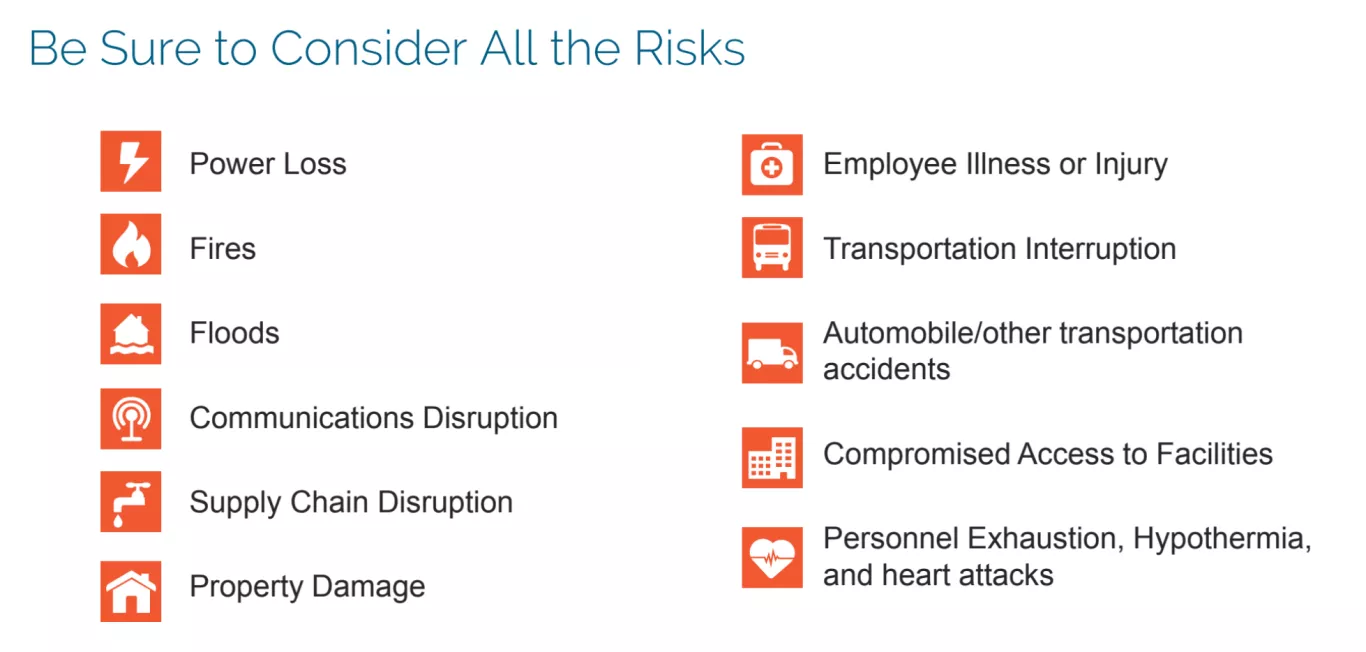
It is essential to evaluate potential risks and outcomes to create an efficient inclement weather plan. Each business will have unique risks, so defining the possible scenarios ahead of time is important. Troubleshooting will eliminate most of the risks, and having risk management strategies outlined will ensure handling the events will be managed quickly and effectively. Once you have isolated and defined individual risks, it is good to prepare a plan of action for each incident. Having all bases covered is key to keeping business continuity intact during the winter months.
Drafting Winter Storm Plans in Stages
Before the Storm
The worst possible scenario for a business is to attempt to cobble together a plan when a storm is on its way or already in your area. Covering these elements ahead of time will enable you to move straight to your plan of action when the storm hits:
- Review insurance coverage (flooding)
- Evaluate the potential risks to determine your business’s most detrimental risks and their potential outcomes: loss of heat, frozen pipes, and inability to access your business site due to snow and ice.
- Identify who will be in charge of clearing the snow and ice from the property – the business owner or landlord.
- Establish a procedure for restoring electrical service on an item-by-item basis (know your electrical load demands ahead of time)
- Determine alternate routes to access business in the event ice or snow blocks main entrances
- Establish an inclement weather attendance policy for employees
- Meet with and discuss your winter weather preparedness plans with your vendors
- Stockpile emergency supplies as needed
- Rocksalt, snow equipment remover, kitty litter, and sand
- Service generators and top off fuel reserves
- Ensure all battery-powered devices have new batteries or crank/solar chargers
- Establish shelter locations and stockpile supplies on location for your employees
- Know ahead of time what local broadcasters will publish the status of your business to the public
- Ensure redundant communication channels (phone lists of employees and their relatives/spouses, backup email addresses, etc.)
- Establish remote access to your corporate website to update your business’s status to vendors
Winter weather is challenging to plan for due to its unpredictable nature. Winter storms are apt to occur with little to no warning, so creating and reviewing a solid plan will prevent panic, leading to serious mishaps and consequences.
During the Storm
Now that you are in the midst of the storm, it is time to implement your plan. If your business has participated in a winter weather tabletop exercise, you can handle events associated with harsh weather as they occur.
- Stay informed and communicate regularly.
- Watch for rapidly changing weather conditions.
- Ensure employee and customer safety and well-being.
- Stay indoors as much as possible.
- Work periodically to keep doorways, walkways, and driveways clear of ice.
- Let faucets drip to keep water flowing in the case of prolonged, low temperatures.
- Keep the contact information for your heating contractor, plumber, fire department, insurance agent, and building owner accessible.
- If your building will remain vacant for a long period of time, assign someone to check indoor temperatures
- Do not overload circuits in your facility with space heaters or other large appliances.
- Locate your emergency weather radio.
- Conserve fuel if necessary.
- Locate water, gas, and power shut-off locations.
Knowing your business’s specific protocol for handling winter weather is imperative to keeping your business up and running during a storm and maintaining operations during prolonged bad weather.
ZERO HOUR: When a Storm is Imminent
You and your team have done the work, researched, and created a safety plan tailored to your business’s operations. Now it is time to implement the procedure and watch as your business weathers the storm.
- Follow the plan. Be decisive and trust the plan.
- Stay abreast of the storm’s status to avoid surprises.
- Alert 3rd party crisis response providers.
- Enact emergency evacuation or shelter-in-place plans for employees.
- Activate your crisis communication plan.
- Secure facilities, buildings, and inventories.
- Don’t be complacent during downtime (losses can incur quickly).
- BE PREPARED TO SELF-SUSTAIN FOR 72 HOURS OR MORE.
Common Mistakes Made During Crisis
- Ignoring warnings
- Being unprepared for long-term power and communication outages
- Unprepared for generation connection (no transfer switch, fuel provider, spider box, or working knowledge of load requirements)
- Failure to prepare for supply chain disruptions
- Failure to adequately stock emergency supplies
- Failure to communicate
- Failure to obtain adequate insurance coverage for loss of use, loss of revenue, and added expense
- Failure to establish emergency procedures and providers for call forwarding, temporary power, communications provider, etc.
It is very easy to panic when wintery weather threatens your business’s continuity. Knowledge of potential mistakes that happen gives the team working on this exercise the power to make the plan as failsafe as possible.
Winter Weather Preparedness Checklist
Our team of experts has put together a brief yet comprehensive winter weather preparedness checklist for your convenience. Use it to help guide your workforce through the most basic safety steps. Aside from the tactical steps, supplies, such as non-perishable foods, need to be prepared in advance:
- Bottled water (at least one gallon per person per day for at least three days)
- Canned goods, especially cozy, warming foods like soups and stews
- Snack foods like chips, crackers, and cookies in sealed packages
- Cereal and granola
- Anything jarred, from jellies to pickles to meats
- Canned tuna and salmon
- Dried pasta and jarred sauce
- Wax-sealed hard cheeses
- Salted butter, which lasts longer at room temperature than unsalted butter
- Dried fruit
- Nuts
- Jerky
- Energy bars
- Shelf-stable juice
- Coffee, tea, and hot cocoa mix (and maybe some marshmallows)
- Extra paper products like toilet paper and paper towels
Learn the Difference Between Winter Weather Advisories, Watches, and Warnings
According to FEMA, these define the three winter weather advisories: Winter Weather Advisory is issued when snow, blowing snow, ice, sleet, or a combination of these wintry elements is expected, but conditions should not be hazardous enough to meet warning criteria. Be prepared for winter driving conditions and possible travel difficulties. Use caution when driving. Winter Storm Watch is issued when conditions are favorable for a significant winter storm event. Heavy sleet, heavy snow, ice storms, blowing snow, or a combination of these events are possible. Winter Storm Warnings are issued for a significant winter weather event, including snow, ice, sleet, blowing snow, or a combination of these hazards. Travel will become difficult or impossible in some situations. Delay your travel plans until conditions improve. If you are armed with this information, you and your team will be able to plan for the worst and expect the best. Agility Recovery Solutions helps businesses plan for unexpected business interruptions, avoid unexpected interruptions, and become resilient. In the event your business is affected by a disastrous winter storm, Agility Recovery Solutions is there to help you remain in business. Our mission is to reduce the impact of business interruptions on organizations and the communities they serve. We help businesses stay in business. Our purpose is to help businesses be prepared before, during, and after an incident. After decades of helping businesses recover from real disasters and manage through emergency messaging incidents, we bring the collective experiences of thousands of hours in the field. We’ve evolved into the leading business continuity and disaster recovery end-to-end solution in the market.
Want to know the secret for keeping your manufacturing business running even after it experiences a disaster? Good business owners know that their companies’ ongoing success and well-being depend on operational resilience. The manufacturing industry is no exception. So, manufacturers need to have business continuity plans . It’s best to form these plans as soon as you launch your manufacturing company. Without them, you run the risk of frustrating clients and not generating as much revenue. Below, we’ll get into some key things you need to know about developing and preserving business continuity. Keep reading to learn more.
What Challenges Do Manufacturing Companies Face?
A manufacturing company faces many of the same emergency preparedness challenges that other companies confront. Yet, there are some key differences. Manufacturing companies might be especially vulnerable to certain kinds of risks. Because the manufacturing industry relies on the ability to promptly create and deliver items to customers, companies might stagnate if their internal problems interfere with this process. Your goal as a manufacturing leader should always be to get your products to your consumers as fast as you safely can. To accomplish this, you need to avoid staffing, equipment, and materials disruptions . If you work long enough, you have a high probability of encountering problems in at least one of these areas. Companies with a solid business continuity plan fare better during these times.
What Areas Should Your Plan Include?
A smart business continuity plan doesn’t only look toward the future. It involves looking at what you can do in the here and now to make sure you stay afloat during an emergency. To get started on formulating a business continuity plan, you’ll need to call a team meeting that includes your company leaders. You should identify some of the specific risks to your company. You should also focus on prevention whenever possible. Then, look at the resources you’ll need if these things happen. If it’s not possible to prevent an emergency from occurring, figure out the likelihood of it happening. Then, look at its potential impact on your business. You should plan for the most likely emergencies first. In the past, business continuity plans were difficult to formulate and required a lot of long hours from workers. Now, that’s not the case.
Incident Management
The main goal of any business continuity plan should center on doing as much prevention as possible. As such, you need a system that allows you to share what you’d like your employees to do. Always start with creating action lists for your workers. Action lists let them know what needs to get done when certain circumstances happen. As people complete the actions, they can check them off the list. Incident management puts you in control in the case of an emergency. You’ll also get real-time updates, so you can oversee how your employees are handling the crisis. Be sure to review your plan in advance. You can identify potential fail points and correct them before an emergency happens.
Emergency Contact System
After identifying your potential problems, you’ll want to develop a robust emergency communication system. Communication is essential when you have an ongoing emergency. In some cases, the emergency will involve physical danger to your workers. Your employees will need to know how to adapt and alter their actions in all cases. You need a communication system that allows you to share information. It should also give your employees the ability to ask questions and communicate updates. MyAgility allows you to send mass messages that include information about potential hazards and employee instructions. These messages are bi-directional, so your workers can reply. You’ll know if they need resources to handle the emergency, and you can check on their safety. MyAgility also lets you send out updates to people. You can let your employees know when the situation evolves and give them updated instructions. You can also let them know when the situation has concluded, and they can go about business as usual.
Planning, Testing, Training, and Exercising
After you finish the planning phase, you need to get into testing , training, and exercising . An emergency isn’t the time to teach your employees about your plan. Instead, everyone should know about the plan beforehand. You should train them on how to implement the plan. For the best results, go through exercises with them. That way, they’ll have the ability to execute the plan without needing someone to walk them through it.
Ready to Improve Your Emergency Response?
Your manufacturing business needs to have a quick and dynamic response to the emergencies it might face. Business continuity planning helps you avoid as much disruption as possible and keeps you on track to meet your business goals. When you put time and effort into your business planning, you’ll save yourself money and keep your employees safer. Ready to improve your response to emergencies? Contact our team to get started.
Unlike hurricanes or tornadoes , earthquakes don't occur at predictable times or in predictable patterns. Earthquakes rarely give any warning, which is why they present such a challenge to preparedness. One earthquake doesn't cause much damage, but large earthquakes can cause widespread destruction and loss of life. Any organization's emergency plan should consider how to protect employees, assets, and business continuity. In this article, you'll learn the best ways to prepare for the unexpected and keep your business intact.
Preparing Your Company for an Earthquake
Earthquakes are one of the most significant threats to business continuity, with devastating effects on companies, employees, and customers. Earthquakes occur in remote, high-risk areas with few or no warning systems, making them nearly impossible to predict. In the aftermath of an earthquake , employees are often left without access to their offices, computers, or other critical infrastructure they need for their jobs. Moreover, disasters often disrupt transportation networks, telecommunications lines, electricity grids, and water and sewer systems, making it difficult for employees to get to work. You can reduce the potential impact of an earthquake on your business by ensuring that you have an emergency plan and conducting regular earthquake preparedness drills. This enables you to assess your workplace's vulnerabilities and plan for potential disruptions, which can reduce the chances of injury and damage.
Establish an Emergency Plan
You should establish your company's emergency plan ahead of time. In addition to routinely training employees on what to do during an emergency, you should encourage all the key stakeholders in your company to participate in an emergency training exercise. You and the key stakeholders should also establish an alternate worksite if possible. In a natural disaster, your employees will appreciate the level of preparation you put into a disaster plan.
Design Your Company’s Emergency Plan With the Following
- – In the event of an earthquake, it is essential to establish a designated emergency area outside of the workplace. Ideally, the location should be open-air and free of other buildings or power lines. Make sure that your employees are aware of the site of the designated emergency area.
- – After evacuation, designate one or more individuals to conduct a roll call of employees, depending on the size of your company.
- – Having teams handle basic first aid, search and rescue, fire and evacuation, damage assessment, and security is an excellent way to involve your employees in the process.
Prepare Disaster Supply Kits
You can also mitigate your employees' injury rate if you have a disaster supply kit on hand after an earthquake. During a time of any disaster, you may lack access to food, water, and information, for some time. A disaster supply kit at your workplace needs to contain, at the very least, the following:
- – Bottled water
- – Hand-crank or battery-powered radio
- – Additional batteries
- – Emergency first aid kit
- – Emergency whistle
- – Local maps with information about the nearest hospital and police station
- – Chargers and backup batteries (or power banks) for cell phones
- – Pain relievers and other non-prescription medications
Develop a Business Continuity Plan (BCP) and an Emergency Action Plan (EAP)
Business continuity plans and emergency action plans are essential components of every business. BCPs ensure that a company's ability to respond to and recover from the unexpected is protected and minimizes downtime for the organization. Your employees need an EAP in case of an emergency to know what to do. Getting expert assistance can be an excellent way to build a fully actionable EAP and BCP for business owners without the time or expertise to do so themselves. The best way to determine whether your plan will effectively protect your organization is to partner with Agility’s expert business continuity testing team to develop a testing protocol tailored to your unique needs. Both weather and technology failures can account for power outages. Business owners should prepare businesses to support their productivity even when faced with a power outage and consider a backup plan that includes additional computer equipment , an emergency power supply like a generator , or a portable power and connection pack like ReadyTechGo .
Store Information Remotely
Businesses should have all critical company information, including client data, work orders, contracts, intellectual property, marketing information, and other sensitive materials, safely stored in the cloud if an unexpected disaster hits. Businesses should also have critical business data, like employee training records, sales records, and financial statements, on a remote server. Having the valuable materials mentioned above will enable your company to do business still while handling the aftermath.
Prepare Your Employees to Deal with Emergencies with Training and an Emergency Messaging System
As a result of a natural disaster, time is essential, and you must take action immediately. A person may become overwhelmed in a moment of crisis and freeze up when they should be acting quickly. Organizations that are likely to be affected by natural disasters should prioritize preparing their employees to respond to natural disasters such as hurricanes or power outages.
Importance of Earthquake Awareness
Earthquakes can cause significant disruption for businesses and their employees. Employees who are knowledgeable and prepared for earthquakes are safer and less likely to become seriously injured. Companies that establish an emergency preparedness plan are more likely to recover from the aftermath of an earthquake. Contact Agility today to strengthen your resilience against earthquakes and other disasters.
The new era of business continuity forces us to prepare for business as unusual. The workforce is more distributed than ever, with 83% of businesses now using work from home as part of their recovery strategy. Since the start of the pandemic, 12% of employees have moved more than 50 miles from their office, and an additional 22% are considering or planning to move 50 miles or more from their office (PWC). Many organizations plan a hybrid approach to returning to the workplace.
The world has continued to see relentless major weather events throughout the course of the pandemic, including an ice storm in Texas that knocked out power, hurricanes that caused flooding and disaster from the Gulf to the East Coast, a first-ever derecho in the Midwest, and fires across the western part of the U.S.
Recovery Strategy Needs to Evolve for Business as Unusual
Recovery strategy has permanently changed, largely due to the combination of the pandemic along with more frequent, more widespread, and more potent natural disasters, and further complicated by distributed workforces. In the past, most organizations had to think only about recovering one location; with a distributed workforce, that one location may have turned into dozens or even hundreds of disparate sites. How will you plan to recover all those locations when employees are working from home – rather than an office? How will you manage the next interruption to your business operations in a world where the office isn’t just in one place – it’s everywhere?
We live in a time when business is anything but usual, and with that comes a new era of business continuity.
ReadyTechGo: Mobile Productivity Solution for a Work-From-Anywhere World
That’s why we’re excited to introduce Agility ReadyTechGo, the solution for a work-from-anywhere world. In times of need, Agility ReadyTechGo delivers the ability to power ahead with cellular connectivity, one-touch Wi-Fi setup, and 24/7/365 support. It’s a lightweight, rugged, waterproof, and mobile solution with a high-capacity battery backup that’s available for your team when and where they need it most. ReadyTechGo packs are available on demand for Agility customers or to keep on hand for anytime usage.
MyAgility gives you enhanced bi-directional messaging capabilities. Deliver messages in a cascading fashion by controlling which of the five modes of communication goes out first – for example, beginning with SMS, and if there’s no response, sending a push notification, and going down the list from there.
In a world where the work site happens across multiple sites, now your recovery, and your return to normalcy, can as well. We look forward to sharing these innovations with you and giving you a head start in your business continuity and recovery efforts.
Jon Bahl, CEO, Agility

Regardless of whether you are afraid of ghosts, tornadoes, wildfires, hurricanes, floods, or man-made crises like acts of terror (the author suggests appropriate levels of concern regarding each of these and more), you must prepare for who you will need to communicate with, what you will communicate, and how you will do so when a crisis befalls your organization. The following are some helpful suggestions for developing an effective crisis communications plan. Start today with some of the basics and then build on those until you are satisfied that you will be able to reach your various audiences.
Start with a General Risk Assessment:
- – Identify the top threats to your organization and any vulnerabilities.
- – Analyze what business and operational functions are critical.
- – Identify the resources needed to continue those critical functions: People, Processes, and Technology required, and Communications needs for each. Establish a Crisis Management Team, and those within that group responsible for Communications.
Develop and regularly update an Emergency Contact List to include:
- – Home Phone
- – Alternate Mobile
- – Personal E‐mail
- – Family Contact Information
- – Evacuation Plan
Communications Infrastructure
- – Develop a tactical response plan for Voice/Phone redirection
- – Establish processes & plans to re‐establish your network connectivity:
- E‐mail
- Data Processing
- Virtual Private Network (VPN)
- Remote Services
- Applications
Internal Communications
- – Set up an Alert Notification System capable of multiple means of communication to employees, stakeholders and community. TEST regularly.
- – Ensure that employee, vendor, and supplier mobile voice communications are not reliant on a single network. Utilize multiple carriers and train all critical personnel on the use of text messaging.
- – Establish a separate, formal notification plan for employees’ immediate families and close relatives in the event of loss of life, missing personnel, etc. Additionally, ensure that caregivers, daycare operators, and others upon whom employees may depend for family member support can receive appropriate information.
- – Ensure that a formal system exists to integrate new hires into the Crisis Communications Plan and conduct regular trainings to update all personnel on the policies and procedures.
- – Establish a secure, universally available, and easily accessible database of information about the company in case of emergency to include company background information, critical documents, key contacts, passwords (if they can be stored in an encrypted format), etc.
- – Consider setting up a password‐protected online message board specific to your organization.
External Communications – Online Presence
- – Consider establishing a public hotline and/or a “dark” Website that can be activated on short notice to provide critical information during an emergency to everyone in the community.
- – Consider using an Online Social Networking Platform for web-based crisis communications (Facebook, Twitter, LinkedIn, etc.) and follow best practices for use of such platforms.
- – Establish remote hosting for your entity’s website.
- – Ensure proper bandwidth capability for spikes in traffic during crises.
- – Ensure remote access to your website, and establish a team to manage updates to the site during disasters.
- – Coordinate all Crisis Communications Planning with key vendors and suppliers to ensure a seamless transition.
Media Communications Strategy:
- – Designate primary and secondary spokespersons.
- – Ensure all Employees know WHO the Spokesperson is.
- – Arrange for media to have 24‐hour access to a spokesperson.
- – Ensure designated spokespersons have training in dealing with the media.
- – Establish a policy for all employee interaction with Media, ON and OFF‐SITE.
- – Maintain trustworthy, credible relationships with the media at all times. If you do, the media will be less suspicious and more cooperative during a crisis.
- – Identify key audiences and develop a strategy and messaging for each.
- – Create key messages and talking points to ensure consistent a message.
- – Ensure you have a media kit at the ready containing information about your organization, as well as a list of approved contacts.
- – Discuss possible problem areas and potential negative impacts.
- – Identify main media outlets through which information about your organization will be disseminated (Radio and TV stations, print media, etc.).
- – Find a signage vendor with multiple regional locations to use for signage needs before, during, and after a disaster.
During the Crisis
- – Have all employee, vendor, community, and media contact information on hand or in your emergency kit.
- – Be the first to break the news about how your organization is responding. Even if the situation is still evolving, begin with full disclosure. ALWAYS respond to media requests.
- – Continue to communicate regularly with all key audiences until the crisis has passed. Consistency is important.
- – Make an effort to continuously monitor online and offline conversations in order to evaluate the strengths and weaknesses of your strategy and messaging.
- – Confirm facts, communicating openly and accurately about the situation. Your communications team must be fully aware of all the facts and know the proper, approved messages. NOTHING is “off the record.”
- – Use your Alert Notification System to keep all audiences posted on status and next steps.
- – During an evacuation, have a central point of contact for all employees, and ensure you know where your people are located.
- – During an evacuation, consider your phone lines ‐ redirection to cell phones, answering service, Google Voice, or Agility lines could be critical.
After the Crisis
- – Following the crisis, notify all critical people of next steps.
- – Learn from the experience and anticipate the next crisis. Plan for likely and even unlikely scenarios based on this most recent crisis, and know the steps you’re going to take before you have to take them.
- – Debrief staff on their experiences, praising people for what went well
- – Improve your plan as needed, and aim to regularly update it, including response to lingering fallout from the most recent crisis.
The art of communication is the language of leadership.
James C. Humes.
In a time of unpredictable and muffled economic recovery, leaders face myriads of challenges. Ensuring that your employees are staying connected and communicate without interruption has recently become a top priority for some companies. To outplay the unexpected, business leaders and managers need to take an innovative approach when maintaining proper communication channels. Even before the pandemic shifted the global workforce into their homes, businesses began implementing a unified communications strategy. In 2019 Zeus Kerravala, founder of ZK Research, uncovered that 90 percent of organizations already had at least one digital initiative in place . Another recent survey examined the state of the UC market and discovered that the top three drivers for UC adoption are the improvement of employee productivity (79%), reduction of operational costs (75%), and improvement of response time (72%). Besides that, between 2015 and 2018, unified communications companies reported growth of more than 20 percent. That shift accelerated in 2020. Although a global pandemic is rare, common occurrences such as power outages or inclement weather can affect large parts of a company's workforce. Businesses need to be ready for any event that might shut down their office or damage one or more of their communications platform. Having a unified communications strategy in place can help seamlessly transition employees into remote work while keeping productivity levels high . However, Unified Communications deployment is nuanced and shouldn't be approached as rolling out a single technology. The solution needs to help users collaborate and communicate in a productive manner that enhances workflow in real-time. An industry publication found that the vast majority of company solutions weren't integrating with their CRM and that employees still used their personal phones to connect with their team. There's a lot to consider before implementing a UC strategy, but here are eight important topics to focus on when looking for a solution that effectively addresses your needs and serves as a tool for growth and connectivity.
1. Evaluate your business needs
The first thing you should do is think through how your employees communicate with one another, clients, and customers. Their workflow should be the top consideration for the UC plan. To offer a seamless and enjoyable user experience, voice, video, chat, and instant messaging should be blended, with preference given to what employees use most. The UC plan should also embrace how employees access data and files, such as cloud or legacy services. And even though employees will eventually get back into the office, experts believe that all companies will be actively using video conferencing and chatting.
2. Consider potential challenges
Before you commit to a solution, consider all of the challenges that might arise for your teams. How will your video conferencing and VOIP services fit in with the existing phone system, and how will employees be trained if remote work is still ongoing? Another important consideration is the legacy environment already in place and how it will integrate with the UC in terms of applications, devices, and connectivity.
3. Choosing an on-premise or as-a-service platform
Think about the benefits of both models before making a decision. On-premise offers you more control and can save on overhead, but as-a-service products can save money in the long run, and they usually offer better technology and quicker updates. Two other options that integrate legacy environments with cloud services are managed UC and hybrid UC.
4. Choose a team collaboration tool
In 2020, collaboration tools went from nice-to-have to absolute necessity. Whatever platform you choose should adapt to the way your employees work, not the other way around. They should have the freedom and ability to create channels, connect over audio, video, chat, or even document conversations for reference. Essential aspects of an advanced unified communication platform:
- – High-quality audio and video: Around 90 percent of companies use video chat, so the connection’s quality is critical.
- – Ease-of-use: The tool should enhance work, not hinder it.
- – Meeting transcription: If employees don’t have to take notes, they can be more attentive.
- – Screen sharing: This is crucial for a collaborative workforce, remote or not.
- – Messaging and chat: Employees need an easy way to communicate quickly.
- – Mobility: Users should be able to work or join meetings on a PC, Mac, tablet, or phone.
- – Virtual backgrounds and video layouts: Offers creative ways to liven up meetings and gives users privacy in the home.
- – Noise suppression and muting: Cuts out distracting background noises
- – Language translation: Important for companies with a global presence.
5. Address UC security
Security is a high-level priority anytime a new solution or product is implemented. With cyberattacks on the rise , companies need to be assured that their information is private and their work remains protected. According to industry experts, common UC security concerns are:
- – Theft of service
- – Denial of service
- – Hacking tools
- – Mobile threats
- – Unauthorized access
The UC security plan should work around options that provide the best protection without hindering the user experience and team collaboration.
6. Implement and integrate
The implementation strategy should identify how UC applications will integrate with your existing infrastructure, both digitally and in the human workflow. The current work-from-home model makes this harder to gauge, but the more systems that live in the cloud, the easier the integration tends to be.
7. Manage Unified Communications
Successful management is a daily experience for IT teams as they keep up with the latest industry trends and information. Companies need to monitor and track performance and security to ensure that employees are always using the tool in its most efficient state. Make sure any future vendors will work with the UC solution and always be on the lookout for new updates that optimize current platforms.
8. Train employees
For a successful adoption, employees need to experience firsthand how the tools can enhance their workflow and make their tasks easier to complete. They should attend formal training sessions and have access to easy "cheat sheets" on how to operate the solution. Any negative experience an employee has can significantly undermine the UC strategy. No unified communications solution is a one-size-fits-all platform. Still, by considering these eight elements in your research, you can find the right UC plan to successfully transform your workplace.