
In this short video, Tech Services Manager, Jason Brinker, explains how Agility Recovery helps organizations protect critical data and maintain business continuity with Disaster Recovery as a Service (DRaaS). From custom PC imaging to cloud-based server backup and rapid data restoration, our DRaaS solutions are built to minimize downtime and safeguard your operations—especially in the event of a cyberattack or unexpected outage.
Avoid data loss, reduce downtime, and recover faster. Agility’s expert-managed DRaaS platform delivers:
- – Advanced data backup and recovery tools
- – Flexible, scalable cloud-based disaster recovery
- – Long-term server and file retention
- – Proven support for business continuity and compliance
Whether you’re recovering from a ransomware attack or planning for future disruptions, Agility gives your team the speed, confidence, and expert guidance to recover critical systems—fast.
Watch now to see how DRaaS from Agility keeps your business running, no matter what.
2024 has seen a significant uptick in ransomware attacks, affecting organizations across various industries. These cyber incidents have caused substantial financial losses, operational disruptions, and reputational damage.
Here’s a look at some of the major ransomware attacks this year and how cyber resilience solutions can help businesses both mitigate these risks and recover swiftly.
Notable Ransomware Attacks in 2024
1. Ascension Health System
In May 2024, Ascension, a major health system, experienced a ransomware attack that disrupted clinical operations across 140 hospitals. The attack resulted in compromised patient data and significant operational downtime.
2. Change Healthcare
A February attack on Change Healthcare, a leading healthcare platform, exposed sensitive patient data. This breach highlighted vulnerabilities in healthcare IT systems and the critical need for multi-factor authentication (MFA).
3. UnitedHealth Group
In early 2024, UnitedHealth Group faced a ransomware attack that disrupted its pharmacy services. The attack, attributed to the BlackCat ransomware group, caused widespread service interruptions and exposed critical data.
4. Schneider Electric
Schneider Electric, a global leader in energy management, was targeted by the Cactus ransomware group. The attack disrupted operations and exposed sensitive corporate information.
Solutions to Boost Your Resilience Against Ransomware Attacks
Agility Recovery offers comprehensive cyber solutions designed to enhance your business's resilience against ransomware attacks. Here’s how our solutions can help mitigate risk and ensure quick recovery:
1. Penetration Testing (PEN Testing)
Regular penetration testing is essential to identify and address vulnerabilities in your systems before cybercriminals can exploit them. By simulating real-world cyberattacks, our PEN testing services help you stay ahead of evolving threats and strengthen your defenses.
2. Ransomware Impact Analysis (RIA)
A ransomware impact analysis evaluates your business’s susceptibility to ransomware attacks and helps you develop effective mitigation strategies. This proactive approach ensures that you can identify weaknesses, prepare response plans, and minimize the impact of potential attacks.
3. Data Backup and Recovery
Ensuring your data is regularly backed up and easily recoverable is vital for business continuity. Our data backup and recovery solutions enable you to restore critical information quickly, minimizing downtime and financial losses in the event of an attack.
4. Cybersecurity Tabletop Exercises
Conducting tabletop exercises allows your team to practice responding to simulated cyber incidents in a risk-free environment. These exercises improve coordination, communication, and preparedness, ensuring your team can respond effectively to real-world threats.
5. Multi-Factor Authentication (MFA) Implementation
Implementing MFA adds an extra layer of security by requiring multiple forms of verification before granting access to sensitive information. This significantly reduces the risk of unauthorized access and enhances your overall cybersecurity posture.
Take Action
The major ransomware attacks of 2024 underscore the urgent need for robust cybersecurity measures. Agility Recovery’s comprehensive cyber solutions can help you mitigate the risk of ransomware attacks and ensure your business can recover quickly. Don’t wait for an attack to take action – talk to an Agility cyber resilience expert about how to proactively protect your business today.
Cybercrime has rapidly become one of the costliest disruptions an organization can face. Recent events in Las Vegas have sent shockwaves through the business world, highlighting the grave risks that data breaches pose to companies and their valued customers.
Hackers have grown increasingly brazen, aiming at high-profile companies like MGM Resorts and Caesars Entertainment in Las Vegas. These events present a clear need to examine the alarming rise of business-related cybercrime and discuss how companies can safeguard themselves against prolonged downtime while adding an extra layer of protection through services like Agility’s data recovery solution .
MGM Resorts and Caesars Entertainment: Victims Despite Preparedness
Cyber technology experts have commended MGM Resorts International and Caesars Entertainment for their proactive approach to safeguarding their operations against the ever-present threat of a security breach. These giants of the Las Vegas Strip, boasting a combined total of 16 resorts, made substantial investments in technology and diligently adhered to regulatory frameworks. They implemented a plethora of cyber protections , protocols, and security measures, leaving no stone unturned in their quest for cybersecurity. Yet, even with these precautions in place, they found themselves victimized by relentless cybercriminals.
The High Cost of Inadequate Data Protection
One of the most distressing aspects of these data breaches is their devastating impact on the affected businesses and their customers. MGM and Caesars now face class-action lawsuits for alleged failure to protect their customers' data adequately. Rebuilding trust with existing and future customers is an onerous task that both companies must now navigate. Jefferies Gaming analyst David Katz recently estimated that MGM Resorts International was hemorrhaging 10-20% of its daily revenue due to the breach. The actual number reported by MGM once the breach was resolved totaled roughly $100 million . This staggering financial loss demonstrates a data breach's immediate and tangible consequences on a business's bottom line. Such losses can lead to a host of long-term issues, from decreased stock value to compromised customer loyalty.
Paying the Price: Ransoms and Stolen Data
Days before MGM's computer systems fell victim to a cyberattack; Caesars Entertainment reluctantly paid a staggering $15 million ransom to a cybercrime group that successfully infiltrated and disrupted its systems. This cybercriminal organization initially demanded a $30 million ransom, revealing their audacity and expertise in extortion. Caesars ultimately agreed to pay roughly half of the demanded sum, highlighting the desperate measures that companies may resort to when facing the aftermath of a data breach. Adding to the horrors of these breaches, hackers managed to steal Social Security numbers and driver's license numbers from a "significant number" of loyalty program customers of Caesars Entertainment. This chilling revelation underscores the deeply personal and far-reaching consequences of data breaches on individuals.
The Soaring Threat of Business-Related Cybercrime

The disclosure of these breaches coincided with a concerning global trend. According to a report from the World Economic Forum, cyberattacks spiked by a jaw-dropping 156% in the second quarter of 2023 compared to the first three months of the year. Notably, the attack on Caesars occurred weeks before the assault on MGM Resorts, which has since wreaked havoc on MGM's operations. The fallout has forced guests to endure long check-in wait times and crippled electronic payments, digital key cards, slot machines, ATMs, and paid parking systems. The company's website and mobile app had been rendered inaccessible for nearly four days.
Protecting Your Business and Customers: A Vital Imperative
As evidenced in these cases, the preferred tactic for ransom-seeking cybercriminals involves using social engineering to infiltrate a company's IT systems. They excel at manipulating individuals within organizations, gaining unauthorized access with alarming ease. For instance, the hackers in this case reportedly boasted that it took a mere 10 minutes to breach MGM's system after identifying an MGM tech employee on LinkedIn and contacting the company's support desk. Then, the hackers managed to infiltrate Caesars' system by deceiving an employee at a third-party vendor. Compared to Caesars Entertainment, MGM Resorts International has chosen not to pay the ransom demands. This decision aligns with the FBI’s counsel against paying ransoms, as doing so offers no guarantee of retrieving stolen data and can incentivize cybercriminals to target more victims.
Investing in Protection: The Way Forward

The global average cost of a data breach in 2023 was a staggering $4.45 million , reflecting a 15% increase over the past three years. This financial toll underscores businesses' need to invest in robust cybersecurity measures and data protection. In response to breaches, 51% of organizations plan to increase their security investments. These investments encompass incident response (IR) planning and testing, employee training, and adopting advanced threat detection and response tools. These proactive measures are critical for mitigating the risk of future breaches and ensuring swift, effective responses when breaches occur. Additionally, businesses should consider partnering with data recovery and backup service providers like Agility Recovery . These services offer a lifeline in the event of a breach, enabling companies to swiftly recover critical data, minimize downtime, and continue serving their customers without disruption.
Conclusion
The recent data breaches at MGM Resorts and Caesars Entertainment serve as a chilling reminder of the escalating threat of business-related cybercrime. Protecting your business and your customers from the catastrophic consequences of data breaches is no longer a choice—it's an imperative. Proactive measures, including robust cybersecurity, employee training, and data recovery and backup services , are essential components of a comprehensive defense strategy. By taking these steps, businesses can fortify their resilience in the face of cyber threats, safeguard their customers' trust, and ensure their continued success in a digital world fraught with peril.
In a perfect world, you’ll never have to worry about what to do after a data breach. Unfortunately, cybercrime is too sophisticated and growing too fast to safely rest in that assumption.
The reality is that 52% of all businesses have experienced a disruptive event in the past five years. Cybercrime accounts for an increasingly significant portion of that disruption, and it’s always evolving. While it’s essential to have strong cybersecurity defenses, breaches can still happen, so you need an emergency response plan. Here’s what you should do after a data breach.
1. Contain the Breach
The first step to take when you discover a breach is to contain it. If you can stop it from spreading early, you’ll minimize the damage. Conversely, failure to contain it could result in massive losses. Alert your IT department or security response team immediately so they can get to work stopping it. That process should involve finding the breach’s source, looking for vulnerabilities to secure, and taking things offline to prevent it from spreading. Because many breaches come from insiders, you should restrict user accounts’ privileges until you learn more. As teams go through this process, it’s important to record everything. Save a copy of the breached system, avoid deleting any data, and write down what you find and do. These records will help you later.
2. Assess the Damage
Once you’re sure you’ve contained the breach, look through your systems to see what the incident affected. Remember to check everything – not just where you found the breach – because sometimes attacks are more extensive than they seem initially. Check system logs to see what files people or systems accessed around the time of the event. Looking through the records you kept during the first step can also help. As you discover what kinds of data or accounts the incident affected, consider the future damage it could cause. Learning the true extent of the data breach will help you know what else you should do. If you discover the attacker found employee email addresses or names, you’ll know phishing may be a bigger threat in the future. You can then alert everyone to stay on their toes and run more anti-phishing training.
3. Inform All Affected Parties
Next, it’s time to inform any employees, partners, or customers the breach might’ve affected. Part of good cybersecurity is teaching workers to report suspicious activity and respond to emergencies, but they must know about events to act. The quicker you can tell everyone, the faster they can take action to reduce the impact. Many legal regulations require businesses to notify users of data breaches. While these timelines aren’t always specific, it’s best to do that sooner rather than later. Europe’s General Data Protection Regulation (GDPR) says to alert them without undue delay , so communicating within a few days of the event is likely the best way to go. These alerts should include what happened, how it may affect the party in question, what you’re doing about it, and how they should respond. Some actions on their part, like changing passwords, may be necessary.
4. Test New Security Patches
As you investigate the breach, your IT or security team should be able to patch the vulnerability that led to the event. Rolling out these updates quickly is essential, but ensuring they work is equally critical. Once you have a fix in place, test it. Just as fire departments test fire hydrants against set standards , IT departments should test security patches to see if they hold up. Without these tests, you can’t be sure another attacker won’t breach your network the same way the last one did. Be sure to apply this across your whole organization, not just where the incident occurred. It’s also a good idea to make this penetration testing part of your regular business continuity plan . As your business grows, networks and security systems often become more integrated and interconnected, but with more complexity and connectivity also comes more attack surfaces you need to cover. Every time you change something about your IT environment, test it against the kind of attack that breached your systems the first time to ensure it doesn’t suffer the same fate.
5. Review and Improve
Finally, take this event as an opportunity to improve your security posture. After you’ve fixed the vulnerabilities, informed all parties, and settled any legal side effects, have a meeting to review the situation. Look over what happened, how everyone responded, and how those actions impacted the outcome. What worked well? What didn’t? You can use the answers to these questions to see where and how you can improve your data breach response in the future. Having a defined business continuity plan will lessen the overall cost and damage of a future emergency. Creating and refining such a plan requires understanding your strengths and weaknesses, which these reviews provide. Ideally, you’ll never suffer a data breach, but if you do, don’t let this real-world experience go to waste.
Data Breaches Don’t Have to Spell the End
Data breaches are an intimidating prospect and an increasingly likely scenario for many businesses. While these events can be damaging, they don’t have to be disastrous. Quick responses and proper planning will mitigate their impact. These steps will help you contain a breach, lessen the damage, and prevent future ones. If you can do that, you can ensure your business thrives despite these attacks.
Zac Amos is the Features Editor and a writer at ReHack, where he loves digging into business tech, cybersecurity, and anything else technology-related. You can find more of his work on Twitter or LinkedIn.
You don’t get to be a CEO without taking some chances, but there is a difference between taking on risk in search of an outsized reward and taking on unnecessary, avoidable risks. In an era when so much of business depends on data and computing, the proactive CEO values a solid business continuity and disaster recovery (BCDR) plan. After all, why would a leader risk the damage that could be done by failure to recover quickly from a systems outage, the destruction of a facility, a ransomware attack , or the loss of critical data? Unfortunately, the necessity of BCDR is not apparent to everyone. To help you justify the investment, here are four critical reasons that you, the CEO, should care about business continuity and disaster recovery.
1. Because Downtime is Expensive
If your employees lose access to business-critical applications and data, there is a direct impact on productivity and revenue. While this sounds obvious, many organizations do not consider the total cost of downtime. To better understand how the damage adds up, consider the following example created with Datto’s Recovery Time and Downtime Cost calculator . Let’s say your business has 100 employees, the average hourly revenue is $1,500, and the backup data set amounts to 2 TB. Given these parameters, a full restore from a local backup would take over 8 hours. The associated downtime cost would amount to $34,000 in lost revenue. Modern BCDR products can quickly launch a virtual instance of an application and all its data on a virtual server hosted within the backup environment. This lets users continue operations while primary application servers are restored. Choosing a BCDR solution that minimizes downtime makes good business sense.
2. Because Backup Alone is Not Enough
Backup and business continuity are not the same. You’d be hard-pressed to find a business today that doesn’t conduct some form of data backup . But what happens if a flood wipes out your primary and backup servers? You need to know the systems your business relies on will continue to operate, no matter what. Sending a copy of data offsite for disaster recovery is one way to ensure business continuity. Historically, this meant sending tapes to a secondary location or tape vault. Today, BCDR solutions can run applications from backup instances of virtual servers. The best of them extend this capability to the cloud—an approach known as disaster recovery as a service (DRaaS). The ability to run applications in the cloud while onsite infrastructure is restored is a game-changer for disaster recovery. As CEO, you don’t want yesterday’s backup technology.
3. Because Disasters Take Many Forms
Not every disaster is broadcast on news and weather channels. Most IT downtime is a result of common, accidental (or malicious) data deletion, damage to computer hardware, or poor security habits. For example, a recent OWI Labs survey found that 81% of respondents occasionally or regularly use public WiFi, despite security risks. A ransomware attack or virus can halt operations just as easily as a tornado or a power surge. These “lowercased” disasters are typically a result of human error, which is unpreventable. Having technology in place that allows your business to continue operations following these man-made disasters is equally, if not more important than protecting against a hurricane that may or may not strike your business.
4. Because Resilience Matters
Ensuring access to applications and data following a disaster is just one piece of the BCDR puzzle. Evaluating your business’s ability to restore IT operations can be a good starting point for company-wide business continuity efforts, but good BCDR planning should look at the business as a whole, and the goal should be to develop business resilience, in addition to cyber resilience. In fact, many BCDR planning efforts start by conducting a business impact analysis or risk assessment — these studies can reveal weaknesses in your business’s ability to continue operations that go far beyond IT. You know a disaster (natural or otherwise) will be coming to your company at some point. When it does, you want to be as well-prepared as possible.
Conclusion
Business continuity and disaster recovery is a company-wide responsibility and failure to protect your business from human error, hardware failure, and/or natural disasters can be detrimental and impact every stakeholder. Once you’ve implemented a solid BCDR plan, you will sleep better knowing you’re fully prepared for any disaster that might come your way. We can help give you that assurance. Working with Datto, we ensure complete, ransomware-free backups and rapid data restoration. The Datto Cloud is immutable, so it’s always possible to recover a clean copy of a file, email, or an entire server. Backups are protected against ransomware, data corruption, and files or emails being accidentally or maliciously deleted. Care to learn more? Contact us today .
In the last few years, the threat of cyberattacks has grown exponentially, and it’s continuing into the new year, threatening cybersecurity measures. By September of 2021, the total number of attacks exceeded all of 2020 . Unfortunately, there’s no sign of slowing down, especially if businesses remain content with the way things are. However, you can break that cycle with the right tools and knowledge. Let’s talk about some cybersecurity trends to watch in 2022 and how you can keep your business safe.
Cybersecurity Trends To Look Out for in 2022
Small businesses are such a large target for cyberthreats because they are in the “sweet spot” for potential attackers. Large companies like Apple or Facebook have major prizes to steal, but their systems are too strong for an average hacker to infiltrate. Conversely, someone’s personal computer may be easy to infiltrate, but it won’t have a big enough prize for the attacker. That puts small businesses without a robust cybersecurity plan in the perfect zone for attackers, which is why preparation is so necessary. Here’s what you need to watch out for this year.
Phishing Scams Will Become More Sophisticated
You probably trust your employees not to send your company’s data to a Nigerian prince who’s strapped for cash, but times have changed. Sure, we all see those social engineering scams in our junk folder and think to ourselves, “Who falls for this?” However, phishing scams are becoming difficult to detect with the rise of deep-fake technology in 2020 through 2021. Scammers are learning to use this technology to replicate staff email addresses, voices, profile pictures, video chats, and more. Unfortunately, this allows them to do far more damage to a company.
Ransomware Attacks Will Continue to Evolve
Ransomware as a service (RaaS) is an evolving tool that is becoming a real thorn in the side of small businesses. Essentially, hackers use this software to cripple your data and only release it upon payment, often exceeding six figures. Unfortunately, this technology is only expanding as we speak. Once it’s in your network, there’s little you can do about it.
Coverage of Unstructured Data Will Expand
Currently, most data is considered unstructured, although most data warehouses are only equipped to cover structured data. Because unstructured data is so widely available for attackers, many of them have become more willing to sort through stacks of it to find the needle in the haystack. Consequently, safe data storage will need to expand to include coverage for unstructured data, which is already happening.
Safe Cloud Storage and File Sharing Will Become More Available
More and more, small businesses are getting the picture. They are adopting safe cloud storage and remote file sharing at record rates in response to the rise of cyber threats and remote work. If you have remote staff, then cloud storage, safe file sharing, and a virtual private network (VPN) should play a significant role in the new year for you and your staff.
What You Can Do to Protect Your Business
Your business needs to be prepared to prevent a wannabe attacker from infiltrating your system and what to do if they are successful. Generally speaking, it takes the average company over 191 days (over half a year) to notice a breach. Imagine how much damage can be done in that time.
Staff Training
Training your employees is the only way to protect against phishing scams. You can have all the security in the world, but if somebody with access to your company’s data is convinced to give it up, it will tank your business. Consequently, training your staff to identify suspicious behavior and report it to the proper authorities is the only way to protect your business from these scams.
Staff Protocols
Part of training your staff should involve teaching them the right protocols, and not just for reporting suspicious activity. There should be strict protocols for secure file sharing, what information needs to be sent through which outlet, and following up with people in person. Unfortunately, there’s no concrete way to prevent staff members from sharing a file if they believe that the email they received was from their supervisor, coworker, or someone who should have access to these files. As a result, staff should be trained to double-check or follow up in person when sharing essential data.
Disaster Relief Plan
Resilience is key to cybersecurity. Again, you can’t prevent everything. However, the average cyberattack costs businesses over $200,000, which generally leads to them shutting down. Having a plan in place to notice and isolate a breach, stop the damage, and allow for business continuity is critical to the survival of your business in this age.
Cybersecurity Services
Only a few small businesses can afford to hire an in-house cybersecurity team, which isn’t always necessary. Conversely, most small businesses can afford to hire outsourced cybersecurity solutions, which can save their business. In 2022, the best investment you can make is to protect your most valuable data with a reliable data backup and recovery solution.
Keep Your Data Safe
Now that you know some of the most pressing cybersecurity trends of the new year, you can keep your business safe for the long haul. The sooner you invest in your data’s security, the less time you will spend at risk of attack. Stay up to date with our latest business continuity tips, and contact us with any questions.
Hurricane season officially starts on Saturday, June 1, and is expected to get more intense later in the summer when things heat up. NOAA defines June 1-Nov. 30 as the timeframe for the hurricane season because it includes more than 97 percent of tropical cyclones. However, there’s a reason that 3 percent exists. Subtropical storm Andrea made a brief appearance to the southwest of Bermuda on May 20.

Based on NOAA’s outlook, it’ll be a near-normal Atlantic hurricane season with a 40% chance of a near-normal season, a 30% chance of an above-normal season, and a 30% chance of a below-normal season.
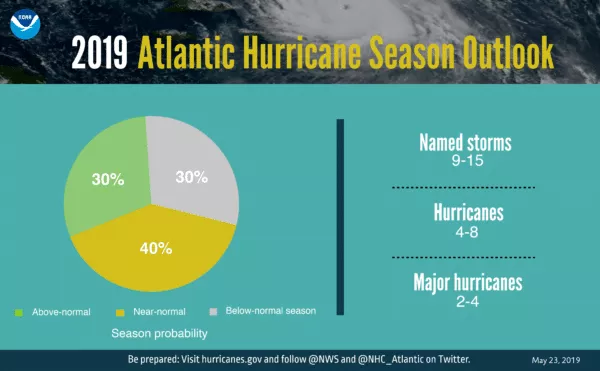
It’s with a 70% confidence that NOAA ranges named storm from nine to 15 with winds of 39 mph or higher. Four to eight of these storms could grow into hurricanes with winds of 74 mph or higher, and two to four major hurricanes.
Create a Plan That Addresses the Entire Business
There’s a common misconception that business continuity planning only affects the IT department. In fact, whether you create a business continuity plan (BCP) internally or choose to outsource it, your BCP should involve strategies for getting critical processes and departments up and running again. If you already have a BCP in place, third-party consultants can provide an objective view of your business and make suggestions for your BCP so that your plan is effective when interruptions occur. Business continuity as a service (BCaaS) uses the expertise of professionals to develop and manage a specific plan tailored to your business’ needs. With a streamlined course of action, your business will be able to remain operational in the event of a disaster.
Prepare Alternate Workspaces
Whether there’s physical destruction to your building or employees and customers are unable to travel, damages from disasters can hinder your ability to maintain normal business activities in your primary office space. If you need to relocate business operations , make sure you have access to an alternate workspace as soon as possible. Fully equipped alternative workspaces like Mobile Recovery Centers (MRCs) can be made available within as little as 24-48 hours of a disaster declaration, while Fixed-site Business Recovery Centers (BRCs) can be made available within as little as four hours of a declaration. Once the alternate location is set up, your company can begin to restore business operations successfully.
Back up and Recover Your Data
Having access to your data and applications is imperative when disaster strikes. A fully managed and monitored cloud recovery platform will protect your IT infrastructure. With secure data vaulting and recovery , your data will be recoverable on- or off-site within your recovery time objectives.