
“Data is the new currency” is one of the new slogans of the digital transformation. Modern consumers recognize the value of their data, and 67 percent are willing to share more data with banks in exchange for new benefits. Surprisingly, banks don’t always afford sensitive data the same protections they do for physical currency. While PwC’s 2017 Risk in Review report reveals that the financial services industry has strong cyber risk maturity overall, there are a few common mistakes that could be leaving your institution vulnerable. To give you an idea of the gravity of these errors, think of your cybersecurity practices in terms of cash management and physical security.
Easily Hackable Encryption Methods
- – Blowfish
- – 3DES
- – SHA1
- – MD5
Transmitting Unencrypted Data Is Like Sending Unsecured Bulk Cash Shipments
Would you ever transfer a bulk cash shipment to a major customer without using their armored carrier service? Not a chance. You know that that decision would not only be a liability for your institution, but it would also put your customer’s assets at risk and breach their trust. Unfortunately, banks don’t always provide the necessary protection for sensitive data that customers expect. Data must be securely encrypted in transit and at rest, but 30 percent of FIs say they struggle to protect personally identifiable customer information. Many banks use easily hackable encryption methods such as Blowfish, 3DES, SHA1, and MD5. Instead, use an advanced encryption algorithm such as AES .
Giving Unvetted Vendors Access to Data Is Like Handing Cash Over to an Unverified Armored Carrier
Going back to the bulk cash shipment scenario, imagine handing over currency to an armored carrier guard without first verifying their identity. This is an egregious security violation, wouldn’t you agree? Yet when it comes to sensitive data, many banks fail to vet third-party vendors they allow to access the sensitive data in their care. In fact, 41 percent of financial services respondents ranked assessment of security protocols and standards of third-party vendors as the top challenge to information security efforts. The FFIEC’s guidelines for outsourcing technology services recommend a “comprehensive outsourcing risk management process to govern technology service provider (TSP) relationships.” Make sure you work with vendors whose operations are regularly examined by a third party. This ensures the vendor’s risk management and information protection practices adequately address data confidentiality and regulatory compliance.
Disregarding Network Alerts Is Like Ignoring Your Vault Alarm
Would you be appalled if your vault alarm went off and your staff members ignored it? In a way, that’s what is happening with cybersecurity alerts. Institutions are only able to investigate 56 percent of security alerts they receive on a given day. Of those, only 46 percent of legitimate alerts are remediated. Granted, security operations managers see more than 5,000 security alerts per day — exponentially more than you’ll ever receive from your burglar alarm. However, the lack of resources for monitoring alerts is concerning. With there being a security talent shortage, outsourcing can help your institution meet its overall strategic plan and corporate objectives. The FFIEC has specific guidelines for using a managed security service provider (MSSP). You might also consider using a fully managed cloud vaulting solution to move critical data off-site to protect yourself against ransomware.
Assuming Employees Know Cybersecurity Best Practices Is Like Expecting Them to Know Your Physical Security Policies Without Training
When hiring a new employee, what if you assumed they knew the proper cash handling guidelines, how to handle a holdup situation, or how to respond to an active shooter event? That’s a disaster waiting to happen. Chances are, you invest countless hours on training employees in these areas. Even if someone has experience in the financial services industry, it’s imperative to make sure they understand your institution’s specific policies and procedures. Unfortunately, training is one of the biggest cybersecurity challenges in banking. In fact, less than half of financial services organizations polled even have a formal information security policy. To reduce the risk of cybersecurity threats, it’s critical to create a security culture. The FFIEC recommends annual security training to reinforce guidelines for endpoint security, login requirements, and password administration. The training should include the following three increasingly common scenarios:
- – Phishing and social engineering
- – Data theft through email or removable media
- – Unintentional posting of confidential or proprietary information on social media
Improving your cybersecurity practices is not only the right thing to do, but the FFIEC, Gramm-Leach-Bliley Act, and other regulatory agencies and regulations require it. If you’re unsure where to start, the FFIEC Cybersecurity Assessment Tool is a helpful resource for assessing your bank’s cybersecurity maturity.
Cybercrime has rapidly become one of the costliest disruptions an organization can face. Recent events in Las Vegas have sent shockwaves through the business world, highlighting the grave risks that data breaches pose to companies and their valued customers.
Hackers have grown increasingly brazen, aiming at high-profile companies like MGM Resorts and Caesars Entertainment in Las Vegas. These events present a clear need to examine the alarming rise of business-related cybercrime and discuss how companies can safeguard themselves against prolonged downtime while adding an extra layer of protection through services like Agility’s data recovery solution .
MGM Resorts and Caesars Entertainment: Victims Despite Preparedness
Cyber technology experts have commended MGM Resorts International and Caesars Entertainment for their proactive approach to safeguarding their operations against the ever-present threat of a security breach. These giants of the Las Vegas Strip, boasting a combined total of 16 resorts, made substantial investments in technology and diligently adhered to regulatory frameworks. They implemented a plethora of cyber protections , protocols, and security measures, leaving no stone unturned in their quest for cybersecurity. Yet, even with these precautions in place, they found themselves victimized by relentless cybercriminals.
The High Cost of Inadequate Data Protection
One of the most distressing aspects of these data breaches is their devastating impact on the affected businesses and their customers. MGM and Caesars now face class-action lawsuits for alleged failure to protect their customers' data adequately. Rebuilding trust with existing and future customers is an onerous task that both companies must now navigate. Jefferies Gaming analyst David Katz recently estimated that MGM Resorts International was hemorrhaging 10-20% of its daily revenue due to the breach. The actual number reported by MGM once the breach was resolved totaled roughly $100 million . This staggering financial loss demonstrates a data breach's immediate and tangible consequences on a business's bottom line. Such losses can lead to a host of long-term issues, from decreased stock value to compromised customer loyalty.
Paying the Price: Ransoms and Stolen Data
Days before MGM's computer systems fell victim to a cyberattack; Caesars Entertainment reluctantly paid a staggering $15 million ransom to a cybercrime group that successfully infiltrated and disrupted its systems. This cybercriminal organization initially demanded a $30 million ransom, revealing their audacity and expertise in extortion. Caesars ultimately agreed to pay roughly half of the demanded sum, highlighting the desperate measures that companies may resort to when facing the aftermath of a data breach. Adding to the horrors of these breaches, hackers managed to steal Social Security numbers and driver's license numbers from a "significant number" of loyalty program customers of Caesars Entertainment. This chilling revelation underscores the deeply personal and far-reaching consequences of data breaches on individuals.
The Soaring Threat of Business-Related Cybercrime

The disclosure of these breaches coincided with a concerning global trend. According to a report from the World Economic Forum, cyberattacks spiked by a jaw-dropping 156% in the second quarter of 2023 compared to the first three months of the year. Notably, the attack on Caesars occurred weeks before the assault on MGM Resorts, which has since wreaked havoc on MGM's operations. The fallout has forced guests to endure long check-in wait times and crippled electronic payments, digital key cards, slot machines, ATMs, and paid parking systems. The company's website and mobile app had been rendered inaccessible for nearly four days.
Protecting Your Business and Customers: A Vital Imperative
As evidenced in these cases, the preferred tactic for ransom-seeking cybercriminals involves using social engineering to infiltrate a company's IT systems. They excel at manipulating individuals within organizations, gaining unauthorized access with alarming ease. For instance, the hackers in this case reportedly boasted that it took a mere 10 minutes to breach MGM's system after identifying an MGM tech employee on LinkedIn and contacting the company's support desk. Then, the hackers managed to infiltrate Caesars' system by deceiving an employee at a third-party vendor. Compared to Caesars Entertainment, MGM Resorts International has chosen not to pay the ransom demands. This decision aligns with the FBI’s counsel against paying ransoms, as doing so offers no guarantee of retrieving stolen data and can incentivize cybercriminals to target more victims.
Investing in Protection: The Way Forward

The global average cost of a data breach in 2023 was a staggering $4.45 million , reflecting a 15% increase over the past three years. This financial toll underscores businesses' need to invest in robust cybersecurity measures and data protection. In response to breaches, 51% of organizations plan to increase their security investments. These investments encompass incident response (IR) planning and testing, employee training, and adopting advanced threat detection and response tools. These proactive measures are critical for mitigating the risk of future breaches and ensuring swift, effective responses when breaches occur. Additionally, businesses should consider partnering with data recovery and backup service providers like Agility Recovery . These services offer a lifeline in the event of a breach, enabling companies to swiftly recover critical data, minimize downtime, and continue serving their customers without disruption.
Conclusion
The recent data breaches at MGM Resorts and Caesars Entertainment serve as a chilling reminder of the escalating threat of business-related cybercrime. Protecting your business and your customers from the catastrophic consequences of data breaches is no longer a choice—it's an imperative. Proactive measures, including robust cybersecurity, employee training, and data recovery and backup services , are essential components of a comprehensive defense strategy. By taking these steps, businesses can fortify their resilience in the face of cyber threats, safeguard their customers' trust, and ensure their continued success in a digital world fraught with peril.
Imagine waking up one day to find your entire business paralyzed. Your sensitive data was stolen, and your hard-earned reputation is in ruins. Sounds like a nightmare, right? Unfortunately, this is a harsh reality many businesses face today.
Because technology drives our every move, cyberattacks have become a menacing force that can strike at any moment. The FBI Internet Crime Complaint Center received 800,944 complaints in 2022 for a $10.3 Billion USD loss. According to Statista , 68% of organizations in the United States experienced a ransomware attack and paid the ransom. But let me tell you a secret – protecting your business in the digital realm goes beyond firewalls and antivirus software. You must ensure the continuity of your operations. This continuity will safeguard your assets and build trust with your customers.
Why Cybersecurity Is Crucial for Continuity Planning
Cybersecurity is a cornerstone for business continuity planning. It shields your business from the ever-looming dangers of the digital world. Hackers, cybercriminals, and malicious actors seek to exploit your systems' weaknesses. Without a strong cybersecurity strategy, your business becomes a sitting duck. You are vulnerable to data breaches, ransomware attacks, and other devastating cyber incidents. Focus on cybersecurity to safeguard your critical assets. This ensures the uninterrupted continuity of your operations. Investing in cybersecurity gives you resilience, trust, and peace of mind.
Cybersecurity Strategies for Business Continuity
To ensure business continuity, you must put in place effective cybersecurity strategies. The current threats call for proactive measures to protect your sensitive data. These measures will help maintain seamless operations.
Employee Awareness and Training
Educating your staff on best practices can reduce the risk of human errors that can lead to security breaches. These best practices include:
- – strong password management
- – detecting phishing attempts
- – multi-factor authentication
Vulnerability Assessments and Penetration Testing
Performing penetration testing and regular vulnerability assessments can identify weaknesses in your systems. By finding these weaknesses, you can patch them before malicious actors exploit them.
Defense-in-Depth Approach
You can strengthen your infrastructure by embracing a defense-in-depth approach. You can do this by having multi-layered security measures, such as:
- – firewalls
- – encryption
- – zero-trust architecture
- – intrusion detection systems
Incident Response Plan
You need to have a robust incident response plan in place. This plan ensures that your team can swiftly and effectively respond to a cyber incident. A quick response minimizes the damage and downtime. Update this plan regularly. New threats will emerge, and your organization's cybersecurity needs will evolve. An incident response plan should include these procedures:
- – Reporting a security incident.
- – Identifying the cause of an incident.
- – Recovery from an attack.
- – Identifying which data, systems, or applications were affected by the incident.
Train your team on how to put in place the plan in the event of a security incident. Using these cybersecurity strategies helps you fortify your business's resilience. This ensures that any disruptions caused by cyber threats are swiftly addressed. This allows you to continue serving your customers and maintaining business continuity.
Steps to Protect Your Business

Because cyber threats are constantly evolving, you must protect your business. Implementing effective cybersecurity measures can safeguard your sensitive data and ensure smooth operations. Here are two steps to protect your business from potential cyberattacks.
1. Focus on employee awareness and training
- – Educate your staff on best practices. These practices are creating strong passwords, using multi-factor authentication, and detecting phishing attempts.
- – Promote a culture of cybersecurity awareness. Ensure staff understand how to help maintain a secure environment.
- – Conduct regular training sessions. This keeps everyone updated on the latest cybersecurity threats and preventive measures.
2. Fortify your IT infrastructure
- – Use multi-layered security measures to create a strong defense against cyber threats. These measures include firewalls, encryption, and intrusion detection systems.
- – Invest in good antivirus software. Antivirus software is an essential tool to combat cyber-attacks. This tool scans your computer systems for malicious software. It then removes it before it can do any damage.
- – Use zero-trust architecture. A zero-trust architecture is a security approach that assumes that all users are malicious. Users must be constantly monitored. It uses access control, authentication, and encryption to restrict network access.
- – Set up a backup system. Back up your data regularly. If you have a ransomware attack or other data breach, you can restore files quickly instead of starting from scratch.
- – Perform regular pen testing and vulnerability assessments. These can identify and address any weaknesses in your systems.
- – Keep your software and systems up to date with the latest security updates and patches. This will help remove vulnerabilities from your systems.
With these steps, you can significantly reduce the risk of cyberattacks. This will protect your business from potential threats. Don't wait until it's too late — take action now to secure your business and ensure its continuity.
Costs of Cybersecurity
Many businesses may hesitate to put in cybersecurity measures. They are concerned about costs and resource allocation. But, the potential consequences of a cyberattack far outweigh the investment required to install effective cybersecurity measures. The financial costs of a data breach can be staggering. An IBM and the Ponemon Institute study found that the average cost of a breach in 2022 in the United States is $9.44 million. The global average is USD 4.35 million, a record high. The average cost per compromised record is $164, a seven-year high. These costs include data loss, legal fees, and regulatory fines. These costs do not include the disruption to your business operations and the loss of customer trust. According to Statista , businesses spend an average of 12% of their IT budgets on cybersecurity. This is an average, and several factors affect these numbers:
- – the size of your business and your IT budget
- – the industry you operate in
- – how much data you handle
- – the sensitivity of the data you handle
The average for small businesses is 8%, while large enterprises spend around 20%. Cybersecurity can be expensive if you are a small business with limited resources. But if you do not pay for cybersecurity upfront, you will pay for it later.
Conclusion
Cybersecurity is not a cost—it's an investment. It can be expensive, but it's also necessary for business survival today. A data breach's financial cost can devastate your bottom line. It also affects your reputation and trust with customers. If you want your company to survive, invest in cybersecurity today! Agility is here to help you.
Each year since 2004, October has been designated by Congress as Cybersecurity Awareness Month, a time to educate individuals and businesses alike in protecting themselves online.
According to organizers the Cybersecurity and Infrastructure Security Agency (CISA) and the National Cybersecurity Alliance (NCA) are partnering on this year’s campaign theme — "Secure Our World" — to create resources and messaging for organizations to use when they talk with their employees, customers, and memberships about staying safe online. They list four key action steps everyone should take:
- – Enable multi-factor authentication
- – Use a strong password
- – Recognize and report phishing
- – Update your software
To aid you in improving your organization's cyber-hygiene during Cybersecurity Awareness Month and beyond, we put together some of our top resources below.
Cybersecurity Blogs
- Cybersecurity as a Major Threat to Business Continuity
- Five Ways to Thwart a Cybersecurity Nightmare
- How to Deploy a Cybersecurity Strategy
- Cybersecurity Tips for When You’re Working from Home
- Three Steps to Integrating Cybersecurity with Business Continuity
- Reduce the Impact of Ransomware Attacks with Business Continuity Planning
Cybersecurity Resources
Business continuity planning is the process of planning for the potential issues that a company or business could face while maintaining operations. Creating and updating a business continuity plan is a cornerstone of successful businesses, and you should invest ample time and resources in ensuring that your plan is the best that it can be. Having a well-thought-through continuity plan in place ensures your business can recover seamlessly and be able to continue operations if there is an emergency.
Business Continuity Planning for 2023
As 2023 begins, it is important to start planning— and updating your business continuity plan is a huge part of that. Planning ahead ensures that you have a vision for your business moving forward and that you have the tools and resources in place to manage your growth and maximize success. Not sure how exactly to get started? Read ahead for practical steps and advice.
Perform a Business Impact Analysis
One of the first things you can do to aid your business continuity planning is to perform a business impact analysis. A business impact analysis (or BIA) explores the impact a widespread disruption would have on your business. Performing a business impact analysis is one of the best ways to start planning for the future. Doing so can help you find where there might be vulnerabilities in your operations and overall business model. It’s a great way to find and identify your business’s blind spots and prepare potential solutions. This can also assist with other essential business-related tasks, like budget planning and understanding hiring needs for the upcoming year. Planning ahead and performing a business impact analysis will save you lots of time and stress in any case.
Business Resilience
Part of planning ahead for 2023 should include solidifying your business’s overall resilience. Let’s face it— 2023 is a risky time to be operating a business. Think ahead about ways you can strengthen and solidify your business model. The world is more unpredictable than ever, and businesses need to be built to withstand it. Creating a business continuity and recovery plan will ensure your business is around for the long haul, allowing you to grow and invest in the future.
Disaster Recovery
It might sound obvious, but make sure you have a plan in place for disaster recovery as a part of your business continuity plan. Knowing and identifying issues is one thing, but dealing with them can be a different task. So, make sure you not only have a plan to identify risk, but also have a plan to manage and recover from it.
Risk Management
Now that you have invested in your business’s health and resiliency, you should start figuring out ways to mitigate risk. Investing in risk management plans should be a key part of planning for 2023. One of the biggest lessons that business leaders can take away from 2020 and the COVID-19 pandemic is the need for proper risk management techniques. Don’t leave yourself unprepared like many businesses did— research and understand risk management in your field and implement best practices into your business continuity plan. Once you understand the value of risk management, you should identify and prevent these issues and tackle them head on. With that in mind, here are some common trends and potential risks projected for the year 2023.
Crime
Crime is one of the biggest trends you should be aware of when updating your business continuity plan this upcoming year. With issues like COVID-19, natural disasters, and high inflation, crime is on the rise. Consider common issues such as shoplifting, hackers, and other technology-related scams, and have plans and protocols in place to deal with these problems. Make sure that you also train both yourself and your employees to spot and prevent crime. Doing so will help prevent both financial losses, as well as ensure your business remains safe and trustworthy in the eyes of the public.
Working with Extreme Weather
With more occurrences of extreme weather on the rise it is smart planning to consider how extreme events could affect your business when updating your business continuity plan. Offering flexible work setting for your employees, such as work-from-home or a hybrid model, can help everyone maintain productivity during periods of extreme weather, such as the snowy winter months and extreme temperatures of late summer. It’s always best practice to have a protocol in place before the extreme weather hits, so research potential risks for your area and make a plan well ahead of time.
The Future of COVID-19
While many lockdowns and other early pandemic worries are now a thing of the past, there are still several highly contagious COVID-19 strains that are likely to stick around. Thus, it’s not unreasonable to assume that there will likely be times when your business may encounter issues due to COVID-19, including the possibility of multiple employees being out or even a temporary closure. Thus, it is vital that you have contingency plans built into your overall business continuity plan so everyone knows what to do in the event of COVID-19 affecting your workplace and business operations.
Continuing Work-from-Home (WFH) Trends
The word is in: Work from home is here to stay, as continual studies show that many people (and even employers) enjoy working from home while continuing to maintain similar, or even better, productivity levels as when they were working in the office. Rather than fighting work-from-home , future-minded employers are embracing the trend and strategizing ways to implement it into their overall business model and business continuity plans.
Dealing with Inflation
Inflation was a hot topic in 2022, and businesses and their employees can expect this trend to continue into 2023. Operating costs are likely to remain high due to inflation. Likewise, in response to inflation and the increasing costs of living, many workers are looking for jobs with higher wages. In addition, many states and local towns have passed minimum wage increases in response to the rising rates of inflation. Build inflation into your budget and have a plan in place to manage it going into the year 2023.
New Year, New Regulations
When the new year rolls around, there are almost always new laws and regulations that come into effect, be it on the state, local, federal, or even business level. It’s essential to research these new laws and regulations well ahead of time so that you can understand how they are going to affect your business going forward. Don’t wait until the new year has already arrived— doing so could mean fines or other legal penalizations if it turns out that you have broken labor or safety laws. If you have questions or any confusion or concerns about any new laws or regulations, you should talk to your business’s human resources department and legal team, to ensure you are prepared for new laws going forward. Doing so protects both your business and your employees, so don’t neglect this essential step. It’s part of your responsibility as someone who owns and operates a business.
Cybersecurity
Focusing on cybersecurity is a vital part of business planning in the modern era, and 2023 is no exception to this rule. Recent research shows that cybersecurity events and business disruptions have been some of the most common types of business disasters in recent years. As technology grows and evolves, unfortunately, so do criminals. It will be well worth the effort to have a plan in place ahead of time, so your business’s safety is ensured online. Don’t wait until there is a data breach or extended outage to think about your cybersecurity. Your customers trust that you are being confidential and responsible with their information and jeopardizing that trust could result in a negative blow to your business reputation. Plan before it is too late.
Conclusion
A business continuity plan is a key component of your operations. It should be well thought through, carefully researched, and tested regularly. Creating a business continuity plan prevents a multitude of issues down the line for you and your business. Agility can help you create a customized plan for your business, so you can move forward through 2023 with confidence and maximize growth. Contact us today and learn how we can help you and your business succeed.
In a perfect world, you’ll never have to worry about what to do after a data breach. Unfortunately, cybercrime is too sophisticated and growing too fast to safely rest in that assumption.
The reality is that 52% of all businesses have experienced a disruptive event in the past five years. Cybercrime accounts for an increasingly significant portion of that disruption, and it’s always evolving. While it’s essential to have strong cybersecurity defenses, breaches can still happen, so you need an emergency response plan. Here’s what you should do after a data breach.
1. Contain the Breach
The first step to take when you discover a breach is to contain it. If you can stop it from spreading early, you’ll minimize the damage. Conversely, failure to contain it could result in massive losses. Alert your IT department or security response team immediately so they can get to work stopping it. That process should involve finding the breach’s source, looking for vulnerabilities to secure, and taking things offline to prevent it from spreading. Because many breaches come from insiders, you should restrict user accounts’ privileges until you learn more. As teams go through this process, it’s important to record everything. Save a copy of the breached system, avoid deleting any data, and write down what you find and do. These records will help you later.
2. Assess the Damage
Once you’re sure you’ve contained the breach, look through your systems to see what the incident affected. Remember to check everything – not just where you found the breach – because sometimes attacks are more extensive than they seem initially. Check system logs to see what files people or systems accessed around the time of the event. Looking through the records you kept during the first step can also help. As you discover what kinds of data or accounts the incident affected, consider the future damage it could cause. Learning the true extent of the data breach will help you know what else you should do. If you discover the attacker found employee email addresses or names, you’ll know phishing may be a bigger threat in the future. You can then alert everyone to stay on their toes and run more anti-phishing training.
3. Inform All Affected Parties
Next, it’s time to inform any employees, partners, or customers the breach might’ve affected. Part of good cybersecurity is teaching workers to report suspicious activity and respond to emergencies, but they must know about events to act. The quicker you can tell everyone, the faster they can take action to reduce the impact. Many legal regulations require businesses to notify users of data breaches. While these timelines aren’t always specific, it’s best to do that sooner rather than later. Europe’s General Data Protection Regulation (GDPR) says to alert them without undue delay , so communicating within a few days of the event is likely the best way to go. These alerts should include what happened, how it may affect the party in question, what you’re doing about it, and how they should respond. Some actions on their part, like changing passwords, may be necessary.
4. Test New Security Patches
As you investigate the breach, your IT or security team should be able to patch the vulnerability that led to the event. Rolling out these updates quickly is essential, but ensuring they work is equally critical. Once you have a fix in place, test it. Just as fire departments test fire hydrants against set standards , IT departments should test security patches to see if they hold up. Without these tests, you can’t be sure another attacker won’t breach your network the same way the last one did. Be sure to apply this across your whole organization, not just where the incident occurred. It’s also a good idea to make this penetration testing part of your regular business continuity plan . As your business grows, networks and security systems often become more integrated and interconnected, but with more complexity and connectivity also comes more attack surfaces you need to cover. Every time you change something about your IT environment, test it against the kind of attack that breached your systems the first time to ensure it doesn’t suffer the same fate.
5. Review and Improve
Finally, take this event as an opportunity to improve your security posture. After you’ve fixed the vulnerabilities, informed all parties, and settled any legal side effects, have a meeting to review the situation. Look over what happened, how everyone responded, and how those actions impacted the outcome. What worked well? What didn’t? You can use the answers to these questions to see where and how you can improve your data breach response in the future. Having a defined business continuity plan will lessen the overall cost and damage of a future emergency. Creating and refining such a plan requires understanding your strengths and weaknesses, which these reviews provide. Ideally, you’ll never suffer a data breach, but if you do, don’t let this real-world experience go to waste.
Data Breaches Don’t Have to Spell the End
Data breaches are an intimidating prospect and an increasingly likely scenario for many businesses. While these events can be damaging, they don’t have to be disastrous. Quick responses and proper planning will mitigate their impact. These steps will help you contain a breach, lessen the damage, and prevent future ones. If you can do that, you can ensure your business thrives despite these attacks.
Zac Amos is the Features Editor and a writer at ReHack, where he loves digging into business tech, cybersecurity, and anything else technology-related. You can find more of his work on Twitter or LinkedIn.
With cyber threats like ransomware routinely interrupting business operations around the globe, cybersecurity is not just an IT problem — it’s a business risk that needs to be accounted for in the business continuity plan. But how do you go about doing that?
Gain Executive Support
The tone from the top drives the success of your business continuity and cybersecurity preparedness. If your organization is going to continually strengthen and insulate itself from all of the likely foreseeable — and sometimes even unforeseeable events — you need to get executive support . It’s also important for executives to support a culture of collaboration. Business continuity owners, info security officers, and business units need to be transparent with each other. Sometimes that means admitting that a process under your control has to be improved. If executives support a culture of transparency, people will be more willing to reveal and troubleshoot problem areas in your organization’s processes. Down the road, this could help the organization mitigate a major vulnerability.
Your BC and incident response plans should each include:
- – Classification of various security incidents.
- – Criteria for triggering the plan.
- – Employee roles and responsibilities.
Clearing these obstacles with many employees working remotely could be tricky, especially if there are connectivity issues. This brings us to our next point.
Connectivity
No matter where they work, employees need to have access to the resources they need to do their jobs: voice and data communications, power, phones, computers, etc. After major “perfect storms” (which are becoming the new normal ), cell phone, power and internet connectivity might not be available. For example, after Hurricane Harvey hit Rockport, Corpus Christi and Port Aransas in Texas, wind damage knocked out power and communications. WFH wasn’t even an option for businesses in those areas. In Houston, WFH seemed to be an ideal strategy. Countless roads closed, floodwaters lingered for days, and offices were destroyed. Although the city experienced record levels of flooding, the communications and power infrastructure proved resilient. For many companies, it just made sense to have employees work remotely. But many businesses hadn’t thought through the logistics of the entire company working remotely. The sudden influx of remote employees taxed company resources: VPN licenses, bandwidth availability of VPN concentrators at the home office, etc. How would you handle your entire business working remotely? Think about how you’d respond to the following potential issues :
- – Employees might not have the right equipment, whether because they weren’t issued company-approved hardware in time or because it’s trapped inside the home office.
- – Internet connectivity in employees’ homes isn’t always reliable.
- – A significant increase in remote workers can overload the VPN.
- – Employees not used to working from home might have trouble logging in.
- – Company phone systems might not be compatible with employees’ personal devices.
- – Vulnerable network connections increase the risk of sensitive data exposure.
- – Employees are more likely to use personal devices without appropriate security settings.
The higher your ability to address potential connectivity challenges, the more likely WFH is to succeed. But that’s only one part of the equation.
Evaluate Your Incident Response Plan
The traditional way of looking at business continuity is looking at the inoperability of a facility or a particular service or a function. It’s a worst-case scenario. Cyber threats have just added a whole new world of potential ways to take down a particular operation. Does your organization have a detailed incident response plan that accounts for the various types of security incidents your organization could face? Start with looking at how detailed the incident response plan is. Many businesses simply tack on a brief incident response paragraph — maybe even a page or two — to their business continuity plan . Be advised: That is not a comprehensive incident response plan. Make sure the plan catalogs at least the top seven to 10 security incident types that could disrupt or halt business operations. It should provide for specific responses and procedures tied to those events. You also need to determine what incidents will trigger the business continuity and incident response plans. For example, an email phishing scenario wouldn’t necessarily shut down access to critical data or affect your ability to service your customers. In that case, you might activate your incident response plan but not your business continuity plan. A ransomware attack, on the other hand, could actually take your systems offline. Since it would leave you without access to critical data and the ability to service your customers, you might classify that as an outage requiring a business continuity response.
Test Your Plan
Just as you test your business continuity plan for worst-case scenarios, you need to test scenarios that integrate business continuity and incident response . For example, you could walk through the process of responding to a Cryptolocker outbreak that encrypts a drive or data store and requires the restoration of that data to another platform. To work through how the plans play out in a particular scenario, start with a tabletop exercise before doing a functional test.
You don’t get to be a CEO without taking some chances, but there is a difference between taking on risk in search of an outsized reward and taking on unnecessary, avoidable risks. In an era when so much of business depends on data and computing, the proactive CEO values a solid business continuity and disaster recovery (BCDR) plan. After all, why would a leader risk the damage that could be done by failure to recover quickly from a systems outage, the destruction of a facility, a ransomware attack , or the loss of critical data? Unfortunately, the necessity of BCDR is not apparent to everyone. To help you justify the investment, here are four critical reasons that you, the CEO, should care about business continuity and disaster recovery.
1. Because Downtime is Expensive
If your employees lose access to business-critical applications and data, there is a direct impact on productivity and revenue. While this sounds obvious, many organizations do not consider the total cost of downtime. To better understand how the damage adds up, consider the following example created with Datto’s Recovery Time and Downtime Cost calculator . Let’s say your business has 100 employees, the average hourly revenue is $1,500, and the backup data set amounts to 2 TB. Given these parameters, a full restore from a local backup would take over 8 hours. The associated downtime cost would amount to $34,000 in lost revenue. Modern BCDR products can quickly launch a virtual instance of an application and all its data on a virtual server hosted within the backup environment. This lets users continue operations while primary application servers are restored. Choosing a BCDR solution that minimizes downtime makes good business sense.
2. Because Backup Alone is Not Enough
Backup and business continuity are not the same. You’d be hard-pressed to find a business today that doesn’t conduct some form of data backup . But what happens if a flood wipes out your primary and backup servers? You need to know the systems your business relies on will continue to operate, no matter what. Sending a copy of data offsite for disaster recovery is one way to ensure business continuity. Historically, this meant sending tapes to a secondary location or tape vault. Today, BCDR solutions can run applications from backup instances of virtual servers. The best of them extend this capability to the cloud—an approach known as disaster recovery as a service (DRaaS). The ability to run applications in the cloud while onsite infrastructure is restored is a game-changer for disaster recovery. As CEO, you don’t want yesterday’s backup technology.
3. Because Disasters Take Many Forms
Not every disaster is broadcast on news and weather channels. Most IT downtime is a result of common, accidental (or malicious) data deletion, damage to computer hardware, or poor security habits. For example, a recent OWI Labs survey found that 81% of respondents occasionally or regularly use public WiFi, despite security risks. A ransomware attack or virus can halt operations just as easily as a tornado or a power surge. These “lowercased” disasters are typically a result of human error, which is unpreventable. Having technology in place that allows your business to continue operations following these man-made disasters is equally, if not more important than protecting against a hurricane that may or may not strike your business.
4. Because Resilience Matters
Ensuring access to applications and data following a disaster is just one piece of the BCDR puzzle. Evaluating your business’s ability to restore IT operations can be a good starting point for company-wide business continuity efforts, but good BCDR planning should look at the business as a whole, and the goal should be to develop business resilience, in addition to cyber resilience. In fact, many BCDR planning efforts start by conducting a business impact analysis or risk assessment — these studies can reveal weaknesses in your business’s ability to continue operations that go far beyond IT. You know a disaster (natural or otherwise) will be coming to your company at some point. When it does, you want to be as well-prepared as possible.
Conclusion
Business continuity and disaster recovery is a company-wide responsibility and failure to protect your business from human error, hardware failure, and/or natural disasters can be detrimental and impact every stakeholder. Once you’ve implemented a solid BCDR plan, you will sleep better knowing you’re fully prepared for any disaster that might come your way. We can help give you that assurance. Working with Datto, we ensure complete, ransomware-free backups and rapid data restoration. The Datto Cloud is immutable, so it’s always possible to recover a clean copy of a file, email, or an entire server. Backups are protected against ransomware, data corruption, and files or emails being accidentally or maliciously deleted. Care to learn more? Contact us today .
Every business in the modern age requires near-constant email communication. Something so important should not be left unmonitored — just like you wouldn’t prefer the front doors of your business not to have security cameras.
Emails are just as prone, if not more, to incoming threats. Thankfully, monitoring them is easy, and danger is avoidable. Knowing the current hazards and applying best practices will allow businesses to navigate the digital world safely . Nobody anticipates incidents, so it’s best to eliminate worry and create security. What’s attacking email inboxes, and what preventive measures can a business take?
2022’s Current Threats to Your Inbox
All strong security infrastructure starts with a great business continuity plan . Employees will know measures are in place if any disaster or incident occurs, physical or digital. It’s a worthy endeavor to take as much time as needed to craft a thorough plan to beat 2022’s current email threats. What are the most significant crimes hitting inboxes? Here are some of the top contenders from 2021, according to FBI reports :
- – Phishing
- – Nonpayment or non-delivery
- – Personal data breaches
- – Identity theft
- – Extortion
- – Fake captcha scams
- – Response-based attacks
- – Tech support
It’s important to know what was prominent in previous years to make accurate predictions for the rest of 2022. For example, the FBI’s Internet Crime Complaint Center received 467,361 reports in 2019 . Many scale as more businesses rely on technology. Trends are becoming a reality as phishing scams become more sophisticated and hackers become more innovative. The most common of these attacks for businesses are credential theft variants, representing 58% of email threats in recent history. These are individuals trying to steal login information for your accounts. Phishing and malware delivery via attachments are also on the rise.
Best Tips to Protect Your Business
These scams are dangerous because they are tailored, automated, and impersonate individuals in your company . They succeed by gaining the email owner’s trust by crafting messages that look legitimate and branded. They can appear to be everything from an invoice to something related to current events. Emails relating to the pandemic and international events are easy ways for scammers to fool companies into believing the content. Ultimately, the best action plan is a prepared one.
1. Install Secure Software to Scan Regularly
Consult with your IT team to install excellent antivirus and anti-malware software on every machine in your business. There are plenty of options with varying degrees of protection, but remember, this is something worth investing in the budget. Consider how much peace of mind this security will provide your business. Knowing your assets and employees have a digital insurance policy because you made a significant investment will reduce anxieties. There is other software available that isn’t anti-malware or antiviral, including third-party mail filtering services or encryption software that can pre-scan emails before they hit your employees’ inboxes.
2. Back Up Important Data with Secure Hardware
The hardware is just as necessary as the software. Imagine an identity theft attack coming through your email, and suddenly, you can no longer access your cloud or information regarding the company. It’s worth it to have external hard drives , not connected to Wi-Fi or anything a hacker could potentially breach. Ideally, they contain up-to-date records of your business. Remembering to transfer data regularly to keep it current is essential.
3. Stay Informed of Current Threats
As the saying goes, knowing is half the battle. If your business wants to make security a priority, read tech-related news to ensure you know what threats will look like in the future. They won’t stay the same forever, and even phishing scams can look completely different next year. Make sure you aren’t relying on old knowledge to guide you into the future when this industry is constantly changing and adapting. Share the current trends with employees as well, so they are informed.
4. Set Up Multifactor Authentication and Password Management
Having secure architecture creates resistance for even some of the most brilliant hackers. Many email logins now will ask for multifactor authentication, requiring the cellphone of the account owner to input a code texted to them. Hackers can overcome these barriers, but multifactor identification creates challenges for hackers, buying your business time to fix the issue. Hackers may have the passwords, but they don’t always have all the tools they need to succeed if multifactor authentications are in place. On top of this should be a well-protected password management system to prevent scams like credential and identity theft. Ensure employees change passwords at the recommended frequency with the correct combination of characters for optimal security. Each password should be unique for every account, so the one for your email should not cross over to other sensitive accounts. Once that hacker has one, they can access all accounts; unique passwords prevent this from happening.
5. Curate and Test Your Continuity Plan
Staying protected will be seamless if everyone on your staff knows the protocol for email attacks. Employees will learn how to access documents to follow plans if they’re ever feeling confused or concerned about safe practices. What if there’s a ransomware attack? What if employees aren’t even sure what ransomware attacks look like? These details can all be laid out in a continuity plan , detailing whom to report to, how long operations could be down to fix the issue, and how data retrieval works. Once the business creates the plan, you don’t want to wait for the danger to strike to ensure it works. Thorough testing can occur before that happens — and hopefully, it never will. Testing helps reinforce your emergency protocols in many ways, like identifying weaknesses in the plan, evaluating your employees’ responses, and confirming you will meet your business goals.
6. Train Your Staff
It’s integral to ensure your IT department has insider info on email scams. Teach employees how to avoid phishing, report suspicious messages to proper avenues, and take action if they feel their information is compromised. It’s vital to remind employees how innovative hackers are. Show examples of how social engineering attacks look, like deepfakes or scareware. Encourage workers to ask colleagues around the office if they received similar alerts if the subject line looks questionable. Always remind them never to give away personal information or believe something that may be too good to be true without running it by superiors. The key is to increase awareness to reduce risk. The more intelligent and prepared your employees are, the fewer incidents will occur.
Proceed with Greater Intelligence
The comforting thing about creating a secure digital environment, especially with your employees’ emails, is that it protects your business and the individuals working for you. Embracing operational resilience — anticipating, preparing, responding, adapting, and learning — in the face of potential threats is a great way to prove your company can thrive despite obstacles.
Zac Amos is the Features Editor and a writer at ReHack, where he loves digging into business tech, cybersecurity, and anything else technology-related. You can find more of his work on Twitter or LinkedIn.
Surprisingly, plans on how to deploy a cybersecurity strategy haven’t been a priority for companies around the globe not so long ago. In 2017, the phrase “ransomware attack” was trending like never before . On May 12th, 2017, the WannaCrypt ransomware attack made headlines all over the world. Starting in Europe, the malware quickly spread across the globe, demanding users’ money for the return of seized data. Using exploits stolen from the U.S. National Security Agency (NSA), hackers hit more than 200,000 machines worldwide, affecting different industries and organizations of all sizes. Just a few weeks later, a new cyberattack took a swing at companies’ data worldwide, completely wiping it from hard drives. So how come, after one major cyberattack of the year, some companies were still unprepared for what NotPetya had to bring?
Three Moves to Safeguard Company’s Technology
As a technology-dependent society, certain measures must be taken to protect not only your assets but also your clients’ private information. Compared to the same periods in 2017, the first quarter of 2018 was the most “fruitful” for hackers, with cyberattacks increasing by 32% and 47% in April and June . Below are the steps your organization can take to deploy a cybersecurity strategy.
1. Quantify Cyber Risk
The leadership understands the extent of a risk when it’s translated into numbers. For all financial and non-financial risks, some institutions have quantified losses related to a cyberattack. For example, according to a study by IBM , an average cost per lost or stolen record is $148. Also, the average total cost of a data breach can reach $3.86 million.
2. Secure Cyber Risk Management Through Risk Appetite
The Institute of Risk Management defines risk appetite as “the amount and type of risk that an organization is willing to take to meet its strategic objectives.” Regulators are enforcing the establishment of a cyber risk strategy, which can be based on cyber risk appetite. Doing so typically helps address management’s concerns about whether the business is safeguarded against any potential cyber risks. Approaching cyber risk management in that way allows us to include it in the overall company risk framework, providing insight into whether exposure is affordable or acceptable.
3. Assess and Test the Efficacy of Cyber Protection (Including Third-party Vendors)
As described in “ Deploying a Cyber Risk Strategy Guide, ” it’s in companies’ interest to carefully monitor their Cyber Risks across departments. Such assessments should help reveal any glitches in the effectiveness of protection, how proactive the organization is, and how quickly its business can recover from a disruption.
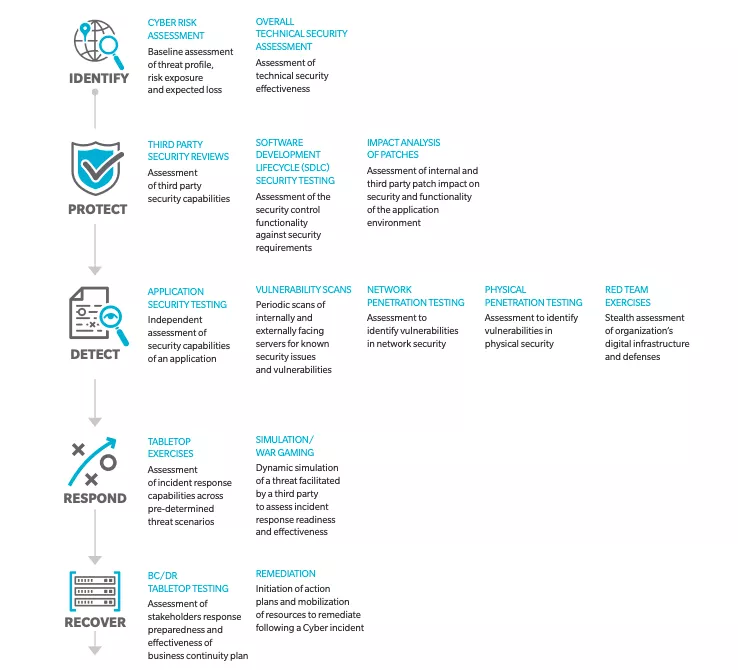
Source: Oliver Wyman As a first step, one needs to identify the risk through cyber risk assessment and an overall security assessment. Secondly, conduct third-party reviews, evaluate security control functionality against security requirements, and assess the internal and third-party impact on security. As a third step, regularly scan internally and externally facing servers for known security issues, along with network security. Then, estimate how well-prepared your team is during tabletop exercises, making sure everyone involved knows their responsibilities in a crisis. And lastly, evaluate the overall effectiveness of your BCDR plan, and how finalized your strategy is should remediation efforts be required.
4. Test Your Cyber Risk Readiness
An organization needs to prepare an incident response plan to become more resilient in the face of a cyberattack. It must extensively cover different attack scenarios, each department’s accountability, response strategy, and all necessary crisis communication scenarios. Continuously testing your incident response plan during a tabletop exercise or a drill can provide invaluable insight. A tabletop exercise allows stakeholders to walk through specific attack scenarios relevant to their business to test their readiness. Such exercise provides avenues for stakeholders to face more realistic aspects of cyber risk and their roles in the event of a crisis. However, incident management plans must be regularly reviewed and improved depending on the ever-evolving threat landscape.