
Largely as a result of the pandemic, many companies are taking a “work-from-anywhere” approach , allowing their employees to work from home or elsewhere. With this comes a host of challenges, including how to keep critical employees connected and productive in the event of a major disaster. Agility recently surveyed 229 customers representing a mix of business sectors, company sizes, locations, and roles to determine the biggest challenges faced and how companies are solving them.
Biggest Concerns About a Distributed Workforce
Data security , productivity, and internet connectivity were most frequently mentioned as the biggest concerns with a distributed workforce. C-suite respondents, however, were more likely to mention concerns about productivity and company culture. Of those prioritizing connectivity:
- – 27% of customers recognize the importance of ensuring critical employees have internet connectivity and/or a backup power supply
- – 24% have prior experience with storms and the pandemic and report a general sense of wanting to be prepared
Customers from the financial, professional services, and health care sectors were slightly more concerned about data security when employees work remotely, while government organizations are more concerned about internet connectivity for remote workers. Professional services and insurance firms have more significant concerns about a distributed workforce impacting company culture.
At the pandemic’s beginning, spotty internet for several employees was one of our major problems.
Professional Services Firm, TN
Using Work From Home as Part of a Recovery Strategy
Using a work-from-home strategy during a recovery when a disaster impacts access to an office building or workspace is more accessible after many organizations used this approach during the pandemic, with 83% of respondents reporting it as part of their ongoing recovery plans. More than 90% of professional services, insurance, and health care companies currently plan to have their employees work from home in the event of a major disaster that results in the loss of access to their workspace.
Return to Office Plans
The majority of companies (60%) are planning a hybrid return to office after the pandemic. Only 29% of respondents reported requiring employees to return to the office full time. Financial and government sector customers are slightly more likely to require employees to be in the office full time.
Disruptions When Employees Work From Home
When asked how organizations would address critical employees’ access to power and internet in the event of a major disaster when working from home, they gave a range of open-ended responses, ranging from “Unsure” to in-depth recovery plans.
If the power is out for everyone and there's a major disaster that wouldn't allow us to operate in our buildings, I'm not sure how we'd be able to function.
Education, CO
Some customers indicated that they had thought about meeting critical employees' needs remotely in the event of a disaster, but in truth, few have created detailed plans that would address remote workers' needs. Most plans involve employees working from alternative sites that have power; only about 25% who claimed to have thought about addressing employees' basic needs while working from home actually had viable plans in place.
Most Common Plans
- 48%: Employees would go to an alternate site with power/connectivity, such as the main office (with a backup generator or recovering with the help of Agility Recovery)
- 25%: Detailed plan with contingencies; critical employees’ possible needs have been addressed
- 20%: No clear plan or unknown, often relying on employees to find their own solutions
- 7%: Case-by-case basis; already have it figured out because of the pandemic
A Work-From-Anywhere Solution
When the "office" can truly be anywhere, it's essential to have plans in place to support employees and help them maintain connectivity and productivity. Customers ranked the top five requirements for a work-from-anywhere product:
- – Unlimited high-speed internet access
- – Backup power supply and charging mechanism for personal computer, phone, and other devices
- – An enterprise-grade backup network connection
- – Personal preparedness app to assist employees or individuals with survival tips in the event of a disruption
- – Continuous monitoring and support, offered as a managed service
We listened to these concerns, and created a product to address all of these priorities: Agility ReadyTechGo , a lightweight, waterproof, rugged, work-from-anywhere product to keep critical employees connected, no matter what.
This year, we’ve seen what feels like countless unprecedented weather events: an ice storm in Texas, heat domes in the Pacific Northwest, wildfires across the country, and a few weeks ago, a major hurricane that decimated states from Louisiana to New York, with additional storms threatening the Gulf Coast yet again this week. In the 1980s, there were fewer than four billion-dollar weather-related disasters each year; in the last five years, the average increased to 16.2, increasing at a fourfold rate. In 2020 alone, there were 22 billion-dollar events, costing $95 billion – the fourth-highest costs on record. Hurricanes, heavy rainfall, and heat waves are likely to continue increasing in the years to come, spurring additional weather-related disasters like flooding, droughts, and wildfires. At Agility, our mission is to help businesses be prepared before, during, and after an incident, so that they can remain in operation and continue serving their communities. We’ve been doing this work for more than 30 years during disasters ranging from the 9/11 attacks to Hurricane Ida. Before any major weather-related event, we supply customers who may be affected with resources, information about the event, and details on how to enlist our support. We remain in close communication with our partners and vendors to ensure the availability of resources and accurate deployment times for our customers. The past few weeks, the Agility Recovery Services team has been helping our community cope with recent disasters and business interruptions. The team responded to organizations activating their coverage as a result of Tropical Storm Henri, and within days, turned around to aid in recovery from Hurricane Ida. We assisted with more than 60 customer locations in the region, restoring power to 50 locations, and are currently working closely with another 70 customer locations in case they need to bring in additional resources. While in the field for Ida recoveries, we were able to put to work our latest mobile productivity pack, ReadyTechGo , when several customers relied on it for their internet connection and power; for some, the ReadyTechGo pack was their only means of communication. Through the years and currently during an active storm season, our operations team supports our customers and communities with around-the-clock coverage. We set up satellite dishes and maintain satellite communications due to poor infrastructure stability; deliver fuel, generators, electrical connections, and locksmiths; even bring in blankets, food, and water; and deploy mobile offices and banking centers. The collective effort across all of Agility’s teams for an event of this magnitude has never been stronger. As we continue seeing these major weather-related disasters occur with increasing frequency in the recent and coming years, Agility will continue its mission of serving our customers and their communities through times of need. If you’ve been meaning to revisit your business continuity and disaster recovery program, now is a good time to make sure your business is well prepared. We are currently doing complimentary high-level plan reviews and scheduling tests into 2022. Feel free to email or call 866-364-9696 to schedule your review today. Jon Bahl, CEO, Agility Recovery

COVID-19 has forever changed the way we work. As organizations quickly transitioned to remote work models, they gradually adopted systems to retain employees and keep their businesses running. HR professionals are now tasked with maintaining continuous communication across a dispersed workforce, demanding careful planning and preparation. Human resources (HR) leaders have been forced to rethink and reorganize their office environments for a post-COVID-19 world. Most important is the strategy involved in reevaluating how work gets done, including the evolution of the workforce. Organizations that carefully plan and develop remote work strategies based on trust and transparency can increase their employees’ engagement and loyalty, which will, in turn, benefit their business. This article explores critical business continuity trends and tips for HR leaders in a remote work environment.
Business continuity trends for HR leaders in 2021 and beyond
The pandemic has created a new business climate focused on remote work. As a result, organizations have had to review and update their business programs. To ensure business continuity, HR leaders must be prepared to manage several critical phases of any crisis simultaneously: preparation, response, recovery, and resilience—and do so seamlessly despite much of their workforce being offsite.
Trend #1: Flexible and adaptive planning
An ongoing trend toward flexible and adaptive planning has continued to increase. As the traditional office workforce moved to a more distributed labor model, HR management processes evolved to align with remote work adjustments. HR leaders have had to adapt quickly to meet the challenges of a remote workforce. For example, the sudden shift from the traditional office environment to working from home created employee morale and engagement challenges. In addition, distributed workforces without proper security protocols created new vulnerabilities for employers and increased opportunities for cyberattacks.
Trend #2: Renewed emphasis on employee well-being
The impact of the recent pandemic presents many challenges for both business managers and HR professionals. Employees who are worried about their health or job stability are less productive. But HR managers can help alleviate employees’ anxiety . Such challenges present opportunities for businesses to think about how they effectively communicate with their teams, maintain the security and sustainability of remote operations, and sharpen their enterprise focus on health and well-being.
Trend #3: Testing to prepare for any disruption
Simultaneous business disruptions are on the rise—including the pandemic and numerous other outside factors. An increased focus on risk management, regulation, and compliance has pushed organizations in regulated industries to revise their business plans to avoid penalties and fines. To create a company-wide culture of preparedness and threat resilience, organizations must establish a unified business continuity testing strategy that HR leaders communicate to all employees. Conducting tests based on simultaneous threat scenarios is a definitive way to prepare your workforce and business operations for the unexpected. In addition, such testing reassures your employees that you are ready for any challenge.
Trend #4: Timely and effective incident management and crisis communication
The COVID-19 pandemic has helped illustrate the importance of an effective incident management and communication strategy. A good plan will still fail if you can't communicate through the process. HR leaders in organizations of all sizes must evaluate, plan, and execute multiple methods to communicate with employees about a disaster situation. When traditional voice communications and telecommunications are impaired, consider alternative systems such as emergency notification software so that everyone has access to the latest information.
Tips for managing and motivating a distributed workforce
Most organizations have transitioned to at least some remote work. While many people believe that employees prefer to work remotely, some members of your team might be struggling. In fact, more than seven out of 10 employers have struggled with this transition. And when researchers measured what motivates employees, they found that those forced to work from home were the least motivated . People with home offices spend more hours working in them than intended, but the home office environment can impact the quality of their work . If your organization plans to maintain a work-from-home structure, even part time, the HR team should work closely with remote employees to ensure their success. To help employees stay engaged and productive, HR leaders must consider employees’ overall well-being, both physical and psychological:
1. Be empathetic
As you maneuver the challenges of managing a remote workforce, remember to be patient. Everyone is working in a different environment and faces their own challenges. Online communication may not always convey a person's intended tone. Be aware of how a recipient might interpret an electronic message. Trust your teams, and help the company's leadership shift its focus from just meeting deadlines to delivering quality work.
2. Establish a schedule and set expectations
To maintain momentum, it’s important to set boundaries, such as work hours and breaks, as well as communicate team expectations. Decide how often you need to communicate with various teams and individual employees. Encourage the use of software that tracks progress and sends project updates, which can add transparency to cross-departmental processes. Remind employees to take time off to recharge and decompress so they don’t burn out.
3. Stay connected
Working remotely can lead to feelings of isolation or a lack of connection between team members. As Gallup research noted , isolation under normal circumstances can decrease work efficiency by 21%. The pandemic has undoubtedly increased this percentage. HR leaders should encourage managers to check in on team members, conduct virtual meetings, and publicly acknowledge employees’ efforts to deliver projects. Another aspect of staying connected is making sure that your team can indeed maintain an internet connection and power. Have you considered how a major weather event could impact work-from-home employees? Consider investing in hotspots and generators, or products like Agility ReadyTechGo , for critical employees to stay online and powered up, no matter where they are.
4. Lead by example
The HR team should demonstrate a commitment to the success of working remotely. Use the same tools to interact and share work progress within the HR team, and don't hesitate to turn on your video when chatting with employees.
5. Update roles and responsibilities
Whether due to layoffs or challenges of working remotely, some team members may have taken on more responsibilities. HR specialists can help team leaders review, update, and clarify the responsibilities of every role in the team, along with the team's objectives.
6. Ask for feedback and celebrate success
Be available to receive various teams’ perspectives to find new and improved ways to accomplish business goals. During check-ins, discuss which processes are working well and ask for suggestions on what to improve while teams are working remotely.
7. Be agile and flexible
Newly remote workforces are sure to encounter challenges that your HR team hasn’t dealt with before. Be ready to adjust to ever-changing circumstances and the inevitability of the unexpected while keeping business continuity in mind.
Communicating with a distributed workforce
Many business leaders have struggled with the concept of staying in touch when their employees are not physically in the office. With so many employees now working remotely, it's more important than ever to be able to easily communicate with them on any device—no matter where they are located. Establishing and deploying a comprehensive communications plan builds employees’ trust and increases their motivation and productivity. For example, monitoring and communicating federal, state, and local updates and guidelines as the COVID-19 pandemic evolves is part of such a plan. Updating workers on the latest company guidelines and protocols can help alleviate employee confusion and anxiety. With the right resources, HR leaders can keep the workforce up to date on any changes made to the company's business and emergency preparedness training. Platforms like Agility Central offer centralized access to a shared library of various resources and educational training for everyone on the team. Emergency notification tools can send a check-in note as a text message or an email to a specific group of people based on their department or location. These tools allow companies to target communications by geo-fencing, ensuring that the appropriate employees receive the necessary information. Maintaining timely and transparent communication with employees is integral to a successful remote work environment.
In conclusion
The COVID-19 pandemic is just one of many disruptors. Business risks and threats are continually increasing and evolving, making business continuity a top priority for organizations. HR management processes must adapt quickly, especially to meet the ever-present challenges of a remote workforce. Business leaders and especially HR professionals must establish and maintain continuous communication across the organization to ensure resilience.
Remote work or working from anywhere (WFA) has become increasingly popular in recent years. The coronavirus pandemic has forced many organizations to implement work-from-anywhere or work-from-home programs as a public health measure. To get the best out of implementing a WFA program, you need to do it right. This article looks at some of the challenges organizations face about WFA and what steps they can take to implement WFA effectively.
Work From Anywhere Can Strain the Company
Research suggests that allowing employees to work from anywhere enables companies to attract top talent, enhance morale, and save money. However, there are several cases where WFA can strain the company’s operational efficiency. Employers may fail to provide remote workers with the resources and training they need to be productive as they work from anywhere. Likewise, supervisors may lack adequate training on how to manage remote workers. Remote workers may not know how to set up a video call. Or they may not know the best way to indicate that they should not be disturbed because they are in a meeting. In many cases, employers yield to their workers’ demand to work from anywhere, only to later discontinue the remote work option when productivity takes a severe hit because employees and managers lack training and resources.
Power Backup Requirements
One of the biggest challenges remote workers can face is power outages. When your remote workers experience a power outage, all they have to rely on is their computer’s battery life; on average, laptop batteries last only about 4 hours. Events such as a downed powerline or severe weather conditions may cause power outages that may last hours or even days. You need to equip your remote workers with backup power solutions to prevent power outages from severely disrupting your operations. These options include:
- A gasoline-powered emergency generator for the entire home
- A UPS battery backup for the router, desktop computer, and other remote worker accessories
- A portable backup power station to charge laptops and phones several times
- A dedicated portable laptop charger
- A smartphone power bank
- A USB hub to transform a single port into multiple outlets for smartphones, USB sticks, webcam, microphones, and more
Providing your remote workers with one or more of these backup power solutions keeps their workspaces operational during power failures.
Cellular and Wi-Fi Access
Cellular and internet connectivity are essential to working from anywhere. Connectivity is one of the top concerns of remote employees as the reliability of their connection directly impacts their ability to collaborate with their colleagues effectively. You need to ensure your remote workers have a fast, reliable internet connection, even if their home internet goes down. Another important connectivity issue you need to address is cybersecurity. A WFA program increases the cybersecurity threats your business faces, so you need to implement measures to ensure they can work flexibly and autonomously without compromising your company’s security. Nurture an organizational culture in the attitudes and behaviors of your remote workers to minimize the company’s exposure to cybersecurity risks. Train your employees to prevent and respond to common cyberattacks such as phishing and malware. Keep your security policies up to date. Numerous apps have emerged to facilitate WFA. However, the use of insecure apps presents a significant cybersecurity risk. Ensure your remote workers use only approved apps and implement a patch policy that all approved apps are up to date across devices. Consider using a cloud access security broker (CASB) to execute your security policy. WFA means that devices will access your network remotely. Encourage your remote workers always to lock their screens when they leave their devices unattended, especially in public places. Ensure their devices are appropriately configured to encrypt data while in rest mode.
Durable, Waterproof, Lightweight Hardware and Accessories
Most employees who are new to working from anywhere don’t have well-equipped home offices. Besides backup power and fast, reliable, and secure connectivity, your remote workers need various hardware to achieve sustainable productivity. Here are a few other things they may need.
- Hotspots
- External battery backups
- Furniture
- Computer monitors
- Monitor mounts
- Laptop stands
- AC adapters
- USB cables and adapters
- Computer speakers
- Headphones
- Microphones and webcams
A suitable desk is essential to a remote workplace. Standing desks, in particular, have become popular as they offer the health benefits of limiting the number of hours spent sitting. Your remote employees also need a durable, ergonomic chair to accompany the desk. Other accessories such as monitors and monitor mounts may become necessary, especially for employees who do work that requires sizable screen space. When an employee shifts from working in the office to remote work, it may be necessary to meet to determine all the resources they’ll need to operate at peak performance.
Remote Access and Tech Support
Your employees who work from anywhere must be able to access the data and content they need quickly. Numerous technologies are available to help your remote workers log into your company network from their devices away from the office. For example, many organizations rely on desktop-as-a-service (DaaS) to deliver company desktops to employees using internet-enabled devices. Instead of using DaaS solutions, you may prefer to use a solution that provides single virtual applications, session-based desktops, or published applications. You need fast, reliable connectivity for whichever type of solution you choose.
Careful Planning and Investment
As you can see from the sections above, a lot goes into successfully implementing a work from anywhere program in which some, or all, of your employees work remotely. It requires careful planning and investment to ensure your remote workers have all the training and resources they need to be as productive away from the office as they were when in the office. Agility ReadyTechGo is the solution for the new work-from-anywhere world, combining cellular connectivity, one-touch Wi-Fi setup, live support, and power. Contact us to get started today.
The new era of business continuity forces us to prepare for business as unusual. The workforce is more distributed than ever, with 83% of businesses now using work from home as part of their recovery strategy. Since the start of the pandemic, 12% of employees have moved more than 50 miles from their office, and an additional 22% are considering or planning to move 50 miles or more from their office (PWC). Many organizations plan a hybrid approach to returning to the workplace.
The world has continued to see relentless major weather events throughout the course of the pandemic, including an ice storm in Texas that knocked out power, hurricanes that caused flooding and disaster from the Gulf to the East Coast, a first-ever derecho in the Midwest, and fires across the western part of the U.S.
Recovery Strategy Needs to Evolve for Business as Unusual
Recovery strategy has permanently changed, largely due to the combination of the pandemic along with more frequent, more widespread, and more potent natural disasters, and further complicated by distributed workforces. In the past, most organizations had to think only about recovering one location; with a distributed workforce, that one location may have turned into dozens or even hundreds of disparate sites. How will you plan to recover all those locations when employees are working from home – rather than an office? How will you manage the next interruption to your business operations in a world where the office isn’t just in one place – it’s everywhere?
We live in a time when business is anything but usual, and with that comes a new era of business continuity.
ReadyTechGo: Mobile Productivity Solution for a Work-From-Anywhere World
That’s why we’re excited to introduce Agility ReadyTechGo, the solution for a work-from-anywhere world. In times of need, Agility ReadyTechGo delivers the ability to power ahead with cellular connectivity, one-touch Wi-Fi setup, and 24/7/365 support. It’s a lightweight, rugged, waterproof, and mobile solution with a high-capacity battery backup that’s available for your team when and where they need it most. ReadyTechGo packs are available on demand for Agility customers or to keep on hand for anytime usage.
MyAgility gives you enhanced bi-directional messaging capabilities. Deliver messages in a cascading fashion by controlling which of the five modes of communication goes out first – for example, beginning with SMS, and if there’s no response, sending a push notification, and going down the list from there.
In a world where the work site happens across multiple sites, now your recovery, and your return to normalcy, can as well. We look forward to sharing these innovations with you and giving you a head start in your business continuity and recovery efforts.
Jon Bahl, CEO, Agility

Why Organizations Should Plan for Potential Impacts of Power Outages
With hot summer days approaching the U.S. this season, businesses are faced yet again with a recurring threat—blackout and power outages that can last hours if not days, leading to significant financial losses in any industry. According to the Department of Energy, yearly power outages cost the U.S. economy $150 billion annually.
The Growing Risk of Power Outages
Power outages have been on the rise in the past couple of years. Particularly, the region that got affected the most was the state of California, with hundreds of thousands of customers being affected in April alone. A single power outage event can devastate an organization’s revenue, productivity, capacity, and labor. Increasingly, utilities are practicing planned de-energization events, or Public Safety Power Shutoffs (PSPSs). As a last resort to prevent power lines from starting wildfires and putting human lives in danger, planned power outages are scheduled to take place during hot, dry days.
The Facts
- 70% of Agility Recovery customers’ business interruptions involve a power outage
- Power outages from storm-related events cost the U.S. economy between $20 billion and $55 billion annually
- Weather-related outages have doubled since 2003
- Approximately 44% of power outages are caused by storm-related events
- Power outages are happening more often and lasting longer
2020 Challenges and Considerations
It is important for organizations to understand how power outages in 2020 will have a different impact on their people and operations amid COVID-19. Here are some questions to start the conversation and get prepared in the event of a blackout:
- If most of your workforce is working from home, how will they be able to continue work?
- How will you communicate with employees, customers, suppliers and more?
- Who is responsible for communicating information during a power outage?
- How will a blackout impact your equipment?
- Do you have a backup generator or a partner to help you acquire one when demand increases?
How Businesses Should Prepare and Respond
Power outages, or blackouts, can strike unexpectedly. One way to mitigate the risks and reduce these types of disruptions is to use “undergrounding”—placing electricity distribution lines underground. This technique is believed to make the service more reliable in those areas more susceptible to the damage. Alternatively, a business can conduct smart grid improvements. The U.S. power grid, for the most part, needs significant modernization . So, it can be helpful to your business to update their facilities for better performance. Some blackouts—called rolling blackouts—are necessary for the longevity of the power system and are typical during the summer months. Furthermore, to mitigate future risk, utility companies are using rolling blackouts to protect dry landscapes from power lines that could overheat and spark deadly fires. It is important to remind employees about your blackout response plans, especially if rolling blackouts are common, and to back up all critical files. To help organizations educate their workforce on how to respond to blackouts, we have developed a quick checklist that covers steps to take before and after a blackout.
Rolling Blackouts
Some blackouts—called rolling blackouts—are necessary for the longevity of the power system and are typical during the summer months. Furthermore, to mitigate future risk, utility companies are using rolling blackouts to protect dry landscapes from power lines that could overheat and spark deadly fires. Utility companies and their equipment have been blamed repeatedly for some of California’s most destructive wildfires. Most notably, California’s Pacific Gas & Electric, recently agreed to plead guilty to unlawfully starting the 2018 Camp Fire that burned more than 153,000 acres , resulting in 85 deaths and over $16B in losses. Despite PG&E’s wildfire mitigation work and efforts to reduce rolling power outages for 2020, California could experience more planned blackouts heading into a fire season that’s likely to be more severe and starting earlier. PG&E may need to rely more heavily power outages during this year’s upcoming wildfire season due to a variety of reasons:
- The coronavirus pandemic has caused difficulties in fire-prevention progress and utility work. According to PG&E, COVID-19 restrictions and economic disruptions “will continue to result in workforce disruptions, both in personnel availability (including a reduction in contract labor resources) and deployment.”
- PG&E’s 2020 wildfire mitigation plan is reportedly on track, but according to their first-quarter earnings report, there is still has a lot of work to be done in grid hardening, vegetation clearing, physical inspections, and installation of specialized gear.
- PG&E stated that their efforts should reduce the number of customers affected by blackouts by one-third, noting that the reduction would only come “if the exact same weather patterns are seen in 2020 as experienced during the largest [public-safety power shutoff] events in 2019.” Keeping that in mind, California experienced a fairly light fire season in 2019 along with a mild winter and lower amounts of rain and snowfall than usual that has since increased the 2020 wildfire risk outlook. This could make it difficult for PG&E to reduce the amount of blackouts this year in an effort to prevent fires.
How to Prepare Your Business for a Planned Power Outage:
If you are anticipating a planned electric outage, here are some steps you can take to reduce the impact:
- Establish an emergency response team responsible for planning and communication regarding power outages and rolling blackouts
- Make sure your utility company has your organization’s updated contact information so they can inform you of planned power shutoffs and updates
- Have team members enable local power outage alerts or apps
- Know your options for relocating personnel, forwarding telephones and obtaining replacement equipment
- Set up a Crisis Communications and Emergency Notification System to communicate your policies, plans, decisions, and news updates to your employees, stakeholders, clients and vendors
- Establish protocol for saving work in progress
- Keep important phone numbers in case emergency assistance is needed
- Turn off major appliances and electronics in the office
- Make sure laptops and mobile devices are fully charged or have backup power supply
- Keep supplies on hand including petty cash, flashlights, extra batteries and battery powered radio
- Ensure backup systems are ready to go and review plans to restore affected systems
For more detailed steps, see the full Responding to Blackouts Checklist. Additional Considerations:
- How your remote employees will continue business if working from home amid a blackout or wildfire
- How travel restrictions may impact your people and operations
- Consider partnering with business continuity services that can provide fast backup office space in a different location or quick access to power generators to keep operations running
As part of our Power Workspace Recovery Solution, Agility helps customers source, reserve, and maintain power generators even with increased demand and price hikes due to simultaneous disruptions like wildfires, blackouts, and pandemics.
Our monthly report on the number and types of business interruptions we have responded to and companies we have recovered, providing our unparalleled business continuity and disaster recovery solutions.
Synopsis
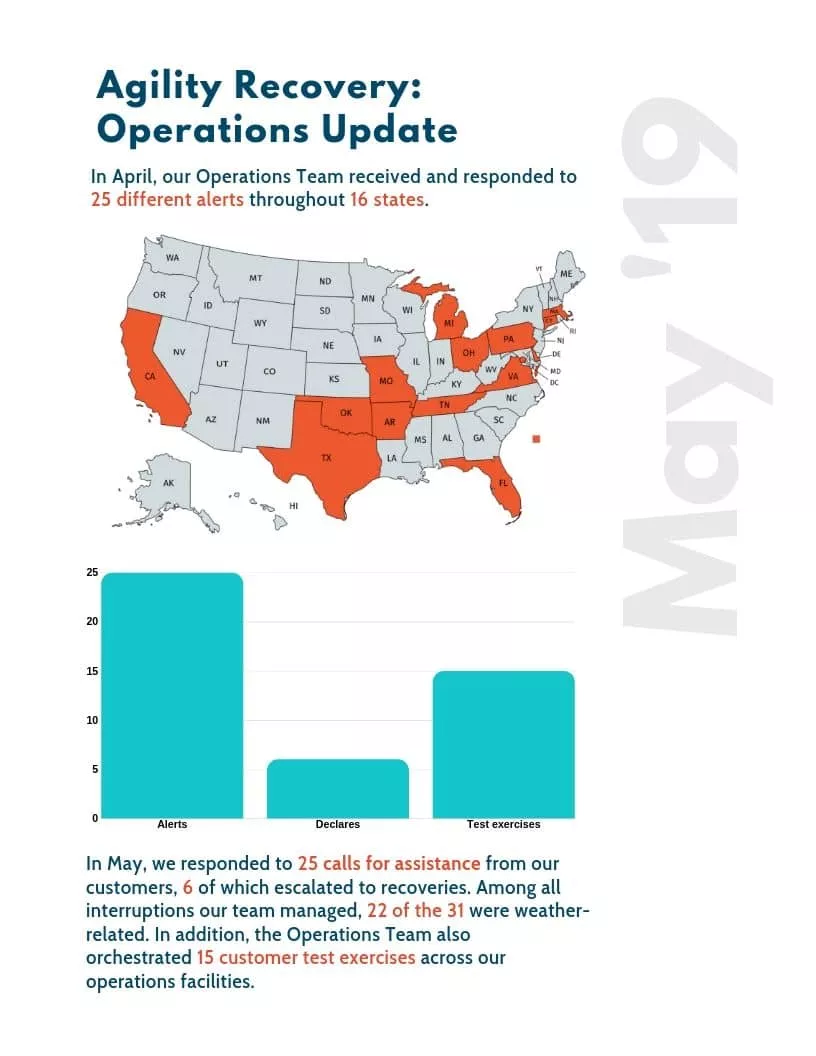
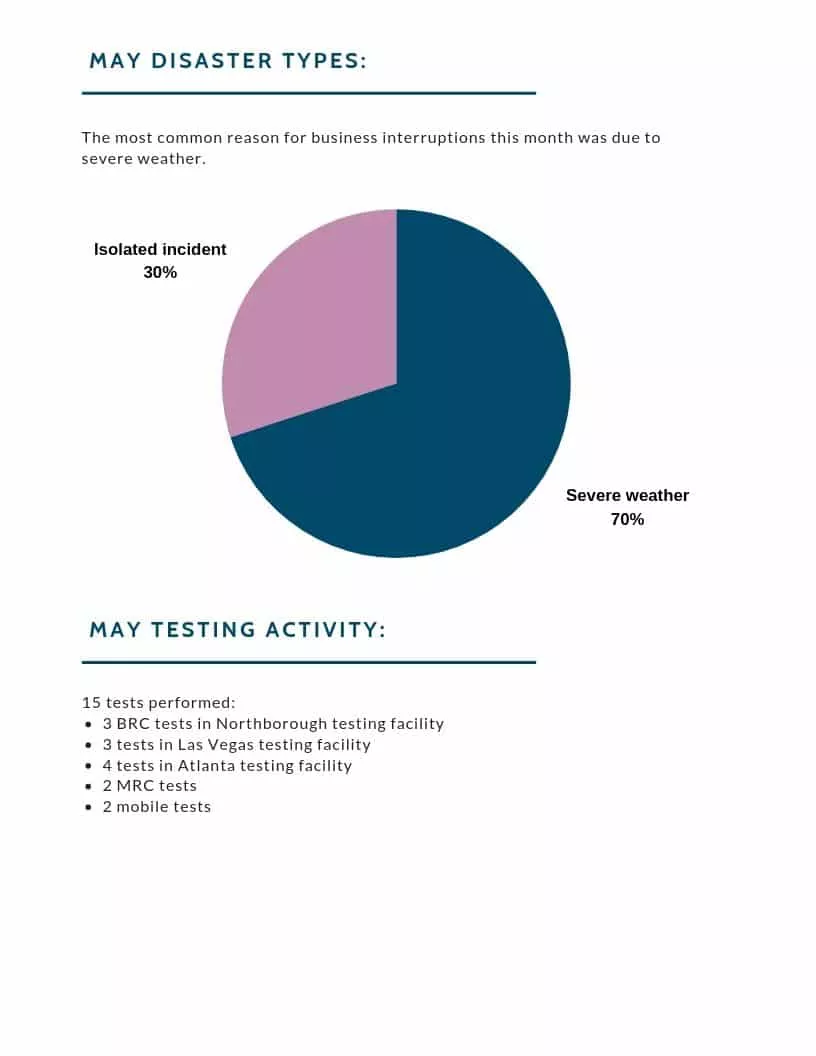
The majority of disruptions were caused by weather-related events, such as tornadoes. With a slight increase in recovery activity, we responded to 25 calls for assistance from our customers, six of which escalated to recoveries. Also, the Operations Team supported 16 customer test exercises across our operations facilities in Las Vegas, Atlanta, and Northborough.
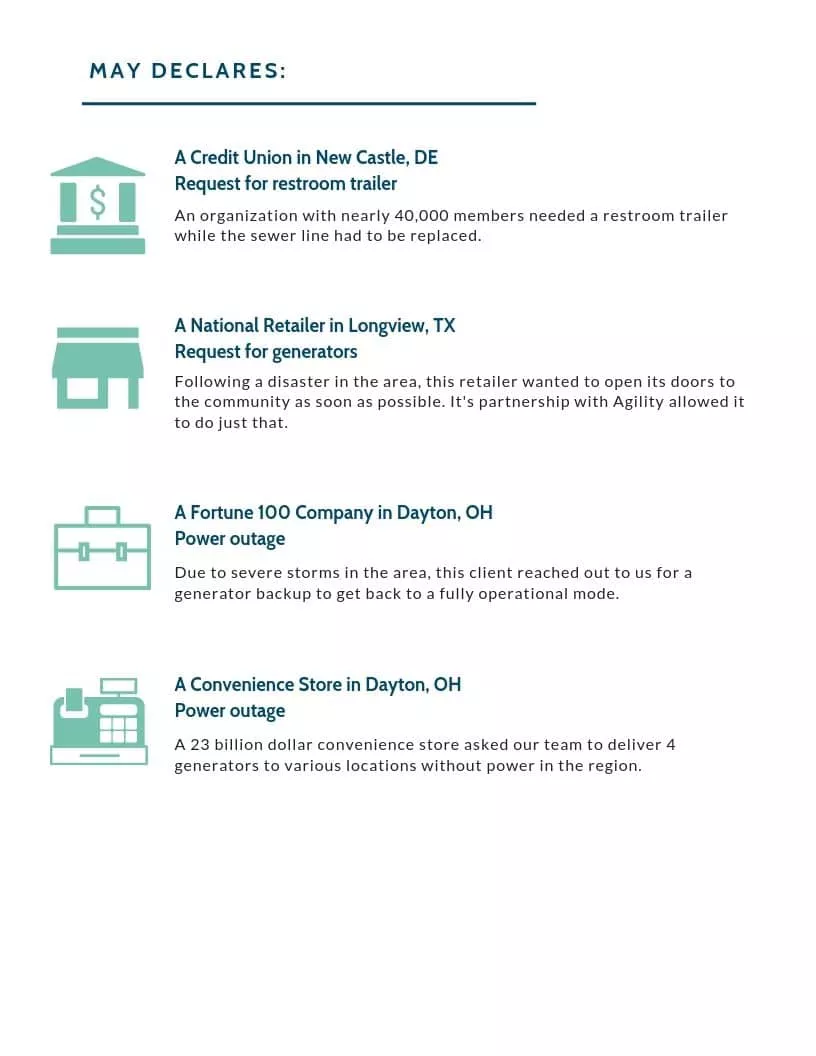
Here are four successful recoveries we’ve completed in May:
-
A credit union in New Castle, DE requested a restroom trailer. As they were undergoing construction, this organization with nearly 40,000 members needed a restroom trailer while the sewer line had to be replaced.
-
A national retailer in Longview, TX requested generators. Following a disaster in the area, this retailer wanted to open its doors to the community as soon as possible. Its partnership with Agility allowed it to do just that.
-
A Fortune 100 company in Dayton, OH experienced a power outage. Due to severe storms in the area, this client reached out to us for a generator backup to get back to being fully operational and be able to service their customers.
-
A convenience store in Dayton, OH faced power outage. A 23 billion dollar convenience store asked our operations team to deliver 4 generators to various locations without power in the region.
Our Operations Team successfully completed 15 different test exercises that involved 3 BRC tests in our Northborough testing facility, 3 tests in Las Vegas, and 4 tests in Atlanta. Besides showcasing the capabilities of our facilities, we also conducted 2 Mobile Recovery Center tests and 2 mobile unit tests.
We invite you to learn more about what we do or to chat about how we can help your business avoid any interruptions.
Our monthly report on the number and types of business interruptions we have responded to and companies we have recovered, providing our unparalleled business continuity and disaster recovery solutions.
Synopsis
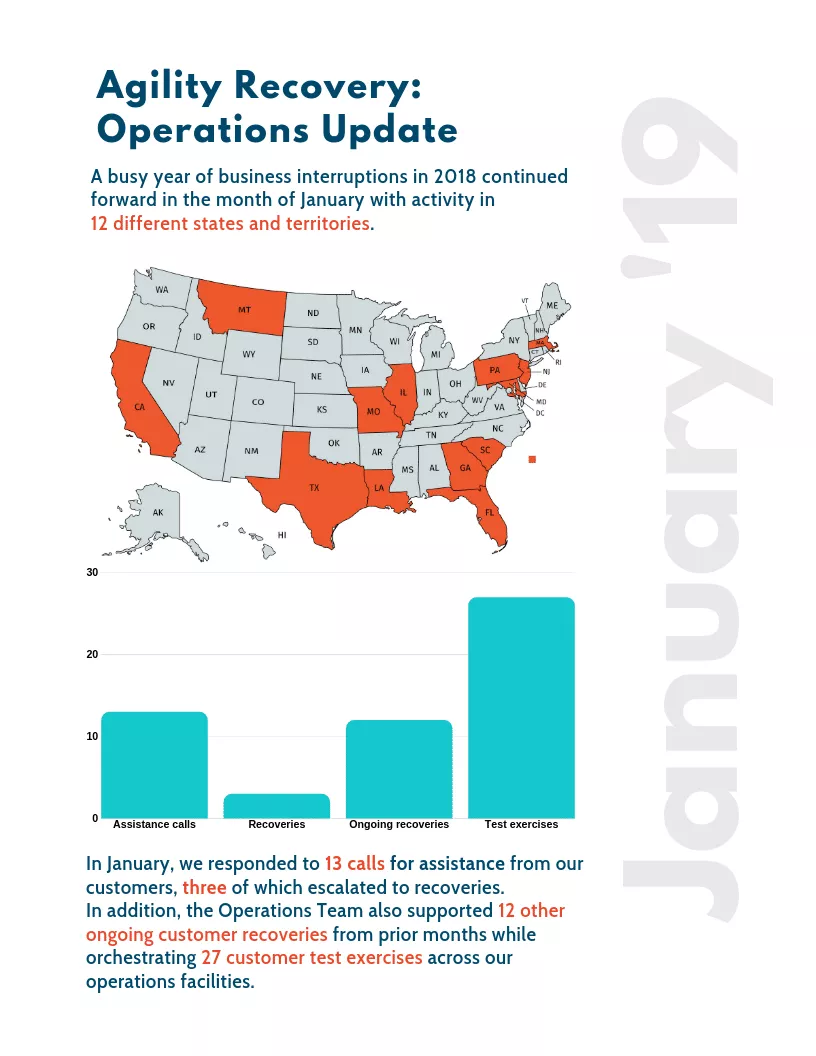
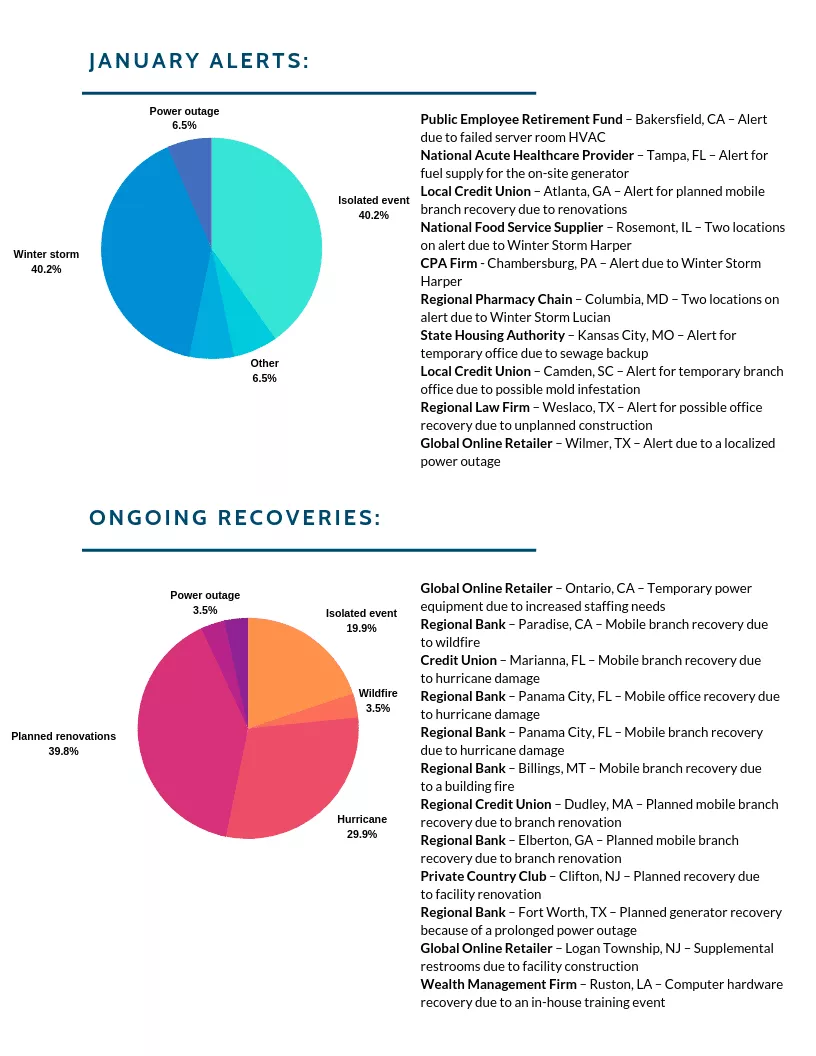
Business interruptions aren’t always mother nature’s plot. However, regardless of the type of interruption event, it’s never on a company’s agenda. From California to Florida, our response team helped businesses across 12 different states to minimize downtime and get back to serving their communities.
The Operations Team had a busy beginning of the year. As many as 13 businesses reached out to us for assistance, which is something we refer to as an alert. More specifically, an alert is a warning notice coming from our customer of a potentially dangerous situation their business may be facing. Placing a customer on alert helps our response team assemble all the necessary resources and, should the case escalate to an emergency situation (Declare Alert), our operations team will be deployed to the customer’s location to prevent business interruption. As for our customers, notifying Agility of a potential business threat provides them with a piece of mind.
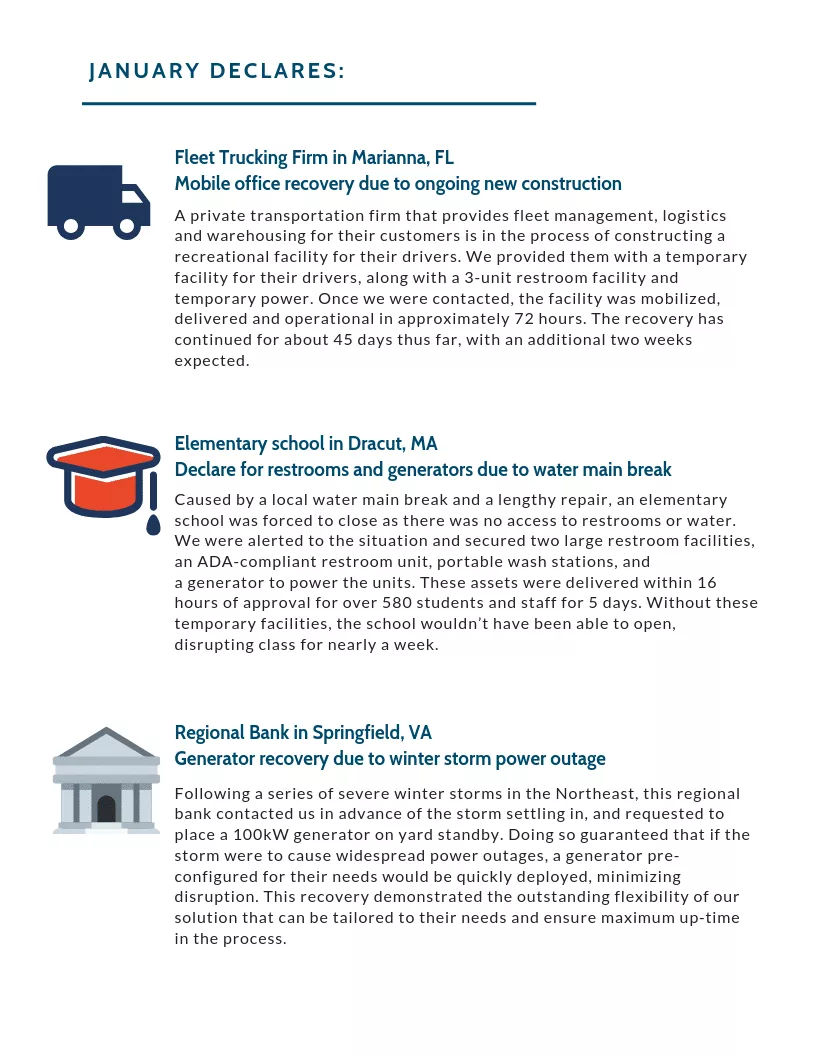
Here are three successful recoveries we’ve completed in January:
-
A fleet trucking firm in Marianna, FL, needed a mobile office recovery as they launched a new construction project. Once we were contacted, the facility was deployed, mobilized, delivered, and operational in approximately 72 hours.
-
An elementary school in Dracut, MA, declared restrooms and generators due to a water main break. In 16 hours, our response team delivered the assets that services over 580 students and staff members for 5 days.
-
A regional bank in Springfield, VA, requested a generator recovery after learning about winter storm power outages in their region. Giving us notice in advance, we pre-configured a generator specifically for their needs allowing it to be quickly deployed in case of disruption.
In the meantime, we also supported 12 ongoing recoveries from previous months, making sure our clients have everything they need when they need it.
We invite you to learn more about what we do or connect with us to chat about how we can help your business avoid any interruptions.
“What will we do if our primary facility is inaccessible? Easy. Our employees will work from home.” We hear this a lot. If your primary facility isn’t available, it makes sense to have employees work from home. Thanks to the cloud, a work-from-home (WFH) alternate workspace strategy is cheaper and more doable than ever before. But what happens when your entire workforce needs to work from home? It sounds extreme, but we’ve seen it happen. Before writing off alternate facilities, think about how a WFH strategy would work for your entire business (or branch). Here are the top issues to consider.
Business Processes
For WFH to go smoothly, you must design business processes to accommodate remote work. The three principles of a successful WFH strategy are:
- – Communication
- – Coordination
- – Culture
During a business interruption , all departments must be able to communicate and solve unforeseen business challenges. Is WFH currently a strong part of your business culture? If not, trying to adapt to a remote workflow in the middle of a crisis will not go over well. Don’t forget about factors that might complicate WFH arrangements, such as supply chain interruptions or seasonal demands.
Plan to have employees work from home during an interruption? Consider how you’ll address these factors:
- – Functions or departments that involve high levels of in-person collaboration.
- – Precautions for handling sensitive data.
- – Supply chain interruptions.
- – Season demands.
Clearing these obstacles with many employees working remotely could be tricky, especially if there are connectivity issues. This brings us to our next point.
Connectivity
No matter where they work, employees need to have access to the resources they need to do their jobs: voice and data communications, power, phones, computers, etc. After major “perfect storms” (which are becoming the new normal ), cell phone, power, and internet connectivity might not be available. For example, after Hurricane Harvey hit Rockport, Corpus Christi and Port Aransas in Texas, wind damage knocked out power and communications. WFH wasn’t even an option for businesses in those areas. In Houston, WFH seemed to be an ideal strategy. Countless roads closed, floodwaters lingered for days, and offices were destroyed. Although the city experienced record levels of flooding, the communications and power infrastructure proved resilient. For many companies, it just made sense to have employees work remotely. But many businesses hadn’t thought through the logistics of the entire company working remotely. The sudden influx of remote employees taxed company resources: VPN licenses, bandwidth availability of VPN concentrators at the home office, etc. How would you handle your entire business working remotely? Think about how you’d respond to the following potential issues:
- – Employees might not have the right equipment, whether because they weren’t issued company-approved hardware in time or because it’s trapped inside the home office.
- – Internet connectivity in employees’ homes isn’t always reliable.
- – A significant increase in remote workers can overload the VPN.
- – Employees not used to working from home might have trouble logging in.
- – Company phone systems might not be compatible with employees’ personal devices.
- – Vulnerable network connections increase the risk of sensitive data exposure.
- – Employees are more likely to use personal devices without appropriate security settings.
The higher your ability to address potential connectivity challenges , the more likely WFH is to succeed. But that’s only one part of the equation.
Employee Needs
Some employees thrive on the solitude and familiarity of working from home. For others, it’s simply not a good fit. Maybe they’re too easily distracted by the piles of laundry that need to be folded, a loose doorknob that needs to be fixed or kids popping in to say hi every five minutes. In the aftermath of a catastrophic event, employees might not have much of a home to work from. After Harvey, for example, many of our clients in Houston had employees whose homes had been flooded. Imagine juggling your job and your search for a reasonable contractor, all while sitting in a room with no drywall and damp, exposed subfloor. Employees may not want to work from home in these scenarios. After Hurricane Katrina, employees of one of our bank customers were thankful to have an air-conditioned Mobile Recovery Center to work from because it still had air conditioning, and many of their homes did not. You might have solid remote working processes in place and a plan for connectivity issues, but if the work ethic isn’t there, WFH isn’t going to, well, work. Make sure you consider the human side of business continuity and identify your employees’ needs ahead of time.
Duration
If employees aren’t a good fit for WFH or if business functions are better suited for in-person interaction, how long can you sustain remote working arrangements? Of our clients who had employees working from home following Harvey, they reported that WFH worked well for about a week. After that, internal processes began breaking down. Consider all the factors we discussed above and the possibility that WFH might not be the only strategy you’ll have to implement. If your facility is inaccessible for a period of time that exceeds your ideal time frame for WFH, have a plan to transition to an alternative facility. To be clear, WFH isn’t a bad strategy across the board. It’s just not always as simple as it seems, and it shouldn’t be the only alternate workspace strategy.