El Niño 101: What Every Resilient Business Should Know
Read more

The UN’s meteorological wing isn’t mincing words. “El Niño is arriving on our doorstep in the coming months with 90% certainty,” UN Secretary-General António Guterres said in early June. “The world must treat it as the urgent climate warning it is.”
For business continuity and risk professionals, that warning carries real operational weight. Here’s what the forecasts show, why this event stands out, and what organizations should be doing now.
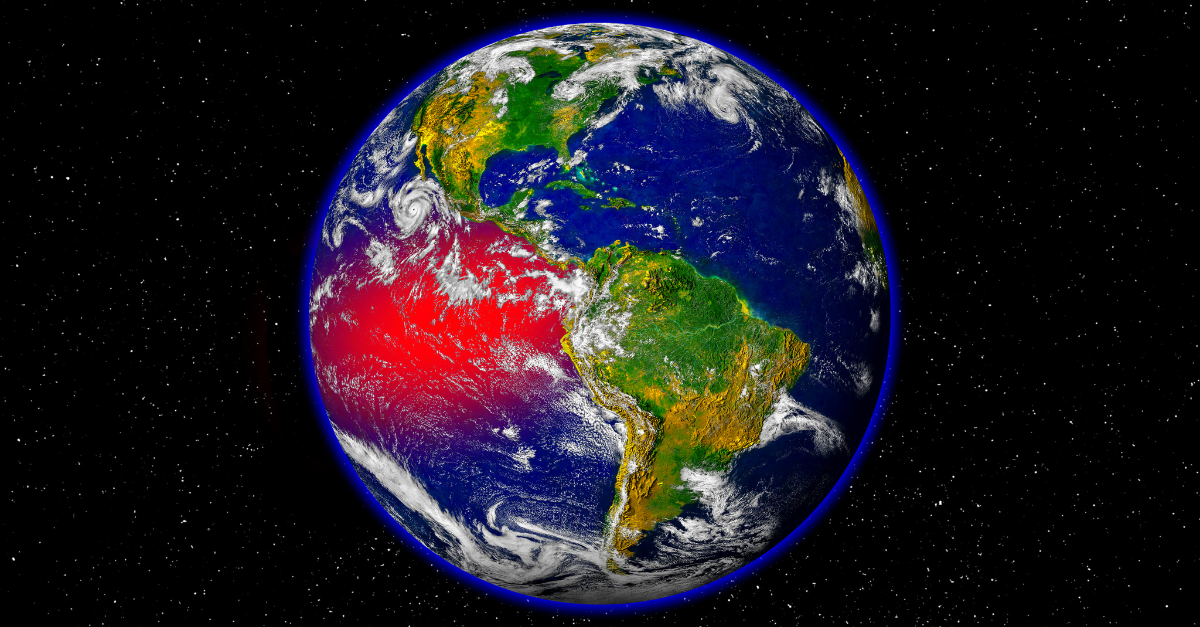
El Niño is a periodic warming of sea surface temperatures in the central and eastern Pacific Ocean. It occurs every two to seven years and disrupts weather patterns across the globe shifting storm tracks, triggering drought in some regions and flooding in others, and pushing global temperatures higher.
A “Super” El Niño, or very strong El Niño in official forecasting language, occurs when Pacific sea surface temperatures exceed the long-term average by 2°C or more. Events at that threshold are rare, occurring roughly once every 10 to 20 years. The last one was in 2015–2016. Before that, 1997–1998.
NOAA’s current forecast puts a 90% probability on El Niño forming by fall 2026 — unusually high confidence for this time of year. There’s a 67% chance it evolves into a strong or very strong event heading into 2027. One NOAA forecaster described the speed of the current ocean temperature shift as “one of the most rapid transitions I’ve seen in the record — maybe the most rapid,” noting that going from a moderate La Niña to a potentially very strong El Niño within a single calendar year is rare by any historical measure.
What makes 2026 different from prior cycles is baseline temperature. “We are coming off the back of record-high baseline temperatures,” according to researchers tracking the event. This isn’t warm ocean water on top of a normal background; it’s on top of an already-elevated one.
El Niño doesn’t hit every region the same way. For business continuity planning, the geographic pattern matters as much as the intensity.
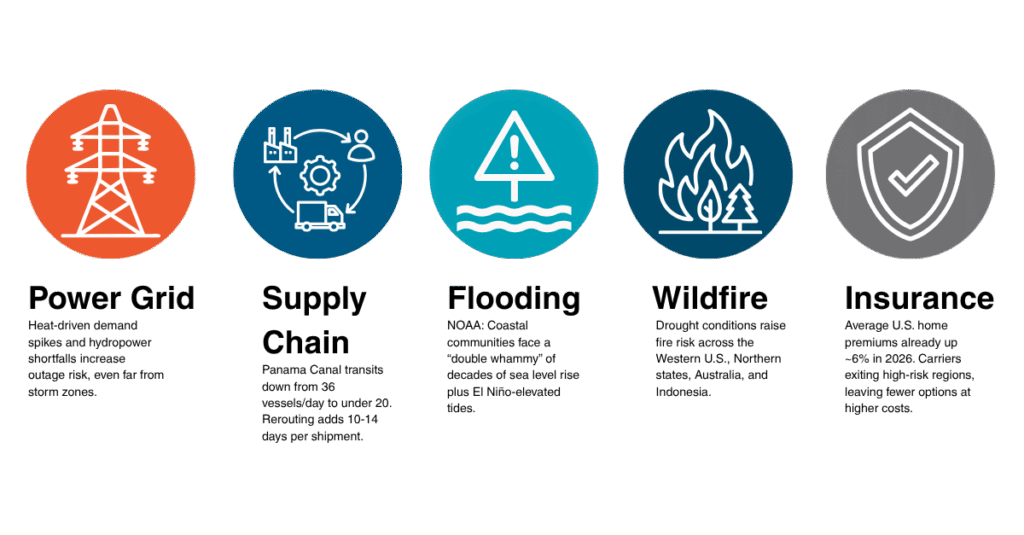
Along the coasts, the risks compound. NOAA oceanographer William Sweet describes the dynamic as “a double whammy”: decades of sea level rise have already brought water levels close to the threshold in many coastal communities, and a strong El Niño raises them further. West Coast communities will see elevated sea levels and stronger high-tide flooding. Storm tracks shift toward the mid-Atlantic, increasing surge risk. Gulf Coast and Southeast regions typically see above-average rainfall.
Inland, Northern states face a higher probability of persistent drought. Wildfire risk increases across Western Canada and the Northern U.S. The Southern states, by contrast, are more likely to see heavier rainfall and flooding — including from atmospheric rivers extending across the West Coast.
The Atlantic hurricane season is expected to be quieter than normal (NOAA forecasts 8–14 named storms, below average), because El Niño increases wind shear that disrupts storm formation. That’s some relief for coastal operations, though the storms that do form can still be destructive.
The effects on global trade networks are already showing up in freight data and commodity markets. Several pressure points stand out:
During the 1997–98 Super El Niño, water levels dropped enough to restrict vessel draft limits and reduce throughput. The same dynamic is playing out again: daily transits have fallen from 36 vessels to under 20, with ships rerouting around Cape Horn and adding 10–14 days and significant fuel costs to each journey. Falvey Insurance Group’s Risk Intelligence team notes that rerouting is also expanding accumulation risk and lengthening insurer exposure periods.
Rice, wheat, sugar, and palm oil production in Southeast Asia, India, and Australia face drought conditions. Indonesia and Thailand, the world’s top rice exporters, are already under pressure. Coffee yields in equatorial growing regions are expected to decline. The last Super El Niño caused losses exceeding $327 million in the agricultural sector alone, according to a Nature study on the 1997–98 event. Longer-term, Dartmouth College research estimated that Super El Niño led to $5.7 trillion in lost global GDP over the five years following the 1997–98 event.
Hydropower-dependent nations including Brazil, China, Zambia, and Zimbabwe face reduced output as drought conditions lower dam reservoir levels. In India, El Niño conditions are projected to raise coal-fired generation by 10% year-over-year to compensate. Simultaneously, heat drives air conditioning demand higher, straining already-stressed grids. The feedback loop — less hydropower, more fossil fuel demand, higher emissions, higher temperatures — is a documented pattern in El Niño years.
Container rates on transpacific routes have already risen ~40% from pre-crisis levels, compounded by Strait of Hormuz disruptions from the Middle East conflict. El Niño is adding a climate layer on top of a geopolitical one, affecting shipping costs, transit times, and commodity pricing simultaneously.
For organizations across the industries Agility Recovery serves, El Niño creates risk at multiple layers, not all of them obvious.
Flooding, wildfire, and severe weather are the most direct threats. Coastal properties face elevated storm surge and high-tide flooding. Properties in drought-prone regions face wildfire exposure. Buildings without adequate stormwater management or backup power face extended outages.
Buildings present a particular vulnerability that’s often underestimated; most commercial buildings lack adequate systems to protect against the kinds of weather events El Niño amplifies. That gap shows up quickly when a flooding event saturates a building’s electrical systems or when a severe storm knocks out utility power for days.
Organizations with suppliers in Southeast Asia, Australia, or drought-affected agricultural regions should treat current conditions as a reason to run stress tests on their vendor networks. El Niño-driven commodity price volatility, already visible in rice, wheat, and energy markets, can create cost shocks even for businesses not directly exposed to weather events.
Heat-driven grid stress, hydropower curtailments, and above-average energy demand create conditions for rolling outages and brownouts. Facilities without backup power face the same risk they do during a hurricane: an unplanned shutdown at the worst possible moment. The difference with El Niño is that the trigger can be a heat wave rather than a named storm, and heat waves rarely appear in organizations’ storm season checklists.
InsuranceNewsNet reported in June 2026 that the average U.S. home insurance premium has already risen nearly 6% from 2025, with high-risk-state premiums exceeding $5,000 annually. El Niño is acting as an accelerant on an already stressed market. Carriers are proactively exiting volatile regions, leaving fewer coverage options and higher costs. For commercial properties, the same dynamic applies, and organizations without adequate coverage entering a high-disruption period face a much steeper recovery path if something goes wrong.
A Super El Niño is, at its core, a planning horizon problem. The impacts unfold over months, not hours, which means organizations that act now have genuine lead time. A few priorities:
If your BC plan was last tested before the most recent cycle of climate disruptions, it reflects a different risk environment. Walk through how your organization would respond to a 3-day power outage during a regional heat wave or how it would respond to a key supplier going dark for two weeks. The scenarios feel hypothetical until they don’t.
Heat-driven grid stress is a real El Niño mechanism, not just a hurricane scenario. Confirm generator availability and fuel logistics now, not after an outage begins. For organizations in coastal or Southern states particularly, the confluence of heat, flooding, and storm risk over the next 12 months warrants treating backup power as a near-term readiness item.
If your critical vendors or raw material sources sit in drought-prone or flood-prone El Niño impact zones, identify your alternates now. The 10–14-day shipping delays already building in cargo routes mean that just-in-time inventory assumptions are riskier this year than in a typical one.
Many standard commercial policies don’t cover flood damage as a default. If your facilities or key vendors are in areas facing elevated flooding risk under El Niño patterns like the Gulf Coast, Southern states, and coastal regions, confirm what your policy actually covers. The conversation is much harder after a loss than before one.
If you have a business continuity membership or recovery partnership in place, use the current lead time to confirm response protocols, test your contact procedures, and update your recovery plan documentation. El Niño’s timeline — with peak impacts likely in late 2026 and into early 2027 — means there’s still time to prepare.
Super El Niño isn’t a new category of disaster. It’s a force multiplier on existing risks: power outages run longer, flooding reaches further inland, supply chain disruptions stack on top of geopolitical ones, and insurance markets respond by tightening. Organizations that treat it as an isolated weather story will likely be surprised by how many systems it touches at once.
For business continuity professionals, the more useful frame is this: what would a 12-month window of elevated weather disruption, commodity price pressure, and grid instability expose in your current plan? The forecasts are giving you that window in advance. The work worth doing is already clear.
Let us assess your current plan and identify gaps before you need to act on them./c
A Super El Niño is an informal term for a very strong El Niño event, defined by sea surface temperatures in the central Pacific exceeding the long-term average by 2°C or more. Very strong El Niño events occur roughly once every 10 to 20 years. NOAA's current forecast gives a 25% chance that the 2026 event reaches that threshold, with a 67% chance of at least a strong event.
The impacts vary by region. Gulf Coast and Southeast businesses face elevated flooding risk from above-average rainfall. Coastal facilities on both the East and West Coasts face higher-than-normal storm surge and tide flooding. Businesses in drought-prone Northern and Western regions face increased wildfire risk. Organizations across all regions may see supply chain disruptions, energy price increases, and grid reliability issues from heat-driven demand spikes.
A strong El Niño typically suppresses Atlantic hurricane activity by increasing wind shear that prevents storms from organizing. NOAA's 2026 outlook forecasts 8–14 named Atlantic storms, on the lower end of normal. However, Pacific typhoon activity tends to increase during El Niño years, raising risk for Asia-Pacific operations.
Organizations should review and test business continuity plans, confirm backup power arrangements, map supply chain exposure in affected regions, verify insurance coverage for flood risk, and connect with recovery partners before disruptions occur. El Niño impacts unfold over months, giving organizations meaningful lead time if they act now.
NOAA forecasts El Niño to develop by fall 2026 and continue through winter into early 2027. The peak of a strong event typically falls between December and January, though effects can linger for months beyond that.